
The sticker price of AI tools is the smallest part of what they cost you.
A marketing team rarely buys one AI tool. It buys four or five, often on different cards, some billed monthly and some yearly. Half of them come with a promo price that quietly ends.
Then the real cost arrives. Seats nobody uses. Renewals at full price. And usage charges nobody forecast.
This guide covers what companies are actually spending on AI in marketing, and what the main tools cost today. It shows the traps in the price tag, and three realistic budget tiers with the maths shown.
Every price below was checked on the vendor's own page on 15 September 2026. Prices change often, so treat this as a snapshot and check before you buy.
Quick Facts: AI Marketing Budgets at a Glance
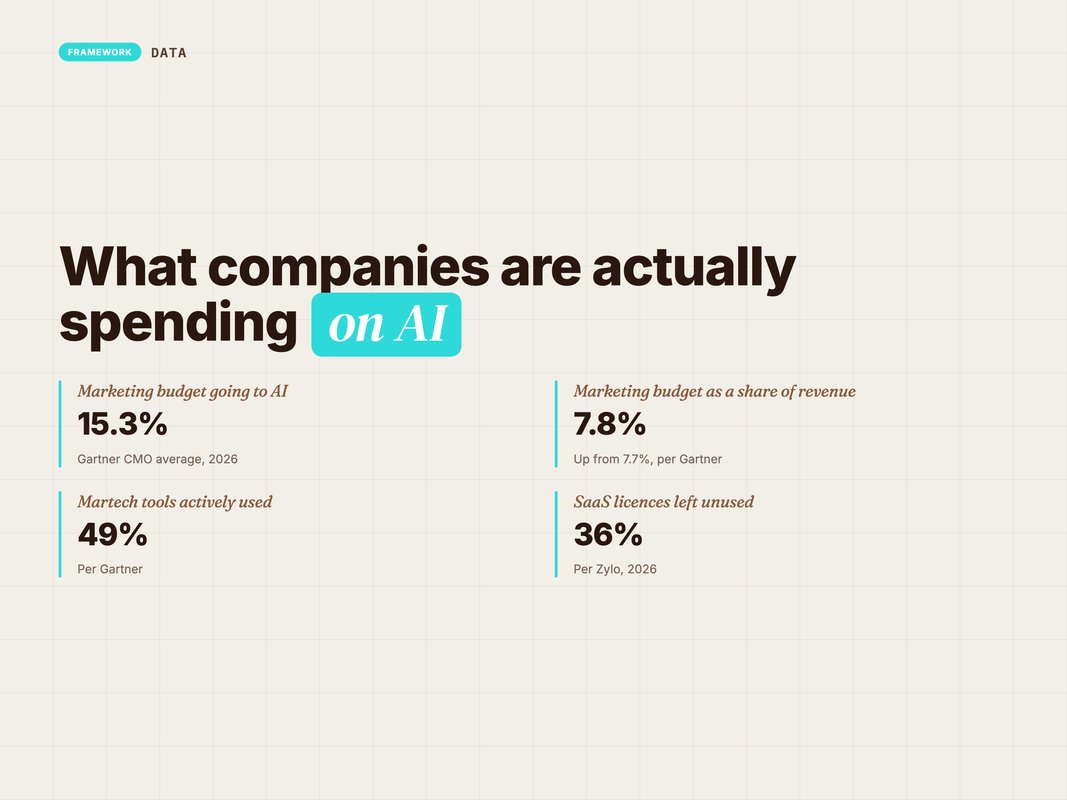
- CMOs allocate an average of 15.3% of marketing budgets to AI initiatives — (Source: Gartner, 2026 — gartner.com).
- Marketing budgets sit at 7.8% of company revenue in 2026, up from 7.7% — (Source: Gartner, 2026 — gartner.com).
- Only 49% of martech tools are actively used — (Source: Gartner, 2026 — gartner.com).
- Organisations leave an average of 36% of their SaaS licences unused — (Source: Zylo, 2026 — zylo.com).
- Most IT leaders, 78%, reported unexpected charges tied to AI or usage-based pricing — (Source: Zylo, 2026 — zylo.com).
What companies are actually spending on AI
Start with the benchmark most budgets get compared to.
Gartner's 2026 CMO Spend Survey found CMOs allocate an average of 15.3% of their marketing budgets to AI initiatives. Marketing budgets overall rose only slightly, to 7.8% of company revenue from 7.7% in 2025 (Source: Gartner, 2026 — gartner.com).
The more AI-ready teams spend more. Gartner found they put 21.3% of their marketing budgets into AI, and their total marketing budgets average 8.9% of revenue.
Two cautions before you copy those numbers.
First, the sample. Gartner surveyed 401 CMOs in North America, the UK and Europe. The vast majority work at companies with over $1 billion in revenue. An Indian D2C brand or a 40-person SaaS company is a different animal.
Second, the pressure. The same survey found 56% of CMOs say their marketing organisation lacks the budget to deliver its 2026 strategy. Only 30% report mature AI readiness.
So the honest read is this. Serious teams put a meaningful slice into AI. But most are still working out how to spend it well.
Q: Does AI actually save marketing money?
A: Often on time before cost. In Gartner's 2025 CMO survey, GenAI delivered returns through time efficiency for 49% of CMOs and cost efficiency for 40%. Some 22% said it reduced their reliance on external agencies (Source: Gartner, 2025 — gartner.com).
What the main tools cost in September 2026
Here are the general assistants most teams use. These are the vendors' own list prices, in US dollars unless marked.
| Tool and plan | Listed price | Billing notes |
|---|---|---|
| ChatGPT Plus | $20 a month, ₹1,999 in India | Monthly only |
| ChatGPT Pro | From $100 a month, from ₹10,699 in India | Monthly only |
| ChatGPT Business | $20 per seat a month | Billed annually, $25 if monthly |
| Claude Pro | $17 a month | Billed annually, $20 if monthly |
| Claude Max | From $100 a month | Billed monthly |
| Claude Team | $20 per seat a month | Billed annually, $25 if monthly |
| Google AI Pro | $19.99 a month, ₹1,950 in India | Monthly |
| Microsoft 365 Copilot | $30 per user a month | Paid yearly, annual commitment |
| Perplexity Pro | $20 a month | Monthly |
Each price comes from the vendor's own page. See OpenAI (Source: OpenAI, 2026 — chatgpt.com). See also OpenAI Business (Source: OpenAI, 2026 — openai.com) and Anthropic (Source: Anthropic, 2026 — claude.com). Then Google (Source: Google, 2026 — gemini.google), Microsoft (Source: Microsoft, 2026 — microsoft.com) and Perplexity (Source: Perplexity, 2026 — perplexity.ai).
And here are common marketing tools with public prices.
| Tool and plan | Listed price | Billing notes |
|---|---|---|
| Canva Pro | US$144 a year, ₹4,000 in India | Yearly, one person |
| Canva Business | US$250 a year, ₹6,800 in India | Yearly, per person |
| Jasper Pro | $69 per seat a month | Monthly, $59 if yearly |
| Semrush | From $139 a month | Monthly, cheaper if annual |
| HubSpot Marketing Hub Professional | $800 a month, three core seats | Plus a $3,000 onboarding fee |
| Midjourney | $10 to $120 a month | By plan |
| Surfer | $99 a month | Billed yearly |
Those come from Canva (Source: Canva, 2026 — canva.com), Jasper (Source: Jasper, 2026 — jasper.ai), Semrush (Source: Semrush, 2026 — semrush.com), HubSpot (Source: HubSpot, 2026 — hubspot.com), Midjourney (Source: Midjourney, 2026 — docs.midjourney.com) and Surfer (Source: Surfer, 2026 — surferseo.com).
If you automate work, you also pay for the API by the token. At Anthropic, Claude Sonnet 5 lists at $2 per million input tokens and $10 per million output tokens (Source: Anthropic, 2026 — claude.com).
That is cheap per task. Say a blog workflow sends 20,000 tokens in and gets 4,000 back. On Sonnet 5, that is $0.04 for input plus $0.04 for output, or $0.08 a run. Volume is what makes it add up.
Our comparison of Claude, GPT and Gemini for marketing covers which model suits which job.
The traps in the price tag
The listed price is often not the price you will pay next year.
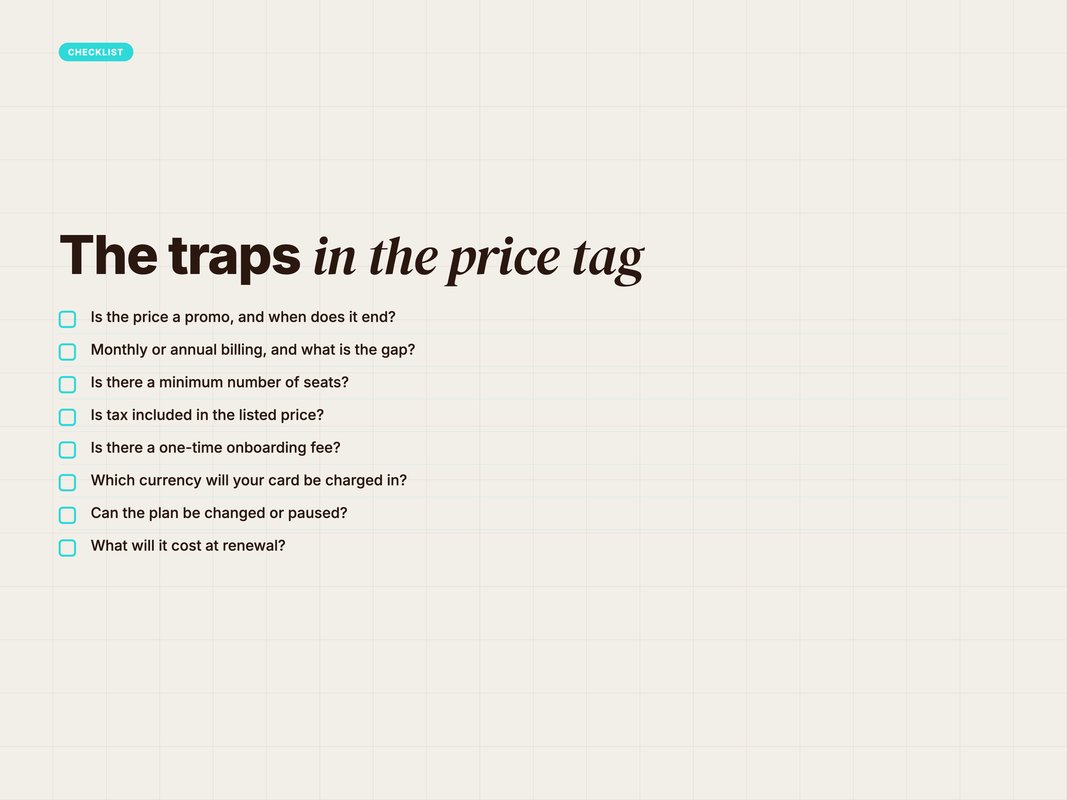
Promotions that expire. Microsoft is selling Copilot Business at $18 per user a month, down from $21. That price runs from 1 July to 31 December 2026 and applies to the first year only (Source: Microsoft, 2026 — microsoft.com). HubSpot's Marketing Hub Starter showed $7 a seat against a $20 list price, for new customers only (Source: HubSpot, 2026 — hubspot.com).
Monthly versus annual. The gap is real. A five-person team on ChatGPT Business pays $20 a seat billed annually, or $25 billed monthly. That is $100 against $125 a month for the same tools.
Plans that change under you. OpenAI paused new sign-ups to its $200 ChatGPT Pro plan from 10 September 2026. At the time of writing, only the $100 tier can be bought (Source: OpenAI, 2026 — help.openai.com). Plan names and limits move often.
Tax. Many listed prices exclude it. Microsoft's India pricing says GST is extra as applicable. Anthropic says its prices do not include applicable tax.
Onboarding fees. HubSpot's Professional tier carries a one-time $3,000 onboarding fee. It never shows up in a monthly comparison, but it is on the invoice.
Seat minimums. Team plans are not sold per person from one. ChatGPT Business lists its plan for teams of 2 to 200 employees (Source: OpenAI, 2026 — openai.com). Claude Team is for teams of 2 to 150 (Source: Anthropic, 2026 — claude.com). Check the minimum before you plan for a single seat.
Currency. Indian teams often pay in dollars. OpenAI says all purchases are in US dollars, with local currency billing only in a limited set of countries (Source: OpenAI, 2026 — help.openai.com). When a price is shown in rupees, it is worth checking whether that is the amount on your card statement.
The hidden cost is the seats nobody uses
The biggest waste in AI budgets is not overpriced tools. It is paid-for tools nobody opens.
Zylo's 2026 SaaS Management Index found organisations leave an average of 36% of their SaaS licences unused (Source: Zylo, 2026 — zylo.com). Gartner found only 49% of martech tools are actively used. Martech makes up nearly 22% of total marketing spend (Source: Gartner, 2026 — gartner.com).
AI makes this worse, because it is so easy to buy. Zylo found expense-based SaaS spend rose 267% year on year, with ChatGPT now the most expensed app. People put AI tools on their own cards and claim the cost back.
That means nobody sees the full bill. Three people might each be paying for a different assistant that does the same job.
Usage-based pricing adds a third problem. In the same study, 78% of IT leaders reported unexpected charges tied to consumption-based or AI pricing.
The fix is dull and effective. List every AI tool the team pays for, including expensed ones. Record who uses it and how often. Cancel anything that nobody opened in the last month.
Do it in one sheet with five columns. Tool, owner, monthly cost, renewal date and last used. It takes an afternoon.
Then set one rule for the future. No AI tool goes on a personal card. Every new tool gets a named owner and a review date. That single rule stops most of the sprawl before it starts.
Three budget tiers, with the maths shown
Here is how we would budget at three sizes, using the list prices above. These are examples, not quotes.
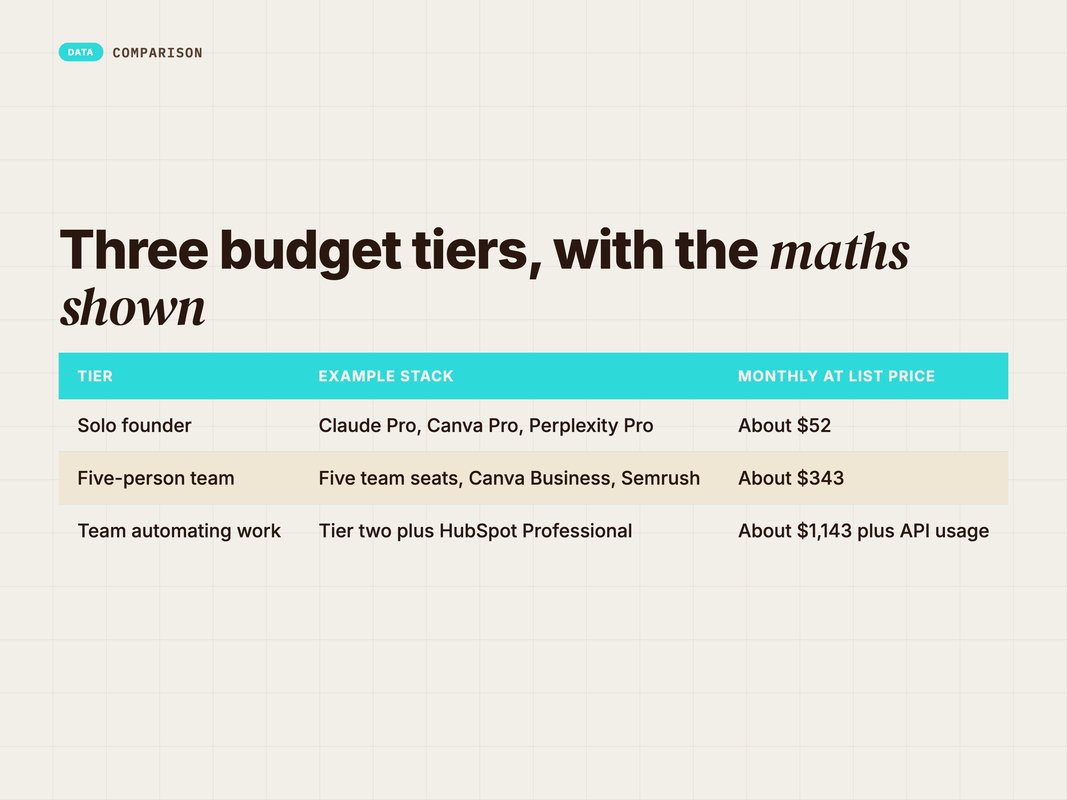
Tier one: a solo founder or freelancer. One general assistant, one design tool, one research or SEO tool. Claude Pro billed monthly is $20. Canva Pro is US$144 a year, or US$12 a month spread out. Add Perplexity Pro at $20. That is $52 a month before tax.
Tier two: a five-person marketing team. Team seats on one assistant, shared design and SEO. Five ChatGPT Business or Claude Team seats, billed annually, come to 5 × $20 = $100 a month. Canva Business for five people is 5 × US$250 = US$1,250 a year, or about US$104 a month. Add Semrush from $139. That is roughly $343 a month.
Tier three: a larger team automating work. Everything in tier two, plus a marketing platform and API spend. HubSpot Marketing Hub Professional starts at $800 a month with three core seats, plus $3,000 once. Tier two's $343 plus HubSpot's $800 comes to about $1,143 a month before API usage. API costs depend entirely on volume, so meter them from the first week.
Notice what drives each tier. At tier one it is the number of tools. At tier two it is the number of seats. At tier three it is usage, which nobody can guess without a meter.
If money is tight, cut in this order. First, the second assistant that does the same job as the first. Then seats for people who use a tool once a month. Then any specialist tool your main assistant now covers.
Keep the tools that save the most hours per rupee. For most teams, that is one strong assistant and one design tool. Everything else has to earn its place.
Q: Should a small team buy several assistants?
A: Usually not. One general assistant with team seats covers most drafting and analysis. Buy a second only when a specific task clearly needs it.
Our list of free AI marketing tools covers where you can start without spending anything.
How to decide what to buy
A simple process beats a spreadsheet of forty tools.
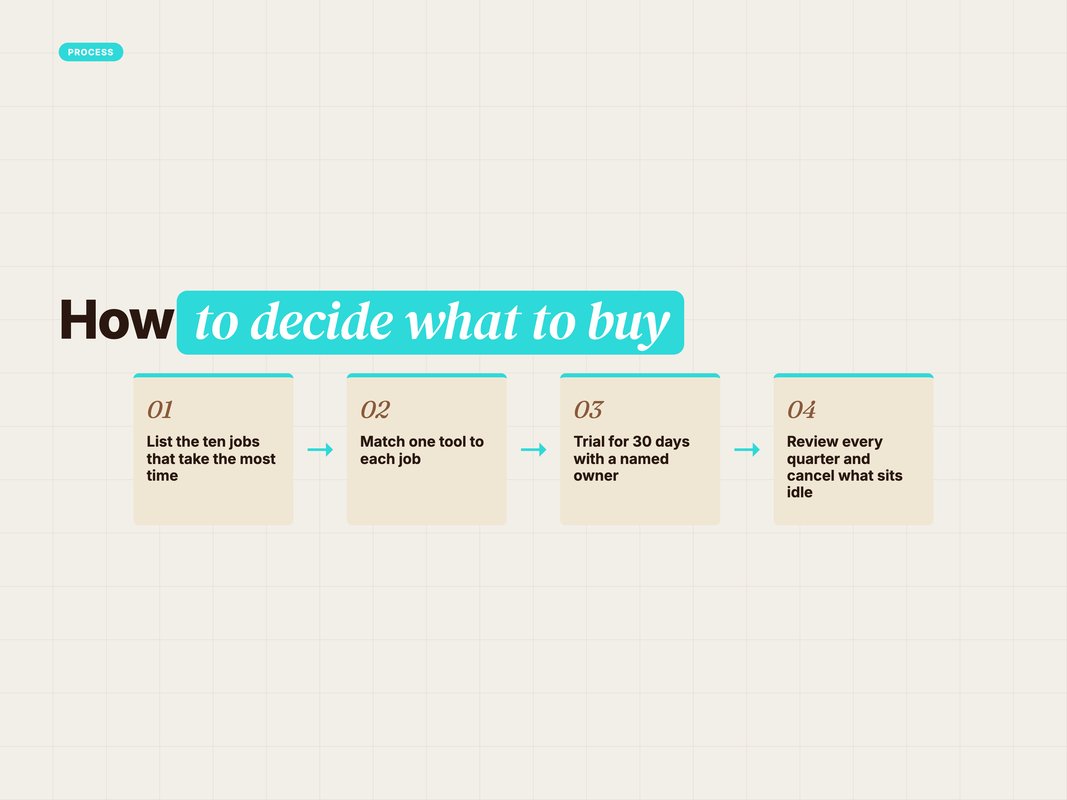
Step one: list the jobs, not the tools. Write down the ten tasks that take your team the most time. Drafting, design, research, reporting, and so on.
Step two: match one tool to each job. Most jobs are covered by one general assistant. Add a specialist tool only where the assistant clearly falls short.
Step three: run a 30-day trial with a named owner. One person decides whether it earns its place. Measure hours saved, not features used.
Step four: review every quarter. Cancel what nobody uses. Check renewal prices before they hit. Move promos to full price in your forecast now.
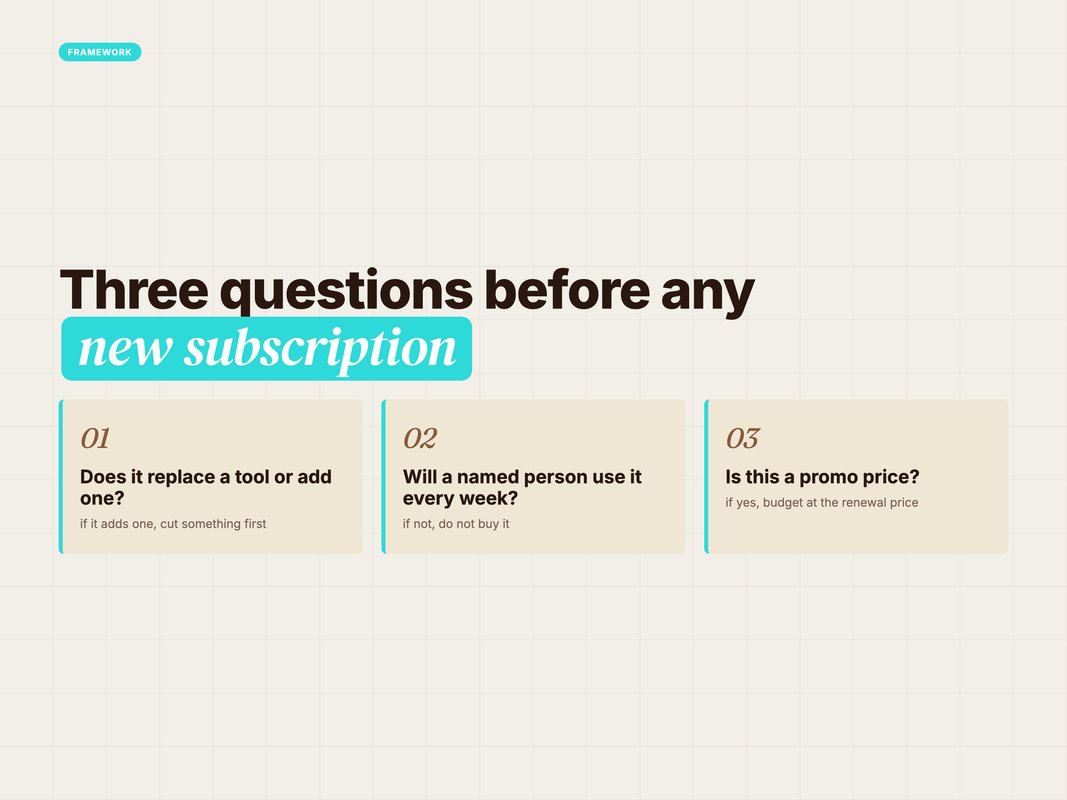
Before any new subscription, we ask three questions.
What we do at YARD
We are an AI-first growth marketing agency. We run performance marketing, LLM SEO, AI creative and AI funnels for D2C and B2B brands.
We run a lean stack on purpose, and we review it every quarter. The same discipline is what we bring to client budgets.
For most teams, the first saving comes from the audit, not a negotiation. We list every AI tool the team pays for, including the ones on personal cards. We match each one to a real job and a named owner. Then we cut the overlap.
The second saving comes from automation done properly. A well-built pipeline on the API often costs less per task than a seat that sits idle. It also produces work that is consistent and checked.
We share what we use in our agency tech stack breakdown. No retainer is needed to ask us for a stack review.
The takeaway
AI marketing tools are not expensive one at a time. They become expensive in bulk, through seats nobody uses and promos that expire.
Serious marketing teams put a meaningful share of budget into AI, with Gartner's large-company average at 15.3%. But the benchmark matters less than the discipline.
List the jobs first. Buy one tool per job. Give each tool an owner. Forecast at renewal price, not promo price. And cancel anything nobody opened last month.
Prices here were checked on 15 September 2026. Check the vendor's page again before you buy.
You can book a call with our team if you want help building a lean AI stack for your marketing.
FAQ
Q: How much of the marketing budget should go to AI?
A: Gartner's 2026 CMO survey found an average of 15.3% of marketing budgets going to AI initiatives. Its sample is mostly large firms in North America, the UK and Europe. Treat it as a direction, not a target.
Q: How much does ChatGPT Plus cost in India?
A: OpenAI's pricing page showed ChatGPT Plus at ₹1,999 a month in India when we checked on 15 September 2026. The page does not say whether GST is included, so confirm the final charge at checkout.
Q: Is ChatGPT or Claude cheaper for a marketing team?
A: At team level they were priced the same when we checked. ChatGPT Business and Claude Team both listed a standard seat at $20 a month billed annually, or $25 billed monthly.
Q: What is the biggest hidden cost of AI tools?
A: Unused licences. Zylo found organisations leave an average of 36% of their SaaS licences unused. Gartner found only 49% of martech tools are actively used.
Q: Are AI tool prices going up or down?
A: Both. Model API prices keep falling, but more plans now come with usage tiers and promotions that expire. Always check the renewal price, not just the first-year price.
Q: Do I need an API budget as well as subscriptions?
A: Only if you automate. Subscriptions cover people using chat tools. Automated pipelines call the API and pay per token, which is usually cheap per task but grows with volume.
Insights from Our Experts
Explore our latest articles on digital marketing strategies.