

For twenty years, the job was simple. Rank at the top of Google. Get the blue link. Win the click.
That job just changed. AI now writes the answer at the top of the page. Your customer reads it. Often, they stop there.
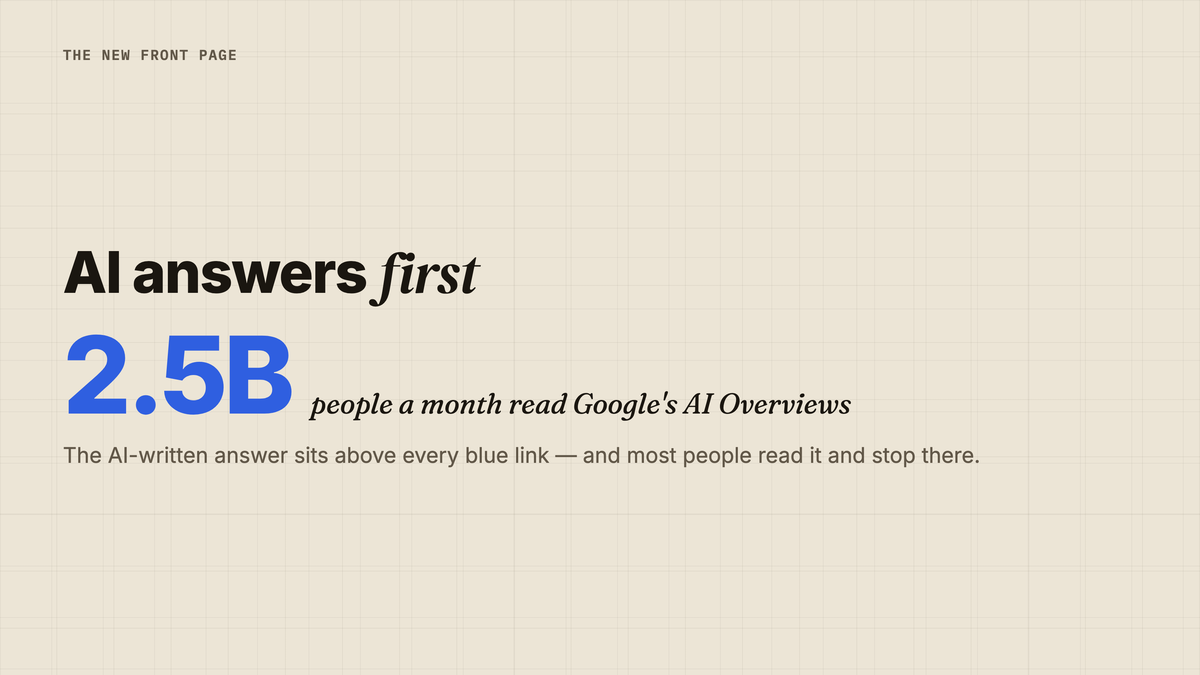
Google's AI Overviews reach over 2.5 billion people a month. That number came from CEO Sundar Pichai at Google I/O in May 2026. So this is not a fringe habit. It is how most people search now.
SEO isn't dead. But the goal moved. The old goal was to rank. The new goal is to be quoted inside the answer. This post shows you the shift, the data behind it, and a plan you can start this week.
The click is drying up
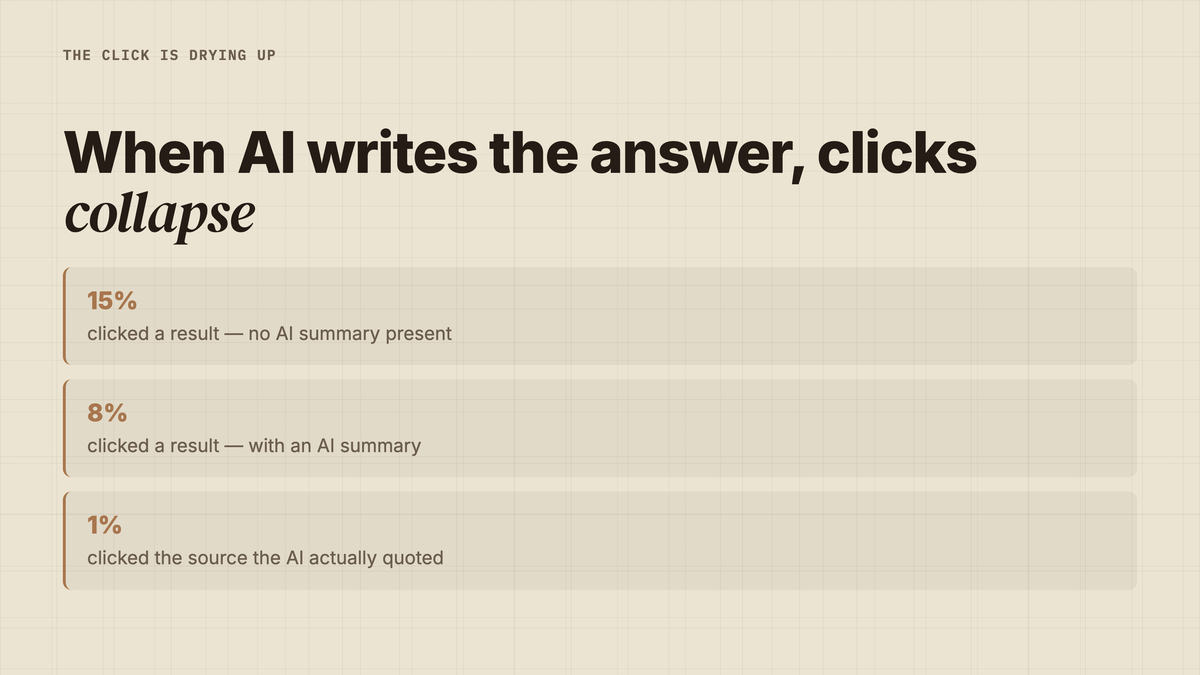
This is not a hunch. The Pew Research Center studied 68,879 Google searches. The data came from 900 US adults in March 2025.
The results are blunt. An AI summary showed up in about 1 in 5 searches. When it did, people clicked a normal result just 8% of the time. Without a summary, that rate was 15%. So the click rate nearly halves.
Now the hard part. Only 1% of people clicked the source the AI quoted. Read that again. Even when the AI names you, almost nobody clicks through.
So the win is no longer the click. The win is the mention. Your brand, named inside the answer. That shapes what the buyer thinks. And it happens before they visit any website.
What AI Overviews actually are
Let's keep this simple. An AI Overview is a short written answer. It sits at the very top of Google. It pulls facts from many sources. Then it stitches them into a paragraph.
The reader gets their answer fast. They do not need to open ten tabs. That is great for them. It is harder for you.
Your page might still be the source. But the reader may never see your brand. Unless the AI names you in the text. That is the whole game now.
Getting cited is the new ranking
Marketers have a name for this shift. They call it GEO, or Generative Engine Optimization. Some call it AEO, or Answer Engine Optimization. Strip the jargon and it means one thing. Make your brand the source AI trusts enough to quote.
Here is the uncomfortable part. You can't do that from your website alone.
In June 2026, VaynerX and Profound published The CMO's AEO Guide. It studied how AI answer engines pick which brands to recommend.
The finding is clear. The winners have broad authority. That means reviews, communities, creators, and publishers. Not just their own blog. In fact, social and user-generated citations rose across five of the six major engines they tracked.
So AI doesn't just read your homepage. It reads what the rest of the internet says about you.
Each AI trusts a different place
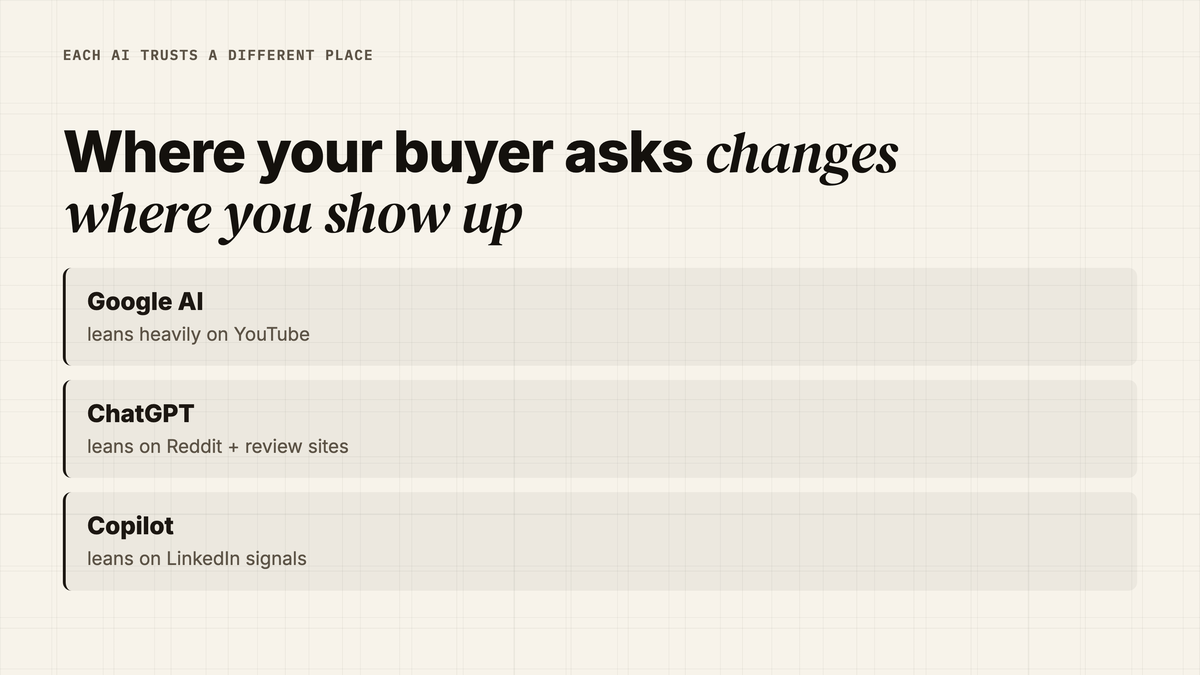
You can't treat AI search as one thing. The same Profound guide found a clear split.
Google's AI leans on YouTube. ChatGPT leans on Reddit and review sites. Microsoft Copilot leans on LinkedIn.
So one blog post won't cut it. Where your buyer asks changes where you need to show up. A video may matter more than a landing page. A Reddit thread may matter more than an ad.
Speed is now part of the game
There is one more finding people miss. The Profound data tracked how fast AI picks up new content.
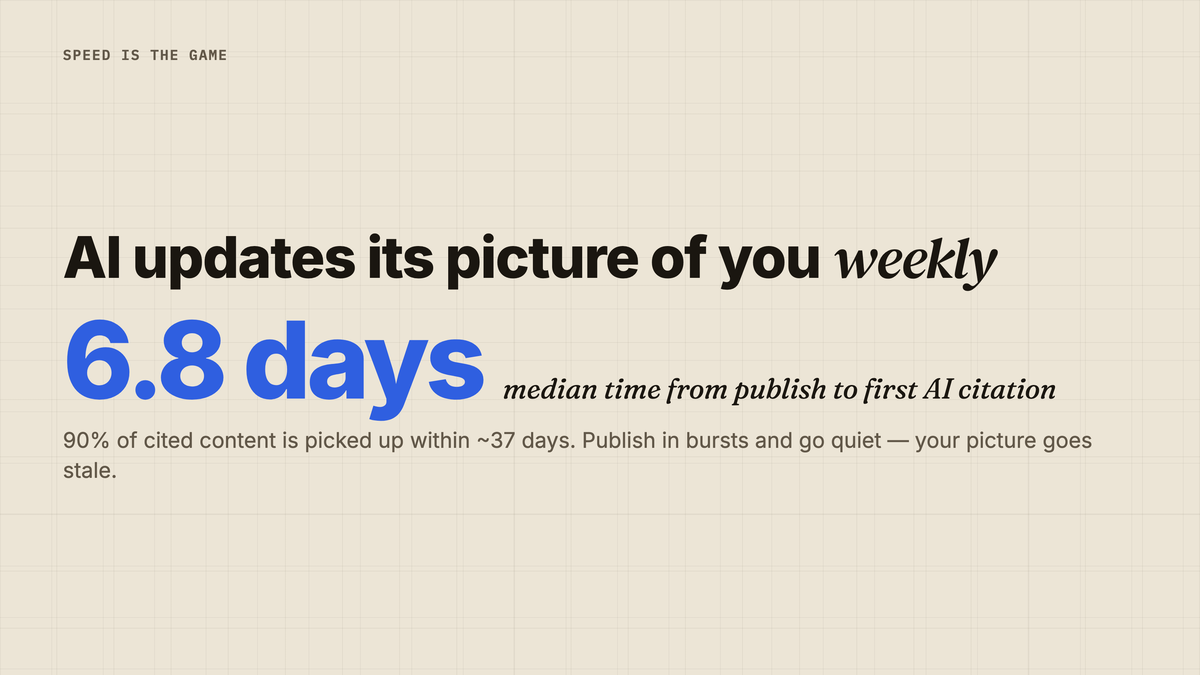
The median time to a first citation is just 6.8 days. And 90% of cited content is picked up within about 37 days.
That kills the old campaign-burst model. AI refreshes its view of you every week. Publish in bursts, then go quiet, and your picture goes stale. So the habit that wins is always-on. Not a quarterly push.
GEO vs old-school SEO
Old SEO chased a rank. You picked a keyword. You wrote a page. You built links. Then you waited to climb.
GEO chases a mention. You still write great pages. But you also seed proof across the web. You want AI to have many reasons to name you.
The skills overlap a lot. Clear writing still wins. Strong topical depth still wins. But the finish line moved. It is no longer position one. It is a sentence inside the answer.
If you already track your funnel well, you have a head start. The same discipline you use for ROAS vs ROI applies here. Measure what matters. Ignore vanity numbers.
A 30-day plan to get cited
You don't need to boil the ocean. Start small and stay steady. Here is a simple month.
Week one: pick five questions your buyers ask. Write one clear, honest answer for each. Keep each answer short and specific.
Week two: publish where your buyers ask. Put a how-to on YouTube. Answer a real thread on Reddit. Share a short take on LinkedIn.
Week three: earn third-party proof. Ask happy clients for reviews. Pitch one guest piece to a trusted publisher. Get named somewhere that isn't your site.
Week four: check the answers. Ask ChatGPT and Google about your category. See if your brand shows up. Note the gaps. Then plan next month.
Repeat this every month. Small, steady, and useful beats one big splash.
How to measure AI visibility
You can't improve what you don't watch. So set up a simple check.
Pick ten prompts a buyer would type. Run them in Google, ChatGPT, and Copilot. Note when your brand is named. Note which source the AI used.
Do this monthly. Track the trend, not one snapshot. Over time you will see what earns mentions. Then you do more of that.
You can also watch referral traffic from AI tools. It is small today for most brands. But it is growing. Treat it as an early signal, not a vanity metric.
What to publish that AI loves
Not all content earns a mention. AI tends to quote a few clear types. Learn them, then make more of them.
First, comparisons. Buyers ask "X versus Y" all the time. A fair, clear comparison is easy to quote. So write the honest one for your category.
Second, how-tos. Step-by-step guides answer a real question. AI loves a clean, ordered answer. Keep each step short and specific.
Third, original data. Run a small survey. Share a benchmark from your own work. Numbers that only you have are hard to ignore. And they get cited often.
Fourth, plain definitions. Explain a term simply. Lead with a one-line answer. Then add the detail below it.
Notice the pattern. AI wants clarity, proof, and a direct answer. Promo copy does none of that. So drop the fluff. Lead with the useful part.
Common mistakes to avoid
Most brands trip on the same things. Here are the big ones.
They hide the answer. The key point sits in paragraph nine. AI wants it up top. So put the answer first.
They only talk about themselves. Every page is a pitch. But AI trusts third-party proof more. So earn reviews and mentions elsewhere.
They publish once, then stop. A big launch, then silence. AI forgets you fast. So keep a steady rhythm.
They chase one platform. All effort goes to Google. But your buyer also asks ChatGPT and Copilot. So spread your bets.
They measure the wrong thing. They watch rankings only. But the mention is the real prize now. So track that too.
Why smaller brands can win
Here is the good news. This shift favors the sharp, not just the big.
Old SEO rewarded huge link budgets. Deep pockets often won. GEO rewards clarity and proof. A small brand can out-teach a giant.
You do not need a thousand pages. You need a few great answers. You need real reviews. You need a clear point of view.
So move fast. Pick your questions. Answer them better than anyone. Get named where your buyers look. A focused brand can punch far above its size here.
The trust signals AI looks for
AI does not guess at random. It leans on signals of trust. You can build these on purpose.
Start with consistency. Say the same clear thing across channels. Your site, your reviews, your social. A steady story is easy to trust.
Add real expertise. Put a named author on your content. Show credentials where they fit. AI favors sources with clear authority.
Then add proof. Cite your own data. Link to solid sources. Show your work. A claim with proof beats a bold claim alone.
Finally, add freshness. Update your best pages often. Add new examples. Refresh old numbers. AI rewards content that stays current.
None of this is a trick. It is just good publishing. Do it well, and the mentions follow.
Give one clear answer per page
Here is a small habit with a big payoff. One page, one question, one clear answer.
Do not bury the point. Lead with it. Put the direct answer in the first two lines. Then expand below.
This helps readers. It also helps AI. A clean answer is easy to lift into an Overview. A messy page is not.
So audit your top pages. Ask a simple test. Can a reader get the answer in ten seconds? If not, fix the top of the page first.
The bottom line
Ranking #1 was the goal for two decades. That era is fading fast. AI now answers first, and the reader often stops there.
So the new goal is simple to say and hard to do. Be the sentence the AI writes about your category. Build authority everywhere your buyer looks. Publish steadily, not in bursts. And measure the mention, not just the click.
SEO isn't dead. It grew up. The brands that adapt now will own the answer later. The ones that wait will watch a competitor get quoted instead.
The path is not a mystery. Write clear answers. Earn proof across the web. Stay always-on. And check the answers each month. Do the simple things well, and do them often. That is how you get named. And the mention, not the click, is the prize worth chasing now.
How YARD can help
At YARD, this is the work we do every day. We help brands show up inside AI answers, not just below them. We map where your buyers ask. We build the proof that AI trusts. And we keep it always-on, so your picture never goes stale.
If you are launching or scaling, the same playbook applies. It is the approach we use when we launch a D2C brand from zero. Start with clarity. Build authority. Measure honestly. Then compound it.
Want to know how often AI already names your brand versus your rivals? That is the audit we would start with. It takes days, not months. And it shows you exactly where to act first.
Frequently asked questions
Is SEO dead in 2026?
No. But the goal moved from ranking #1 to being cited inside AI answers. Google's AI Overviews reach over 2.5 billion people a month. And when an AI summary appears, people click a normal result just 8% of the time, down from 15%. The win is now the mention, not the click.
What is GEO or AEO?
GEO means Generative Engine Optimization. AEO means Answer Engine Optimization. Both mean the same thing in practice. You optimize so AI answer engines cite and recommend your brand. It is not just about ranking a page anymore.
How do I get my brand cited by AI?
Build authority across many sources, not just your website. Get named in reviews, communities, creator content, and publishers. Publish content AI likes to quote, like comparisons, how-tos, and original data. And publish consistently, not in bursts.
Which sources do different AI engines trust?
They differ by platform. Google's AI leans on YouTube. ChatGPT leans on Reddit and review sites. Microsoft Copilot leans on LinkedIn. So you should show up in more than one place.
How quickly does AI pick up new content?
Fast. The median time from publishing to a first AI citation is about 6.8 days. And 90% of cited content is picked up within roughly 37 days. So an always-on habit beats a one-time campaign.
Does ranking on Google still matter?
Yes, it still helps. A strong page can still become the AI's source. But being named in the answer matters more now. Aim for both, and treat the mention as the real prize.
Insights from Our Experts
Explore our latest articles on digital marketing strategies.