

Short answer: no. Google is not losing the search war this year.
Longer answer: the question is wrong.
Google still owns the query. What it is losing is the research step — the messy middle where a shopper compares three options and picks one. That step is quietly moving into ChatGPT search and tools like it.
For a brand, that shift matters more than market share. You do not need ChatGPT to beat Google. You only need enough of your buyers to start there. Many already do.
This piece walks through what the 2026 data actually shows. Then it covers why your dashboard is hiding the change, and what to fix in the next 90 days.
Quick Facts: ChatGPT Search and Product Discovery at a Glance
- Google held 91.0% of worldwide search in August 2026 — (Source: StatCounter, 2026 — gs.statcounter.com).
- Agentic search grew 200% year over year — (Source: Salesforce, 2026 — salesforce.com).
- Traffic from AI chats grew 150% to 428% year over year every quarter measured — (Source: Salesforce, 2026 — salesforce.com).
- Discovery through traditional search fell 15% between August 2025 and May 2026 — (Source: Salesforce, 2026 — salesforce.com).
- Some 70.6% of AI-driven visits arrive with no referrer and get filed as Direct — (Source: Seresa, 2026 — seresa.io).
What the 2026 numbers actually say
Start with the boring number. Google held 91.0% of worldwide search in August 2026 (Source: StatCounter, 2026 — gs.statcounter.com). That is not a platform in collapse.
Now look at the growth rates.
Salesforce studied behaviour from 1.5 billion shoppers across 37 countries. Agentic search grew 200% year over year. Traffic referred from AI chats grew between 150% and 428% year over year in every quarter measured (Source: Salesforce, 2026 — salesforce.com).
Overall site traffic grew in the single to low double digits in the same window.
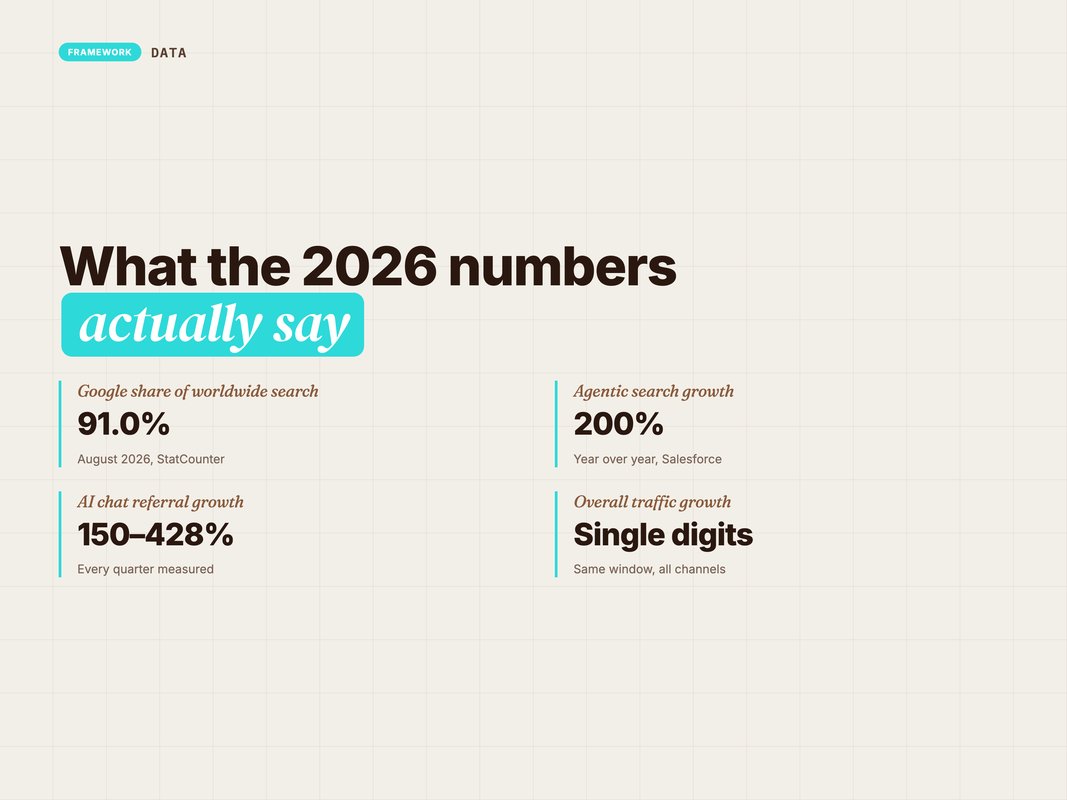
So AI referrals are small. And they are growing many times faster than everything else.
That is the pattern every channel shift starts with. Email did it. Mobile did it. Paid social did it. The volume looks ignorable right up to the quarter it does not.
Q: Is ChatGPT search bigger than Google yet?
A: No, and it will not be soon. Google held 91.0% of worldwide search in August 2026. The change is in where research happens, not in raw query counts.
The shift is in discovery, not in search volume
Here is the number that should move your budget.
Between August 2025 and May 2026, the rate of shoppers discovering products through brand-owned properties fell 7%. Traditional search fell 15%. New channels — AI assistants, social AI, delivery apps — grew 38% (Source: Salesforce, 2026 — salesforce.com).
Read that again. Your own site got worse at discovery.
Shoppers are not typing "best running shoes for flat feet under 8000" into a box any more. They describe the problem. They get three names back. Then they search for the name they were given.
That last search still happens on Google. So your Google traffic looks stable. But the choice was already made somewhere else.
This is why the "is it replacing Google" framing fails. The two are not competing for the same click. One decides. The other confirms.
Q: If Google traffic is flat, why should I care?
A: Because flat Google traffic can hide a lost decision. If an AI assistant names three brands and you are not one, you never enter the search that follows.
Where AI search wins and where Google still wins
Not every query moved. The split is fairly clean.
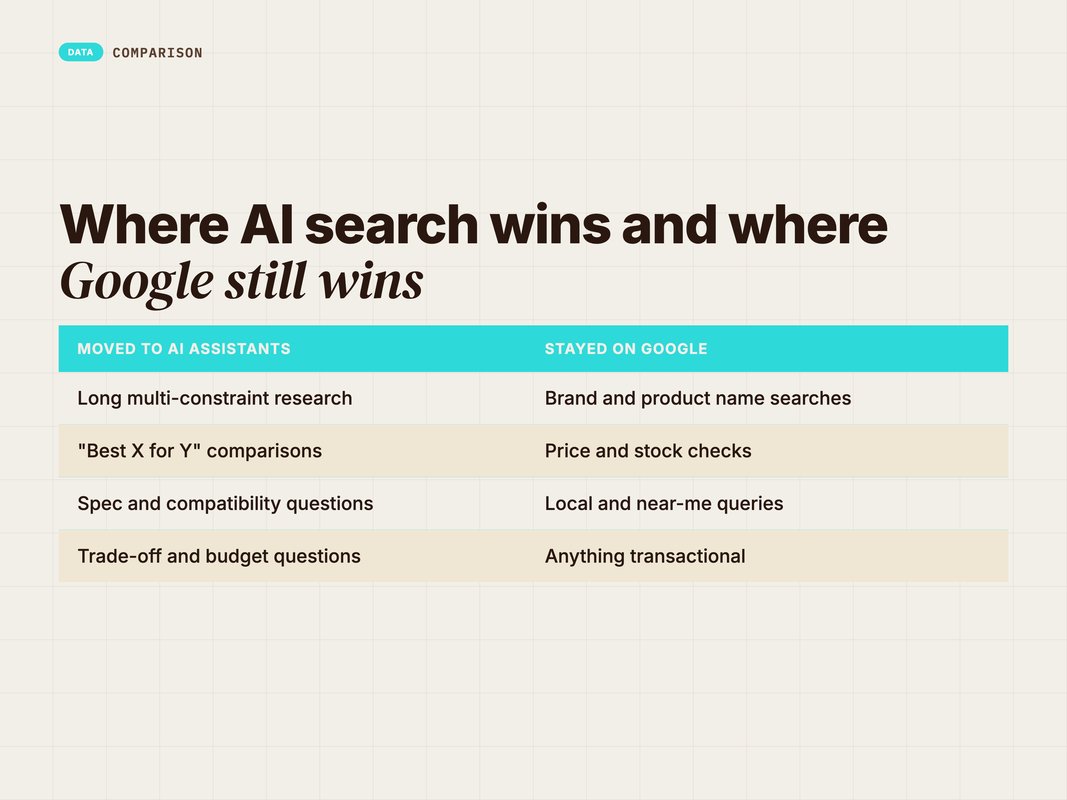
AI assistants win where the shopper cannot phrase the query well. Long constraints. Trade-offs. "I need X but also Y and my budget is Z." A results page is bad at that. A conversation is good at it.
Google still wins on speed, on local, on price checks and on anything transactional. Nobody opens a chat window to find a store's closing time.
The practical read is simple. AI eats the considered purchase. Google keeps the quick one.
If you sell something people research for more than five minutes, this is your channel. If you sell impulse, it matters less this year.
Here is how the split looks by query type.
| Query type | Where it lands now | What decides the winner |
|---|---|---|
| Multi-constraint research | AI assistant | Facts a model can read and quote |
| Brand or product name | Classic rank and page title | |
| Price or stock check | Feed accuracy and speed | |
| "Best X for Y" comparison | AI assistant | Third-party mentions and reviews |
| Local or "near me" | Maps profile and reviews | |
| Spec or compatibility | AI assistant | Structured data on your own page |
Notice the right-hand column. Three of those six rows depend on work you are probably not funding.
Q: Which categories are most exposed?
A: Anything with specs, sizing, compatibility or a long comparison step. Electronics, furniture, skincare, B2B software and travel are all deep in it already.
Why your analytics is hiding all of this
Now the awkward part. You probably cannot see any of this in your reports.
Loamly's analysis of 446,405 website visits found that 70.6% of AI-driven traffic arrives with no referrer header at all (Source: Seresa, 2026 — seresa.io). GA4 has nothing to read. So it files the visit under Direct.
The cause is boring. Many AI apps open links inside an in-app browser. That view often passes no referrer. Your server log looks the same as someone typing your URL by hand (Source: Wheelhouse DMG, 2026 — wheelhousedmg.com).
So two things happen at once.
Your AI channel looks tiny. And your Direct channel quietly swells. If you allocate budget on channel performance, you are underfunding the thing that is growing fastest.
There is a second trap here. AI-referred visits behave better than average.
Over the 2025 holidays, Salesforce found shoppers arriving from AI search converted nine times more often than shoppers from social media (Source: Salesforce, 2026 — salesforce.com). AI search's share of retail traffic doubled over the same season.
High-intent traffic, filed under the one channel nobody optimises. That is the whole problem in a sentence.
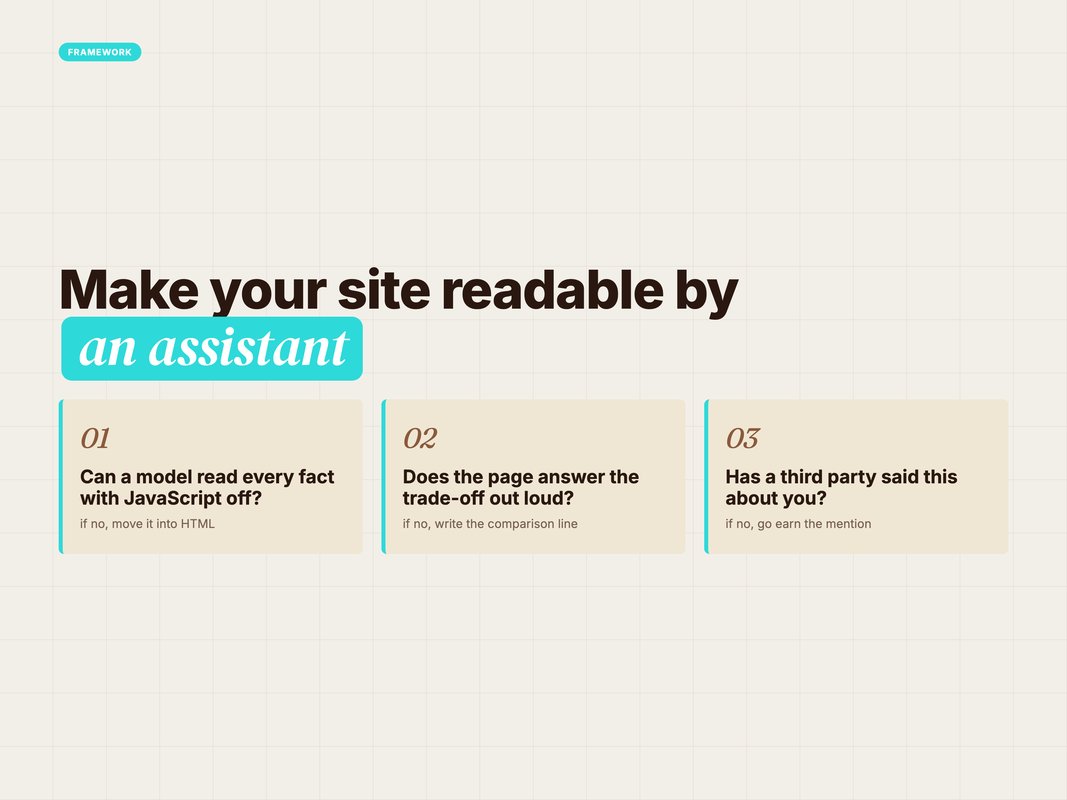
Make your site readable by an assistant
An AI assistant cannot recommend what it cannot parse. Most product pages fail on basics.
The fix is not exotic. It is the same hygiene that helped you rank ten years ago, applied to facts instead of keywords.
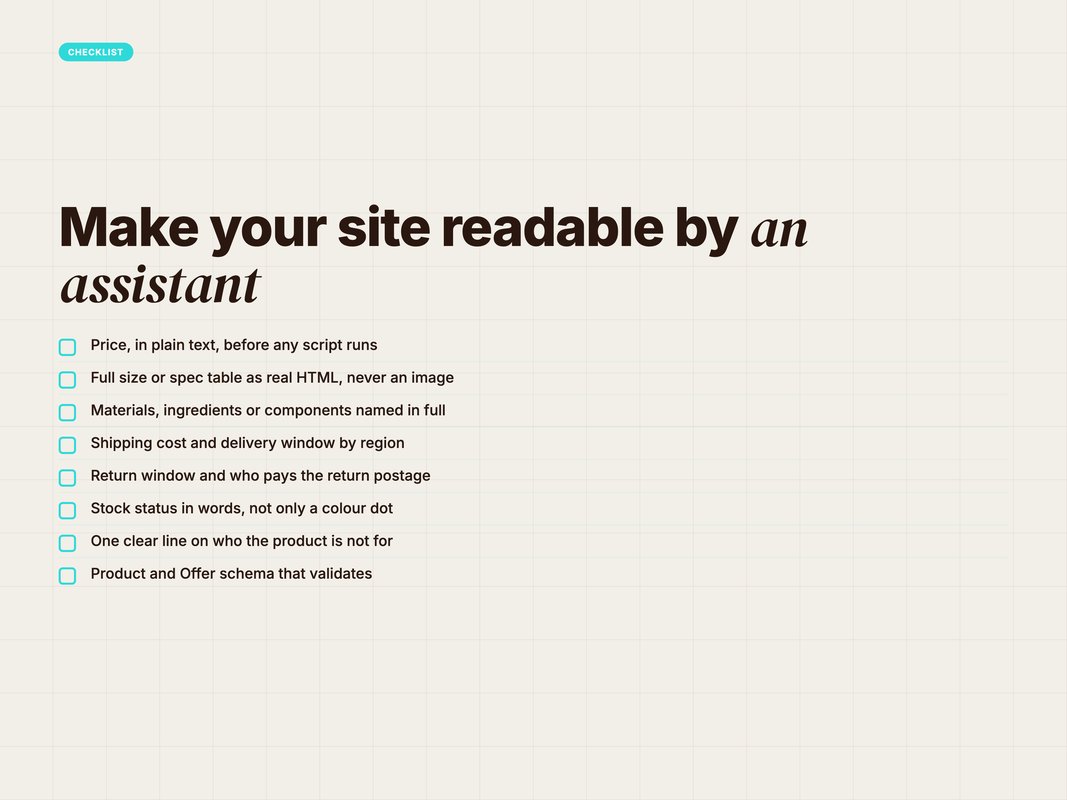
Two rules matter more than the rest.
First, put facts in text, not in pictures. A size chart baked into a JPEG is invisible. So is a price that only renders after a script runs.
Second, answer the comparison question on your own page. If a buyer asks "how is this different from the cheaper one", the answer should exist somewhere a crawler can read. Otherwise a review site answers it for you, in its own words.
There is a simple test for this. Turn JavaScript off and load your best-selling product page.
What is still on screen is what a model reliably sees. If the price vanishes, that is your first ticket. If the spec table vanishes, that is your second.
Run the same test on your three biggest competitors. You will usually find one of them already does this well. That is the brand getting named in the answer.
One more habit worth building. Write the phrase a buyer would say out loud. Then check that the phrase appears on the page.
"Runs half a size small" beats "true to size guidance available". Models quote the sentence that answers a question. They skip the one that dodges it.
Three page types carry most of the weight here. The product page holds the specs. The category page holds the trade-offs. The FAQ holds the objections. Fix those three and you have covered most of what an assistant needs from you.
We run every page through the same three questions before signing it off.
If a page fails any one of the three, it does not get recommended. It gets skipped for a competitor that passes all three.
Q: Does schema markup help with AI assistants?
A: Yes, as a clean signal. Product, Offer, Review and FAQ schema give a machine unambiguous facts. Google documents the required fields for each type (Source: Google Search Central, 2026 — developers.google.com).
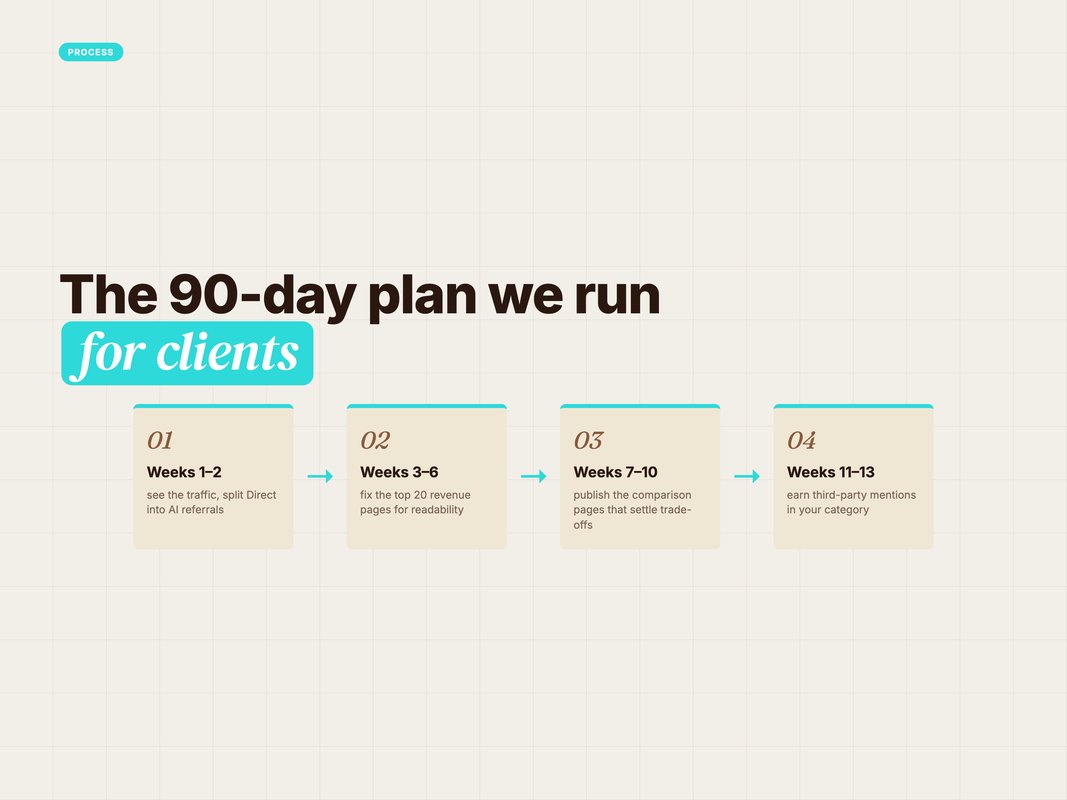
The 90-day plan we run for clients
You do not need a new team for this. You need four passes in order. We covered the wider framework in our guide to Generative Engine Optimization: Getting Your Brand in AI Answers.
Do them in sequence. Skipping to step four is the most common mistake we see.
Weeks 1 to 2 — see the traffic. Build a channel group that catches known AI hosts. Then tag every outbound link you control. Watch Direct fall as the new group fills.
Weeks 3 to 6 — fix the top pages. Take the 20 products that carry most of your revenue. Get every fact into readable text. Validate the schema. Nothing fancy.
Weeks 7 to 10 — answer the comparison. Write the pages that settle a trade-off. Not "why us". More like "X versus Y, and who each one suits". These are the pages models quote.
Weeks 11 to 13 — earn the third-party mention. Get onto the roundups and review pages in your category. A model trusts a source it has seen before, and it has not seen your homepage.
The measurement step comes first for a reason. Without it you cannot prove anything worked, and the budget conversation dies in month two.
One caution on targets. Do not promise a traffic number in quarter one. The honest first goal is visibility: how often you get named when a buyer describes your category out loud. Track that by hand if you have to. Ten prompts, run monthly, logged in a sheet.
What we do at YARD
We are an AI-first growth marketing agency. We run performance marketing, LLM SEO, AI creative and AI funnels for D2C and B2B brands.
This particular problem sits across three teams in most companies. Analytics owns the tracking. SEO owns the content. Merchandising owns the product data. Nobody owns the outcome.
So we start with one audit that covers all three. We pull your Direct channel apart and estimate the real AI share. We test how your top 20 products actually read to an assistant. Then we fix the pages that carry the most revenue first.
The work is unglamorous. Better product copy. Real specs in text. Schema that validates. Comparison content that answers the question a buyer actually asks. Third-party mentions on the pages models already trust.
None of it is new. What is new is the reason to do it well.
If you want to see where you stand, we run this as a fixed-scope audit. You get the current AI traffic estimate, the gap list by page, and a build order. No retainer needed to find out.
The takeaway
ChatGPT search is not replacing Google. It is replacing the part of Google you were never measuring.
The decision step moved. The confirmation step did not. That is why your traffic looks fine while your win rate slips.
The three moves that matter are small. Split your Direct traffic so you can see AI referrals. Put your product facts in readable text. Earn mentions on the comparison pages models already read.
Do those and you show up in both places. Skip them and you get found only by people who already know your name.
None of this asks you to bet against Google. Google still sends most of the clicks, and will for a while yet. It asks you to stop assuming the click is where the choice happens.
The brands winning this year are not the ones with the biggest AI budget. They are the ones whose product data is clean enough to be quoted. That is a content problem, not a technology problem. Which is good news, because you already have the team for it.
Want a second opinion on your product pages?
We will run the assistant test on your top sellers and send the gap list back.
You can book a call with our team to start.
FAQ
Q: Is ChatGPT search replacing Google?
A: No. Google held 91.0% of worldwide search in August 2026. But ChatGPT search is taking the research step of the buying journey, and that step is where brand choice happens.
Q: How much traffic comes from AI chat tools?
A: Salesforce found traffic referred from AI chats grew between 150% and 428% year over year in every quarter it measured. Overall traffic grew in the single to low double digits.
Q: Why does my AI traffic show up as direct in GA4?
A: Many AI apps open links in an in-app browser and send no referrer header. GA4 has nothing to read, so it files the visit under Direct. Your real AI traffic is larger than your report shows.
Q: Does AI traffic convert well?
A: Yes. Over the 2025 holidays, Salesforce found shoppers arriving from AI search converted nine times more often than shoppers from social media.
Q: How do I get my product picked by ChatGPT?
A: Publish the facts an assistant needs in plain HTML text. Prices, sizes, materials, shipping, returns and stock. Add Product schema. Earn mentions on the review and comparison pages the model already reads.
Q: Should I stop investing in SEO?
A: No. The same work feeds both channels. Clean structure, real facts and strong third-party mentions rank on Google and get quoted by AI assistants. Our guide to SEO After AI Overviews — The Complete Strategy Guide covers the overlap.
Insights from Our Experts
Explore our latest articles on digital marketing strategies.