

Hreflang for international e-commerce is where most cross-border stores quietly leak revenue. You launched a German store. You built a French one. Then Google served the wrong page to the wrong shopper.
That is not a hosting bug. It is a missing signal.
Hreflang is the signal. It tells search engines which language and region each page serves. Done right, a UK buyer lands on your GBP pages. A German buyer lands on the German store. Your own versions stop competing against each other.
The stakes are real. 76% of shoppers prefer to buy in their native language. (Source: CSA Research, 2020 — newswire.com/…76-prefer)
This guide is code-first. You get copy-paste tags for all three methods. You get the return-tag rules Google enforces. You get a fix list for the mistakes that break most stores. Let us start with why it matters.
Why International E-Commerce Needs Hreflang
Cross-border shopping is not a niche anymore.
The market is worth about $1.21 trillion in 2025. (Source: Capital One Shopping, 2026 — capitaloneshopping.com/…cross-border)
That trade crosses language lines every day. Around 59% of global shoppers buy from retailers outside their home country. (Source: Capital One Shopping, 2026 — capitaloneshopping.com/…cross-border)
So you sell across borders. But Google does not know which store version to show. Without hreflang, it guesses.
Bad guesses cost you sales. A French shopper sees your English page. Prices show in the wrong currency. The buyer bounces.
Hreflang fixes three problems at once. It routes the right language to the right user. It prevents duplicate-content confusion between near-identical pages. It keeps your regional URLs from cannibalising each other in search.
For e-commerce, that last point is huge. You often have the same product across many locales. The copy barely changes. Google needs help telling them apart.
Q: Does hreflang help rankings directly?
A: No, hreflang is not a ranking boost. It is a targeting and consolidation signal. It helps the right page rank for the right audience and stops regional versions competing. That indirect effect can still lift traffic from non-primary markets.
Correct Hreflang Syntax: Language and Region Codes
Syntax is where most stores fail. The rules are strict but simple.
A hreflang value has two parts. First, the language code. Second, an optional region code.
The language code uses ISO 639-1. It is always two letters. Examples: en, fr, de, es.
The region code uses ISO 3166-1 Alpha 2. It is also two letters. Examples: GB, US, CA, DE.
Join them with a hyphen. Never an underscore.
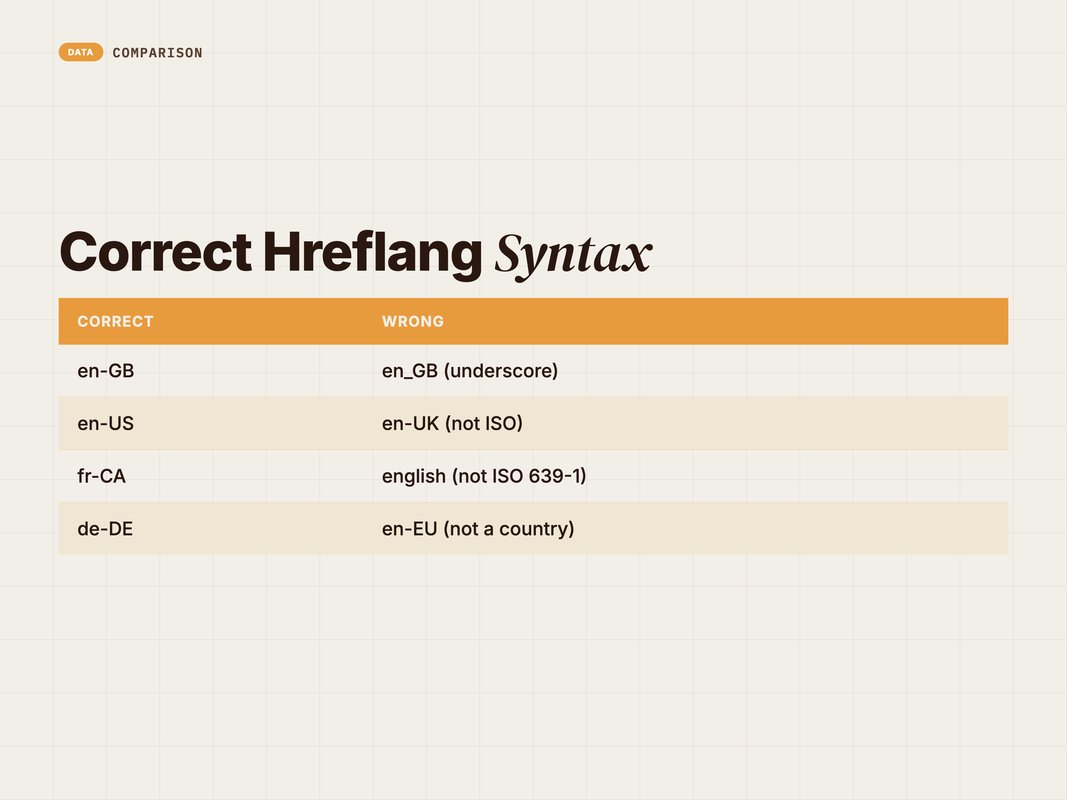
These values are correct.
en          → English, any region
en-GB       → English, United Kingdom
en-US       → English, United States
fr-CA       → French, Canada
de-DE       → German, Germany
es-419      → Spanish, Latin America (UN M49 region code)
These values break.
en_GB       → wrong: underscore, not hyphen
en-UK       → wrong: UK is not the ISO code (it is GB)
english     → wrong: not ISO 639-1
en-EU       → wrong: EU is not a valid ISO 3166-1 country
Incorrect codes are one of the two most common hreflang errors Google reports. (Source: Google Search Central, 2026 — developers.google.com/…localized-versions)
The region code is optional. The language code is not.
Q: Should I always add a region code?
A: No. Only add a region when the language content or pricing differs by country. Usedefor one German page for all German speakers. Useen-GBanden-USwhen currency, spelling, or stock differ. Do not over-segment.
The Three Hreflang Implementation Methods
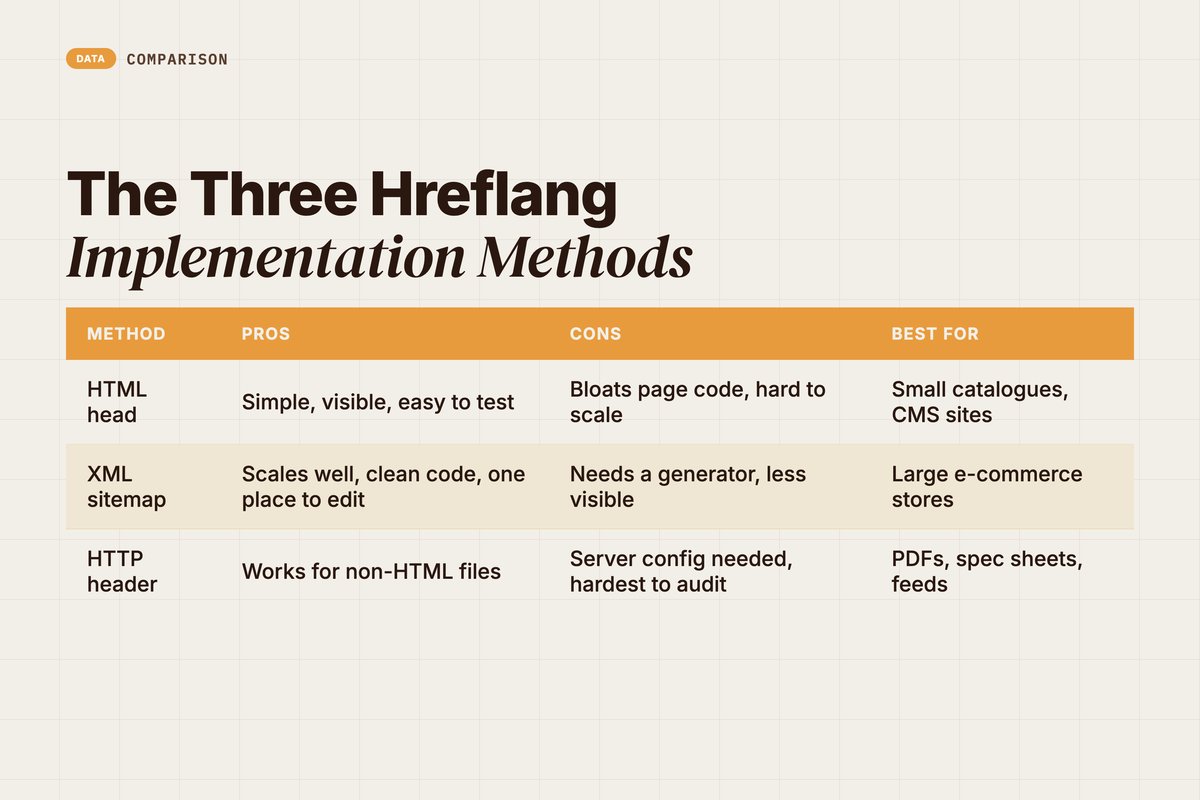
Google supports three ways to add hreflang. Each returns the same signal. You pick one per page type.
Do not mix methods on the same page. That confuses crawlers.
Here is a quick view of all three.
Method 1: HTML Head Tags
Add one <link> per version inside the <head>. Every version links to every version, including itself.
For a product on your UK, US, and German stores:
<link rel="alternate" hreflang="en-GB" href="https://yourbrand.com/uk/product" />
<link rel="alternate" hreflang="en-US" href="https://yourbrand.com/us/product" />
<link rel="alternate" hreflang="de-DE" href="https://yourbrand.com/de/product" />
<link rel="alternate" hreflang="x-default" href="https://yourbrand.com/product" />
Put the same block on all four URLs. Yes, all four. That is the return-tag rule.
Method 2: XML Sitemap
This method scales best for big stores. You list each URL once, with an xhtml:link for every alternate.
<url>
  <loc>https://yourbrand.com/uk/product</loc>
  <xhtml:link rel="alternate" hreflang="en-GB" href="https://yourbrand.com/uk/product"/>
  <xhtml:link rel="alternate" hreflang="en-US" href="https://yourbrand.com/us/product"/>
  <xhtml:link rel="alternate" hreflang="de-DE" href="https://yourbrand.com/de/product"/>
  <xhtml:link rel="alternate" hreflang="x-default" href="https://yourbrand.com/product"/>
</url>
Add the xmlns:xhtml="http://www.w3.org/1999/xhtml" namespace to your <urlset>. Repeat the full block for each URL in the group.
Method 3: HTTP Headers
Use this for non-HTML files like PDF spec sheets. Set a Link header in the server response.
Link: <https://yourbrand.com/uk/guide.pdf>; rel="alternate"; hreflang="en-GB",
      <https://yourbrand.com/us/guide.pdf>; rel="alternate"; hreflang="en-US",
      <https://yourbrand.com/de/guide.pdf>; rel="alternate"; hreflang="de-DE"
All three methods are official and equal in Google's eyes. (Source: Google Search Central, 2026 — developers.google.com/…localized-versions)
Q: Can I use more than one method at once?
A: You can, but do not double-annotate the same page. Google may read conflicting signals. Pick one method per page group. Most large stores standardise on the XML sitemap for clean scaling.
Return Tags and Self-Reference: The Rules That Break Sites
This section is where audits find the most damage. Two rules matter above all.
Rule one: hreflang must be reciprocal. If page A points to page B, page B must point back to A.
Rule two: every page must reference itself.
Miss either one and Google drops the whole cluster. Missing return tags are the single most common hreflang error. (Source: Semrush, 2026 — semrush.com/blog/hreflang-errors)
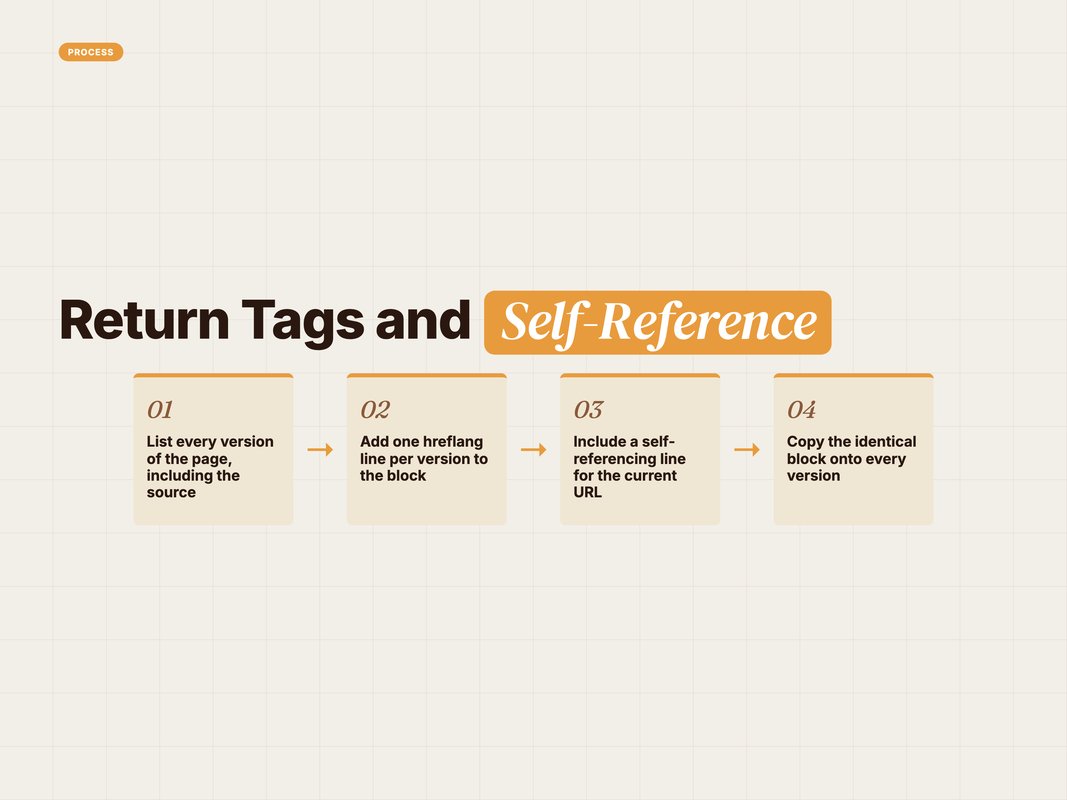
Here is the four-step logic to get it right every time.
- List every version of the page, including the source.
- Add one hreflang line per version to the block.
- Include a self-referencing line for the current URL.
- Copy the exact same block onto every version.
The self-reference trips up many teams. The page must list itself.
<!-- On the en-GB page, this line must be present: -->
<link rel="alternate" hreflang="en-GB" href="https://yourbrand.com/uk/product" />
Missing self-reference is the second most common hreflang mistake. (Source: Semrush, 2026 — semrush.com/blog/the-most-common-hreflang-mistakes-infographic)
Keep the block identical across all versions. Same order. Same URLs. Only the page URL changes context, not the block.
Q: What happens if a return tag is missing?
A: Google ignores the annotation in both directions. Your language targeting silently fails. The page may still index, but it will not route users correctly. Auditors catch this fast, so it is easy to fix once found.
The X-Default Tag: Your Global Fallback
The x-default value is your safety net. It tells Google which page to show when no language matches.
Think of a shopper whose browser is set to a language you do not support. The x-default catches them.
<link rel="alternate" hreflang="x-default" href="https://yourbrand.com/" />
Point it at a language selector or your main global store. For most e-commerce sites, that is the homepage or a country-picker page.
The x-default is optional. But Google recommends it for multi-region sites. (Source: Google Search Central, 2026 — developers.google.com/…localized-versions)
Add it to every hreflang block, not just the homepage. Product pages need a fallback too.
Q: Where should x-default point for a store?
A: Point it at a neutral entry page. A global homepage or a country selector works best. Avoid pointing it at a single locale that assumes a language. The goal is a clean fallback for unmatched users.
The Most Common Hreflang Mistakes (and How to Fix Them)
Most hreflang failures come from a short list of errors. Fix these and you fix 90% of the problem.
Here are the ones that break stores most often. Each maps to a real Google or tool-reported issue.
Quick Facts: Hreflang and Cross-Border E-Commerce
- The cross-border e-commerce market is worth about $1.21 trillion in 2025. (Source: Capital One Shopping, 2026 — capitaloneshopping.com/…cross-border).
- Roughly 59% of global shoppers buy from retailers outside their home country. (Source: Capital One Shopping, 2026 — capitaloneshopping.com/…cross-border).
- Some 76% of shoppers prefer to buy in their native language. (Source: CSA Research, 2020 — newswire.com/…76-prefer).
- Incorrect codes and missing return tags are the two most common hreflang errors. (Source: Google Search Central, 2026 — developers.google.com/…localized-versions).
The top mistakes:
- Using
_instead of-between codes. - Using
en-UKinstead of the validen-GB. - Missing return tags between versions.
- Missing the self-referencing line.
- Pointing hreflang at redirecting or non-canonical URLs.
- Mixing hreflang with a conflicting canonical tag.
- Forgetting the
x-defaultfallback.
The canonical conflict is sneaky. Each version must self-canonicalise. Do not canonicalise the German page to the English one. That cancels your hreflang.
Also point hreflang at final, indexable URLs. No redirects. No 404s. No noindex pages.
Ahrefs and Semrush both surface these errors in dedicated reports. (Source: Ahrefs, 2026 — ahrefs.com/blog/hreflang-tags)
Q: Why does a canonical tag break hreflang?
A: A canonical pointing to another locale tells Google the two pages are one. Hreflang tells Google they are distinct alternates. The signals fight. Google usually trusts the canonical and drops your targeting. Always self-canonicalise each version.
How to Audit and Validate Hreflang at Scale
You cannot eyeball hreflang across thousands of SKUs. You need tools.
Run a full crawl, then check three sources. Each catches different issues.
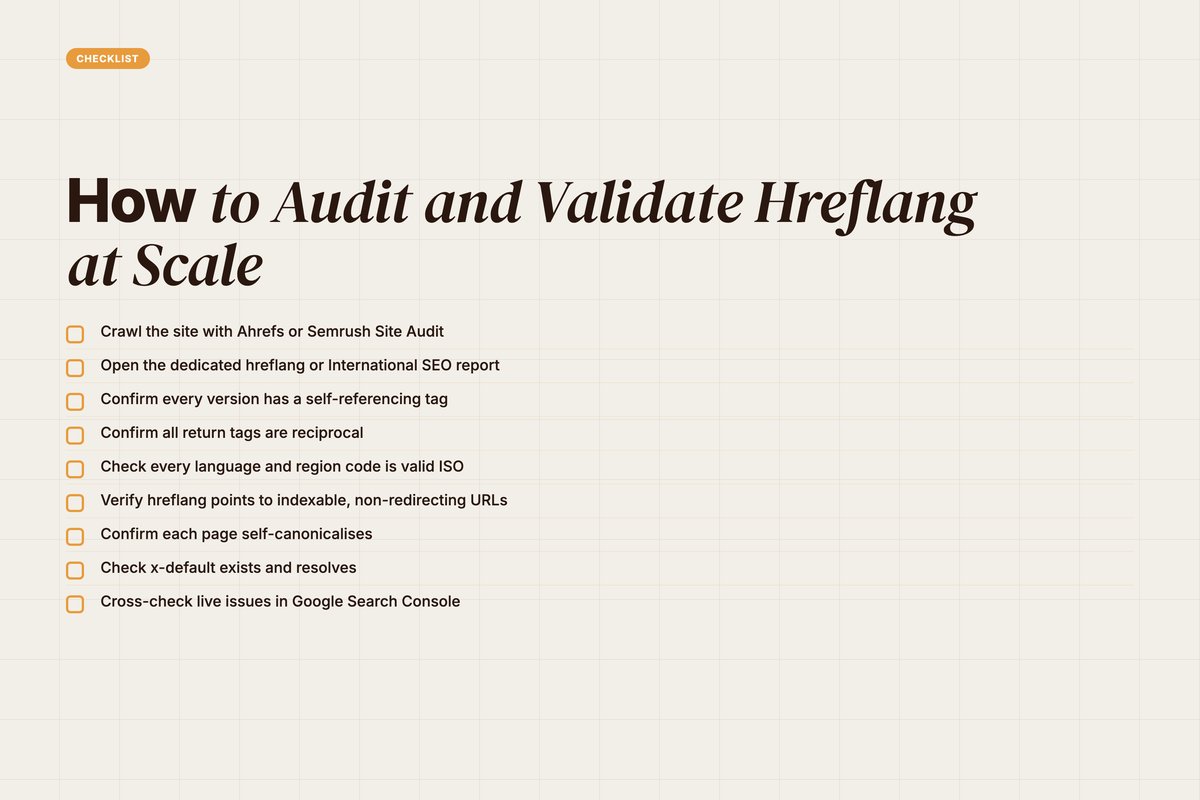
Run this validation checklist on every international store.
- Crawl the site with Ahrefs or Semrush Site Audit.
- Open the dedicated hreflang or International SEO report.
- Confirm every version has a self-referencing tag.
- Confirm all return tags are reciprocal.
- Check every language and region code is valid ISO.
- Verify hreflang points to indexable, non-redirecting URLs.
- Confirm each page self-canonicalises.
- Check
x-defaultexists and resolves. - Cross-check live issues in Google Search Console.
Semrush ships a dedicated International SEO report inside Site Audit. It flags missing values page by page. (Source: Semrush, 2026 — semrush.com/kb/959-site-audit-thematic-reports)
Google Search Console once had a Legacy International Targeting report. Google has since retired it, so use crawlers for validation. (Source: Google Search Central, 2026 — developers.google.com/…localized-versions)
Fix the highest-traffic pages first. A broken tag on a hero product hurts more than one on a dead SKU.
Q: Which tool should I trust for hreflang audits?
A: Use a crawler like Ahrefs or Semrush for structural errors. They test return tags and codes at scale. Then confirm live index behaviour in Google Search Console. Together they cover both code-level and index-level problems.
How AI Speeds Up Hreflang at Scale
Manual hreflang work does not scale past a few hundred URLs. AI closes that gap.
Large stores have thousands of SKUs across many locales. Each needs a full, correct block. That is a lot of repeat logic.
You can script the generation. Feed a locale map into a template and produce every block. Modern AI coding tools write and test that script fast.
Here is a simple pattern for the logic.
For each product:
  1. Pull all live locale URLs for the product.
  2. Build one hreflang line per locale.
  3. Add the self-reference and x-default lines.
  4. Output the identical block for every locale page.
  5. Validate codes against an ISO 639-1 / 3166-1 list.
AI also speeds up the QA side. You can prompt a model to scan a crawl export. It flags underscores, bad codes, and missing self-references in seconds.
At scale, that turns a week of manual checks into an afternoon. The tags stay data-truthful because the model validates against a fixed ISO list, not guesswork.
We build these workflows with Claude and MCP-based tooling. The model reads the crawl, the script enforces the rules, and a human signs off. That mix keeps speed high and errors low.
Q: Can AI replace a manual hreflang audit?
A: Not fully. AI is great at generating blocks and flagging pattern errors at scale. A human still verifies edge cases and business logic. The best setup pairs an AI first pass with a human review of the top pages.
How an AI-First Team Ships International SEO Faster
Hreflang is exactly the kind of work AI-first teams win at. It is rule-based, repetitive, and easy to get wrong by hand.
We are an AI-first growth marketing agency. We run performance marketing, LLM SEO, AI creatives, and AI funnels for D2C and B2B brands.
International SEO sits inside our LLM SEO practice. We treat hreflang as a system, not a one-off task.
The approach is simple. We crawl the store and map every locale. We generate hreflang blocks from a validated template. We run an AI QA pass across the full crawl. Then a human reviews the top-revenue pages.
That keeps two things true at once. Coverage is complete across thousands of SKUs. Quality holds because the rules are enforced in code, not memory.
We wire this with Claude, MCP workflows, and standard crawlers. The tooling does the volume. The strategy stays human.
The payoff for a cross-border store is real. Right page, right shopper, right language. Fewer duplicate-content headaches. Cleaner signals into Google and AI search.
If you sell across borders, this is foundational work. Get it right once and it compounds across every new market you add.
Conclusion: Get Hreflang Right, Then Scale
Hreflang for international e-commerce is not glamorous. But it decides whether a French shopper ever sees your French store.
The rules are strict and worth memorising. Two-letter ISO codes. A hyphen, never an underscore. Reciprocal return tags. A self-reference on every page. An x-default fallback for everyone else.
Pick one method per page group. HTML head for small catalogues. XML sitemap for big stores. HTTP headers for files. Then audit with Ahrefs or Semrush and cross-check in Search Console.
At scale, lean on AI to generate and validate the tags. It turns a fragile manual job into a repeatable system.
Want a team to build that system for you? We help cross-border brands ship clean international SEO from day one. Book a call and we will map your locales, fix the tags, and set up the audit loop.
FAQ
Q: What is hreflang for international e-commerce?
A: Hreflang is an HTML attribute that tells Google which language and region a page targets. For international e-commerce it points shoppers to the right store version. It helps a UK buyer land on your GBP pages and a German buyer on your German pages. It also stops your own regional pages from competing in search.
Q: What is the correct hreflang syntax?
A: Use a two-letter ISO 639-1 language code, then an optional ISO 3166-1 Alpha 2 region code. Join them with a hyphen, like en-GB or fr-CA. Never use an underscore. The region code is optional but the language code is always required.
Q: What is the x-default hreflang value?
A: The x-default value marks a fallback page for users no other tag matches. It usually points to a language selector or your main global page. Google recommends it for sites with many regional versions. It is optional but strongly advised for e-commerce.
Q: What is a hreflang return tag?
A: A return tag is the reciprocal link between two page versions. If page A lists page B as its French variant, page B must list page A back. Google ignores one-way annotations. Missing return tags are the single most common hreflang error.
Q: How do I audit hreflang errors?
A: Crawl your site with Ahrefs or Semrush and open their hreflang report. Both flag missing return tags, bad codes, and self-reference gaps. Cross-check with Google Search Console for live index-level issues. Fix the highest-volume pages first.
Q: Which hreflang method is best for large e-commerce sites?
A: The XML sitemap method scales best for large stores. It keeps hreflang out of your page code and updates in one place. HTML head tags suit smaller catalogues. HTTP headers are for non-HTML files like PDFs.
Insights from Our Experts
Explore our latest articles on digital marketing strategies.