

More content is not a strategy. It feels like progress. It rarely is. Most D2C teams confuse volume with results. They post more. They blog more. They film more. Then they wonder why nothing moves.
Here is the fix. Content is not a volume game. It is a job-matching game. Every asset has one job. That job maps to a funnel stage.
The stages are simple. TOFU builds awareness. MOFU builds consideration. BOFU drives conversion. Each stage needs a different type of content. Each stage needs a different metric too.
When you match the asset to the job, content starts to work. When you do not, you get busy work.
This playbook shows you how. You will learn the three funnel jobs. You will see which content fits each one. You will learn what to measure at every step. And you will stop making random content for good. No fluff. Just a clear map you can use this week. Let us get into it.
Content is a job-matching game
Think about your last ten posts. Ask one hard question. What job did each one do? Most teams cannot answer. That is the real problem.
The content was not bad. It was just aimless. Aimless content is expensive. It burns time and money. It also burns your team's faith.
So flip the model. Do not start with "what should we post?" Start with "what job needs doing?"
Every asset should have a clear job. A job is a funnel stage. There are three of them. Awareness. Consideration. Conversion. Or TOFU, MOFU, and BOFU.
Each job is different. Each one needs its own content. Each one needs its own metric. This is the whole idea. Match the asset to the job. Then measure the job, not the noise.
Do this and content stops feeling random. It starts feeling like a system. A system you can trust. A system you can scale.

The three funnel jobs
Let us keep this simple. A funnel has three jobs. Here they are.
TOFU is the top. Its job is attention. It helps strangers find you. It teaches. It entertains. It builds trust.
MOFU is the middle. Its job is consideration. It helps warm people compare. It shows why you fit. It answers doubts.
BOFU is the bottom. Its job is conversion. It helps ready buyers act. It removes the last friction. It closes.
Each stage moves one step closer to a sale. But you cannot skip steps. A stranger will not buy on the first click. A ready buyer does not need a "what is" guide.
Right content. Right stage. Right time. That is the game. Get the order wrong and you lose people. Get it right and the funnel flows.
TOFU: content that wins attention
The top of the funnel is crowded. Everyone wants attention. So your job is to earn it. Not buy it. Not beg for it. Earn it.
You do this with useful content. Content that helps before it sells. TOFU content is broad. It targets a big group. It solves a common pain. It does not push your product.
Think blog posts. Think short videos. Think how-to guides. Think memes and reels. Think SEO pages that answer real questions.
The goal is reach. You want new eyes. You want people to think "this brand gets me." Trust starts here.
And trust matters more than ever. People trust people, not ads. Nielsen found that 88% of consumers trust recommendations from people they know above every other channel. So TOFU content should feel human. It should sound like a helpful friend. Skip the hard sell. Give value first.
One more thing. Buyers do most of their homework alone. Google calls this the "messy middle." It is the space where shoppers explore and compare before they choose. TOFU is how you show up in that space. Be there early. Be there often. Be helpful.
MOFU: content that builds the case
Now the person knows you. They have a problem. They are weighing options. This is the middle. This is consideration.
MOFU content has a new job. It builds the case for you. It does not shout. It reassures. It compares. It proves.
So the content gets deeper. It gets more specific. Think detailed guides. Think case studies. Think comparison pages. Think webinars and email courses. Think product explainers. Think reviews and social proof.
The reader has doubts. Your job is to answer them. Show how you work. Show real results. Show real customers. Name the trade-offs too. Honesty wins trust here.
This is also where you capture leads. A great guide earns an email. A webinar earns a signup. A quiz earns a reply. Now the person is on your list. Now you can nurture them.
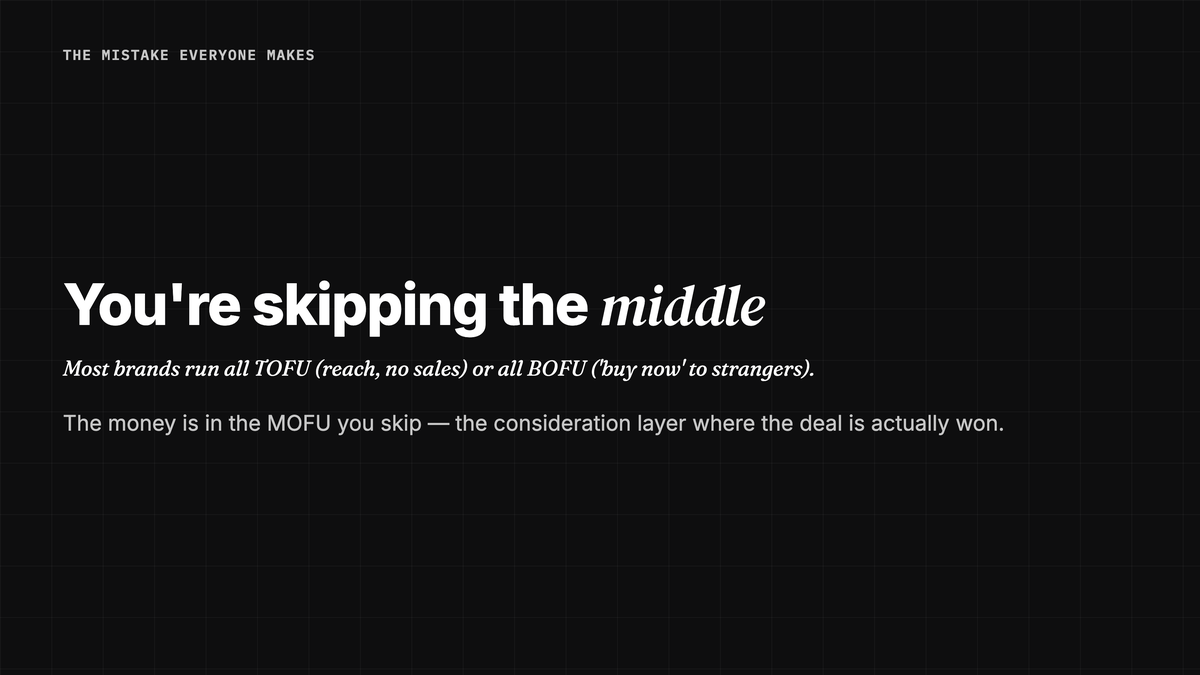
MOFU is where random content hurts most. Teams make plenty of TOFU. They make lots of BOFU. Then the middle stays empty. So warm leads go cold. They forget you.
Do not let that happen. Feed the middle. Keep the case warm.
BOFU: content that closes
The bottom of the funnel is small. But it is where money is made. This person is ready. They just need a nudge.
BOFU content removes friction. It answers the last doubt. It makes "yes" easy.
So the content gets sharp. It gets specific to the buy. Think product pages. Think pricing pages. Think demos and free trials. Think discount codes. Think abandoned cart emails. Think clear FAQs. Think strong reviews near the button.
This content is not broad. It is narrow on purpose. It speaks to one ready buyer.
And small nudges pay off big. Take cart recovery. Klaviyo found that abandoned cart emails drive the highest revenue per recipient of all flows, at $3.65. That is one email. Doing one job. Very well.
For D2C brands in India, BOFU also shines during festive peaks. Think BFCM. Think Diwali sales. A timely offer email can close a slow week.
So build your BOFU now. Do not wait for the rush. Make the last step feel simple. Then get out of the way.
Map content types to each stage
Let us make this real. Here is how to sort your content by job. Read each type. Then ask "what job does this do?"
TOFU types. Blog posts. SEO guides. Short reels. Podcasts. Infographics. Social memes. These win attention.
MOFU types. Case studies. Comparison pages. Webinars. Email courses. Product demos. Buyer guides. These build the case.
BOFU types. Product pages. Pricing pages. Free trials. Cart emails. Testimonials. Discount offers. These close the deal.
Now audit your own library. List every asset you have. Tag each one TOFU, MOFU, or BOFU. You will spot the gaps fast.
Maybe you are all TOFU. Maybe your middle is thin. Maybe your BOFU is weak. That map is gold. It tells you what to make next.
Not more content. The right content. For the stage that needs it. This one exercise changes everything. It turns a messy pile into a plan.
Measure what matters at each stage
Here is where most teams slip. They use one metric for everything. Usually sales. But TOFU does not drive sales fast. So it looks like a failure. It is not. You just measured the wrong thing.
Each stage has its own metric. Match the metric to the job.
TOFU metrics. Reach. Impressions. New visitors. Brand searches. Video views. You are measuring attention. Not sales.
MOFU metrics. Email signups. Time on page. Return visits. Lead volume. Content downloads. You are measuring interest. Not sales.
BOFU metrics. Conversion rate. Revenue. Add-to-cart rate. And two you must track: customer acquisition cost and return on ad spend versus true ROI. Here you are measuring money.
This is the point. TOFU feeds MOFU. MOFU feeds BOFU. So judge each stage on its own job. Do not blame a blog for not closing a sale. That was never its job.
Yet measurement is hard for most teams. The Content Marketing Institute found that a third of B2B marketers name measuring content as a top challenge. You can beat that. Just pick one metric per stage. Track it. Report it. Learn from it. Then repeat.

How YARD can help
This is a lot to run alone. That is where YARD comes in. YARD is an AI-first marketing agency built for D2C and startup teams. We do not chase volume. We build systems. Systems that match every asset to a funnel job.
Here is how we work with you. First, we audit your content. We tag each asset TOFU, MOFU, or BOFU. We find the gaps.
Then we build a plan. A calendar mapped to the funnel, not to random ideas. We make the TOFU content that earns attention. We make the MOFU content that builds the case. We make the BOFU content that closes.
Next, we wire up measurement. One clear metric per stage. Dashboards you can actually read. So you always know what is working.
Our AI tools help us move fast. They handle drafts, research, and edits. But a human owns the strategy. That mix keeps quality high and costs low.
It is a good fit for lean teams. You get an agency's brain without an agency's bloat. And you get content that does a job. Not content that just fills a slot.
Want a funnel that flows? That is what we build. Let us map your content to real outcomes. One stage at a time.
The bottom line
Let us bring it home. More content is not the goal. Better-matched content is.
Every asset has one job. That job is a funnel stage. TOFU wins attention. MOFU builds the case. BOFU closes the deal.
Match the asset to the job. Then measure that job on its own terms. Do not ask a blog to close a sale. Do not ask a cart email to build trust. Each one has its place.
When you sort your content this way, the fog lifts. You stop guessing. You stop posting for the sake of it. You start building a system. A system you can measure. A system you can grow.
So do the audit this week. List your assets. Tag each one. Find the gaps. Fill the weakest stage first. Then pick one metric per stage and track it. Small steps beat big plans that never ship.
That is the whole playbook. It is simple. But it is not easy. The teams that win are the ones that stay consistent. Be one of them.
Stop making random content. Start matching every asset to a job. Your funnel, and your budget, will thank you.
Frequently asked questions
What does full-funnel content actually mean?
It means you make content for every stage of the buyer journey. Not just one. A full-funnel plan covers awareness, consideration, and conversion. TOFU pulls in strangers. MOFU warms up leads. BOFU closes ready buyers. Each stage gets its own content and its own metric. The goal is a smooth path from first click to sale. No gaps. No dead ends.
How do I know if an asset is TOFU, MOFU, or BOFU?
Ask one question. What job does it do? If it earns attention from strangers, it is TOFU. If it helps a warm lead compare, it is MOFU. If it helps a ready buyer act, it is BOFU. A blog post is usually TOFU. A case study is MOFU. A pricing page is BOFU. Tag each asset by its job. The pattern gets clear fast.
Why is more content not a strategy?
Volume without a plan is just noise. More posts do not help if none has a job. You end up busy but stuck. Random content spreads your budget thin. It also confuses buyers. A real strategy matches each asset to a funnel stage. Then it measures the right thing. That is the shift. Fewer, better-matched pieces beat a flood of aimless ones.
What should I measure at each funnel stage?
Use one metric per stage. For TOFU, track reach and new visitors. For MOFU, track signups and lead volume. For BOFU, track conversion rate, revenue, and CAC. Do not judge a TOFU post by sales. That is not its job. Match the metric to the stage. Then you see the real story of your funnel.
Where do most D2C brands go wrong?
They make too much TOFU and too little MOFU. Their middle stays empty. So warm leads go cold. They also use one metric for everything. Usually sales. That makes good content look bad. The fix is simple. Fill the middle. And measure each stage on its own job, not on final sales alone.
How do I start a full-funnel plan this week?
Start with an audit. List every asset you own. Tag each one TOFU, MOFU, or BOFU. Find your weakest stage. Fix that first. Then pick one metric per stage and track it. Do not try to boil the ocean. Small, steady steps win. In a week you will have a real map. That map is your plan.
Insights from Our Experts
Explore our latest articles on digital marketing strategies.