

Thinking Machines Lab shipped its first model on 15 July 2026. It is called Inkling, and the weights are open.
That second part is the story.
Most frontier labs keep their best models behind an API. Inkling ships under Apache 2.0, which means you can download it, change it and run it commercially.
This piece covers what Inkling is and what it is good at. Then it covers the one question a marketing team should ask. That question is not whether it is the best model.
Spoiler: it is not, and the lab says so itself.
Quick Facts: Inkling at a Glance
- Inkling launched on 15 July 2026 with 975B total parameters and 41B active — (Source: Thinking Machines Lab, 2026 — thinkingmachines.ai).
- It is released under the Apache 2.0 licence — (Source: Thinking Machines Lab, 2026 — thinkingmachines.ai).
- Context window runs up to 1M tokens — (Source: Thinking Machines Lab, 2026 — thinkingmachines.ai).
- It was pretrained on 45 trillion tokens of text, images, audio and video — (Source: Thinking Machines Lab, 2026 — thinkingmachines.ai).
- Inkling-Small followed on 30 July 2026 at 276B parameters, 12B active — (Source: Thinking Machines Lab, 2026 — thinkingmachines.ai).
What Inkling actually is
Inkling is a 66-layer decoder-only transformer with a sparse Mixture-of-Experts backbone. Each token routes to 6 of 256 experts, plus 2 shared experts that run on every token (Source: Thinking Machines Lab, 2026 — thinkingmachines.ai).
In plain terms: it is a very large model that only wakes up a small part of itself for any given token. That is why 975B total parameters can run with 41B active.
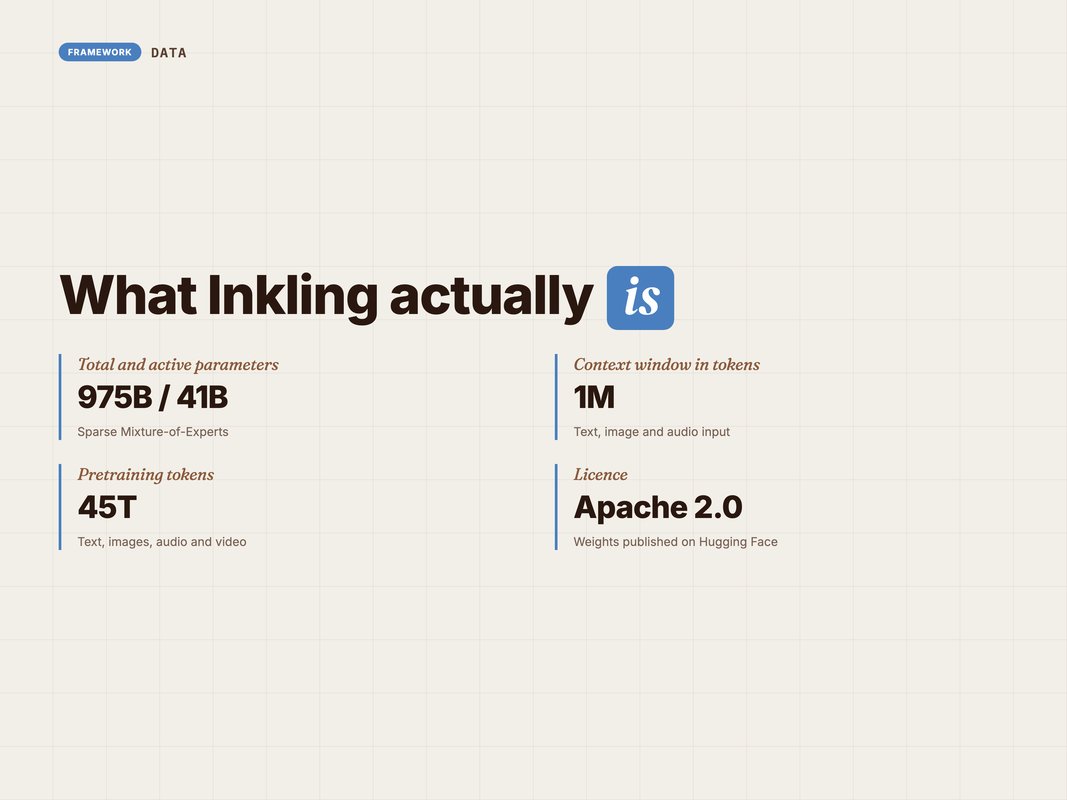
It reads text, images and audio, and it writes text. Images from 40px to 4096px. Audio as 16kHz WAV, up to 20 minutes long (Source: Thinking Machines Lab, 2026 — thinkingmachines.ai).
The context window goes to 1M tokens. Pretraining used 45 trillion tokens of text, images, audio and video.
The lab was founded by Mira Murati, formerly chief technology officer at OpenAI. Inkling is its first public model.
Q: What does "open weights" mean here?
A: The trained model files are downloadable and the licence is Apache 2.0. You can run it on your own hardware, fine-tune it, and ship it in a commercial product.
The benchmarks, in context
Thinking Machines is unusually direct about where Inkling sits. They say plainly that it is not the strongest model available today, open or closed (Source: Thinking Machines Lab, 2026 — thinkingmachines.ai).
That is a refreshing thing for a lab to write on launch day.
The published scores back the framing.
| Benchmark | Inkling score |
|---|---|
| AIME 2026 | 97.1% |
| SWEBench Verified | 77.6% |
| MMMU Pro Standard 10 | 73.5% |
| SimpleQA Verified | 43.9% |
| Humanity's Last Exam, text only | 29.7% |
Strong on maths. Solid on coding. Weaker on broad factual recall, which the SimpleQA number shows clearly.
The pitch is not raw power. Inkling is meant to be a good base to build on. It reads more than text. It thinks cheaply. And it is easy to tune.
One score is worth a note. SimpleQA tests plain factual recall, and 43.9% is not high.
So do not use it as a fact source without checking. Use it as an engine you point at your own data.
That is true of most models. It is just more visible here, because the lab published the number.
Inkling-Small is the more interesting release
Two weeks after Inkling, the lab shipped Inkling-Small. It has 276B total parameters with 12B active (Source: Thinking Machines Lab, 2026 — thinkingmachines.ai).
That is roughly a quarter of the size. The results are the surprise.
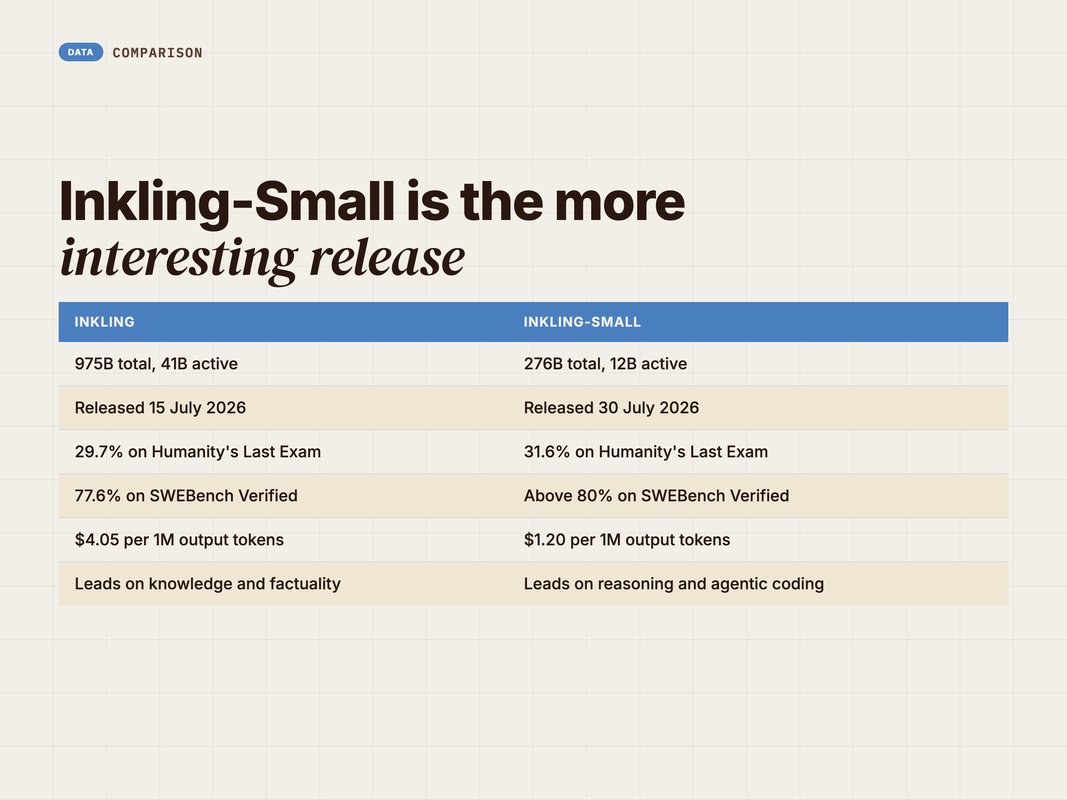
Inkling-Small beat the larger model on reasoning and agentic coding benchmarks. It scored 31.6% on Humanity's Last Exam against Inkling's 29.7%, and cleared 80% on SWEBench-Verified.
The full model keeps an edge on knowledge coverage and factual accuracy.
Then there is price. Inkling-Small output runs at $1.20 per million tokens. Full Inkling runs at $4.05 (Source: Thinking Machines Lab, 2026 — thinkingmachines.ai).
For most real work, the smaller model is the one to test first.
This is becoming a pattern across the industry. The biggest model is rarely the right buy.
Smaller models are cheaper to run. They answer faster. And they are far easier to tune on your own data.
The large model still matters. It sets the ceiling, and it is the better choice when broad knowledge is the job. But most business tasks are narrow, and narrow favours small.
Q: Why would a smaller model beat a bigger one?
A: Different training emphasis. Reasoning and coding respond well to focused post-training. Broad factual recall scales more directly with size, which is why the larger model still leads there.
What this means if you are not building models
Here is the honest answer for most marketing teams. Very little, this quarter.
You are not going to swap your drafting workflow to a self-hosted 975B model. A hosted frontier model is cheaper, faster and better at general work.
But two things do change, and they are worth understanding.
Open weights compress pricing. Every capable open model puts pressure on the API price of closed ones. That is good for anyone buying AI by the token.
Fine-tuning becomes realistic again. A permissive licence plus a model designed for customisation means a narrow, repeated task can get its own tuned model. That was expensive and awkward two years ago.
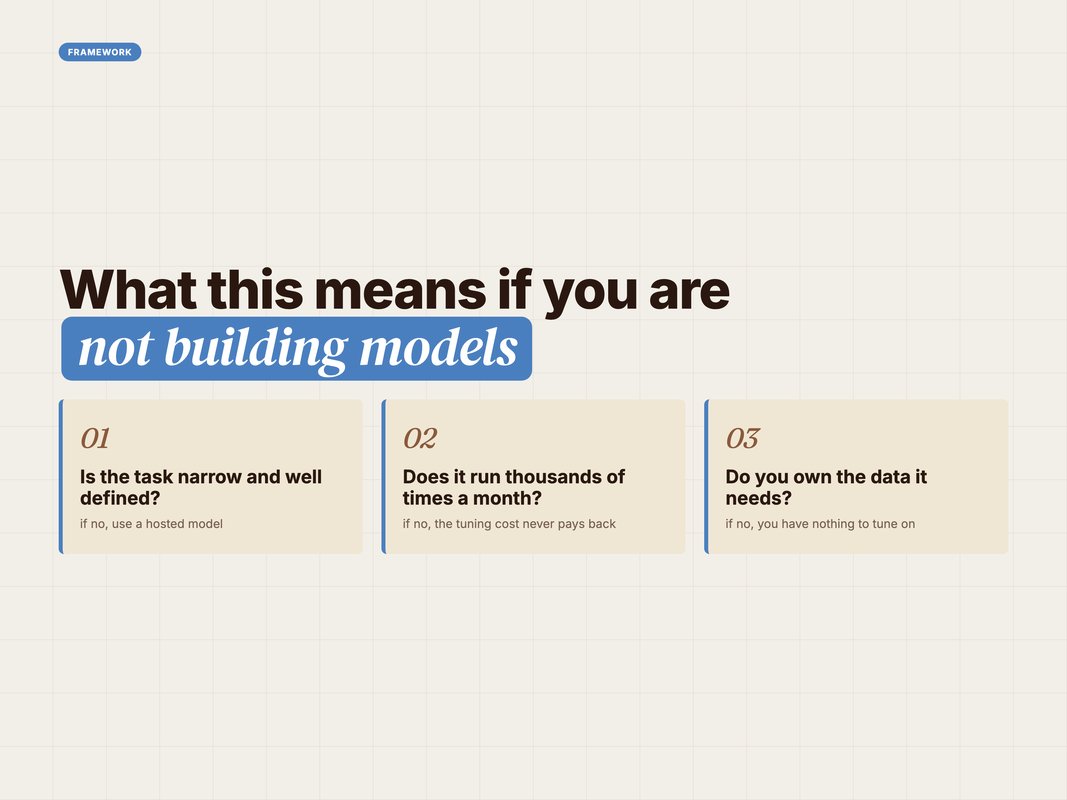
The test is simple. Ask three things.
Is the task narrow? Does it run thousands of times? Do you own the data it needs?
Three yes answers, and an open model starts to make sense. Anything less, and it does not.
Most teams stop at the first question. That is usually the right place to stop.
When an open model is actually the right call
Four situations where this genuinely applies to marketing work.
Data that cannot leave. Healthcare, financial services and regulated categories often cannot send customer data to a third-party API. A self-hosted open model solves that.
A narrow task at huge volume. Classifying a million support tickets. Tagging a product catalogue. Scoring leads on a fixed rubric. Fine-tuned small models beat general large ones on cost here.
Latency that matters. If the output sits inside a live product experience, self-hosting near your users can beat an API round trip.
A house style nothing else captures. A model tuned on your own approved copy can hold a brand voice more tightly than a prompt can.
Note that three of those four are engineering problems, not marketing ones. That is the honest shape of it.
If none of the four applies, keep using a hosted model. Spend the saved effort on your data instead.
That is not a throwaway line. The gap between teams getting value from AI and teams not is almost never the model.
It is whether the data is clean. Whether the task is well defined. Whether someone checks the output.
A better model does not fix a vague brief. It just produces a more confident version of the wrong thing.
How to actually try it
You do not need a GPU cluster to look at this.
Weights sit on Hugging Face, in both original and NVFP4 checkpoint versions. Fine-tuning runs on Tinker, with 64K and 256K context options (Source: Thinking Machines Lab, 2026 — thinkingmachines.ai).
If you just want API access, it is served by Together AI, Fireworks, Modal, Databricks and Baseten.
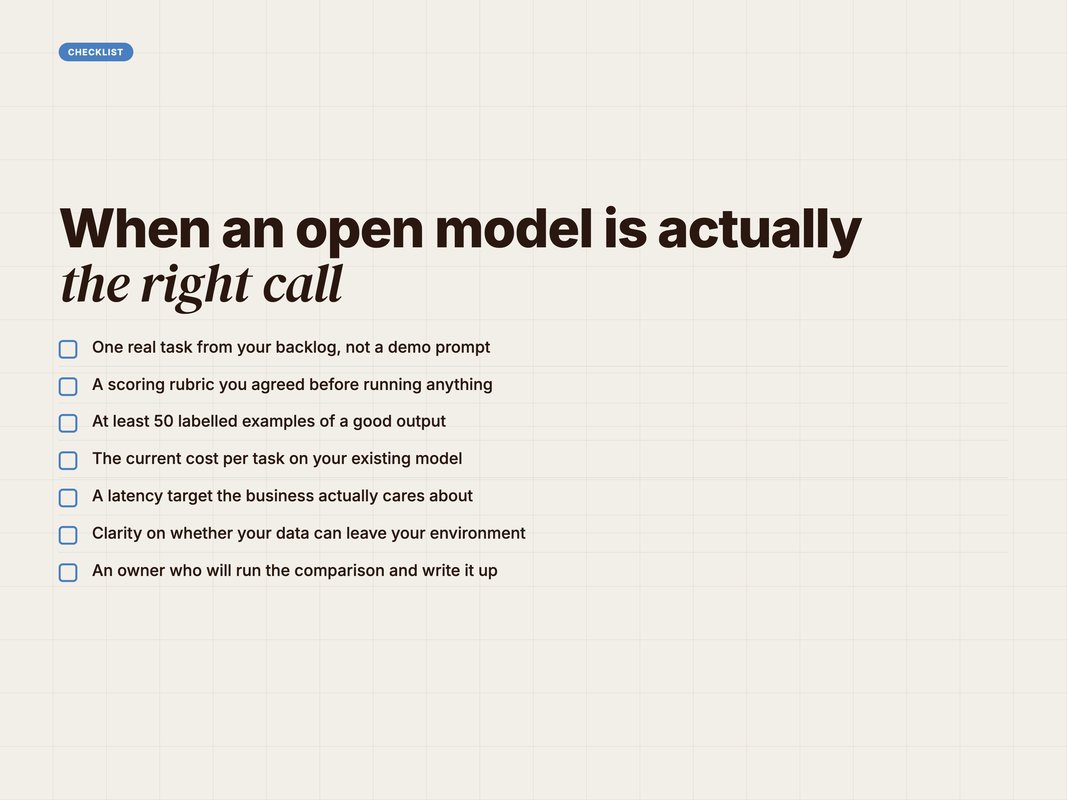
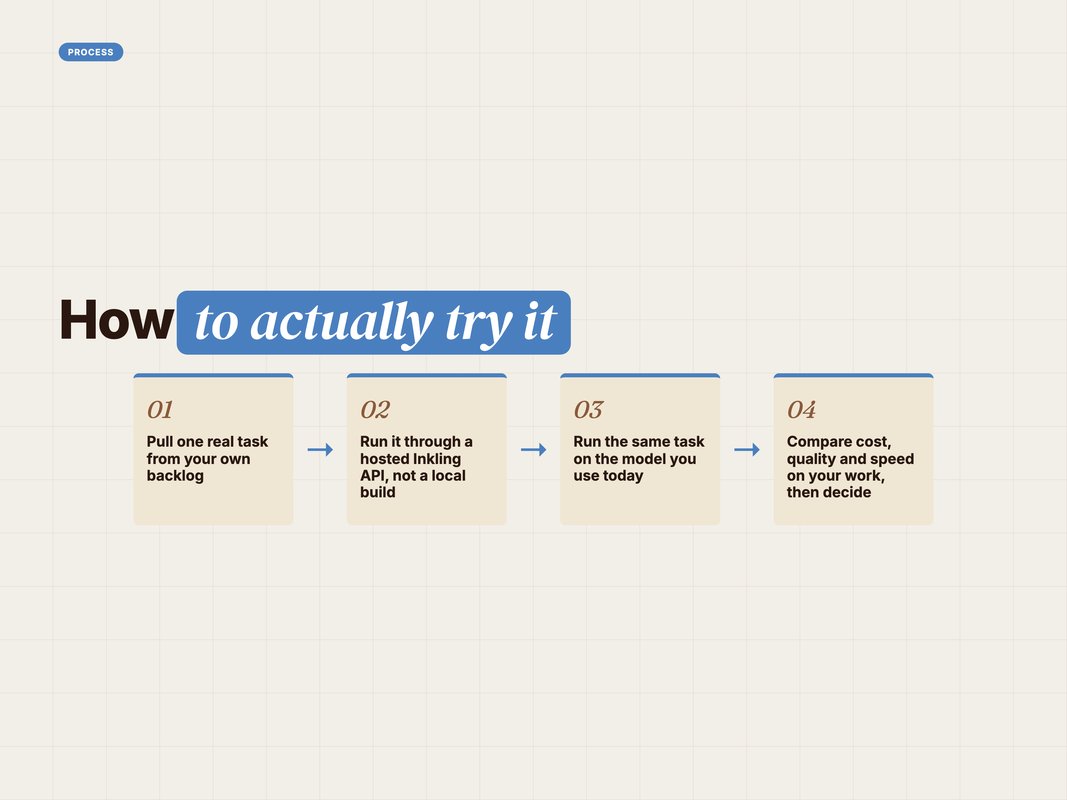
Start with the hosted API and a real task from your own backlog. Run the same task on the model you use today. Compare cost, quality and speed on your work, not on a leaderboard.
That takes an afternoon and tells you more than any benchmark table.
What we do at YARD
We are an AI-first growth marketing agency. We run performance marketing, LLM SEO, AI creative and AI funnels for D2C and B2B brands.
Model launches like this one create a specific kind of noise. Every week brings a new model and a new claim. Most of it changes nothing about what a marketing team should do on Monday.
So we run a standing evaluation set instead of chasing releases. A fixed batch of real tasks from client work: ad copy variants, blog structuring, product data cleanup, review classification. Every new model runs the same batch.
Most models score close on quality. The differences show up in cost, speed and how well they follow a long brief. That is what actually decides which model does which job in a pipeline.
Inkling went through that batch. It is capable, it is genuinely open, and for our general content work a hosted model still wins. For a client with data that cannot leave their environment, it changed the answer.
That is the useful way to read a launch like this. Not "is it better", but "does it change the answer for any job I already have".
The takeaway
Inkling is a large, open, multimodal model released under Apache 2.0 by Thinking Machines Lab. Inkling-Small is the more practical of the two, and cheaper by more than three times.
Neither is the best model available, and the lab does not claim otherwise. What they offer is a strong base you can own, tune and run yourself.
For most marketing teams, that is not this quarter's problem. For teams with locked-down data or one narrow task at massive volume, it might be.
Run your own tasks through it before forming a view. An afternoon of testing beats a month of reading launch coverage.
You can book a call with our team if you want help building an evaluation set for your own stack.
FAQ
Q: What is Inkling?
A: Inkling is the first open-weights model from Thinking Machines Lab, released on 15 July 2026. It has 975B total parameters with 41B active, a 1M token context window, and reads text, images and audio.
Q: What licence is Inkling released under?
A: Apache 2.0. That is a permissive licence, so you can use, modify and deploy it commercially. The weights are published on Hugging Face.
Q: Is Inkling better than GPT or Claude?
A: No, and Thinking Machines does not claim it is. They position it as a good open base for customisation, not the strongest model available. It scored 97.1% on AIME 2026 and 77.6% on SWEBench Verified.
Q: What is Inkling-Small?
A: A lighter version released on 30 July 2026, with 276B total parameters and 12B active. It matches Inkling on many tasks at a quarter of the size, and costs $1.20 per million output tokens against $4.05.
Q: Should a marketing team use Inkling?
A: Only if you have a repeated, narrow task and a reason to own the model. For general drafting and analysis, a hosted frontier model is cheaper and better. Inkling wins on fine-tuning and data control.
Q: Where can I run Inkling?
A: Weights are on Hugging Face. It is available for fine-tuning on Tinker, and through APIs from Together AI, Fireworks, Modal, Databricks and Baseten.
Insights from Our Experts
Explore our latest articles on digital marketing strategies.