

DeepSeek took V4 Pro out of preview on August 13, 2026. The change is listed in the company's API changelog.
That is the news. The bill is the story.
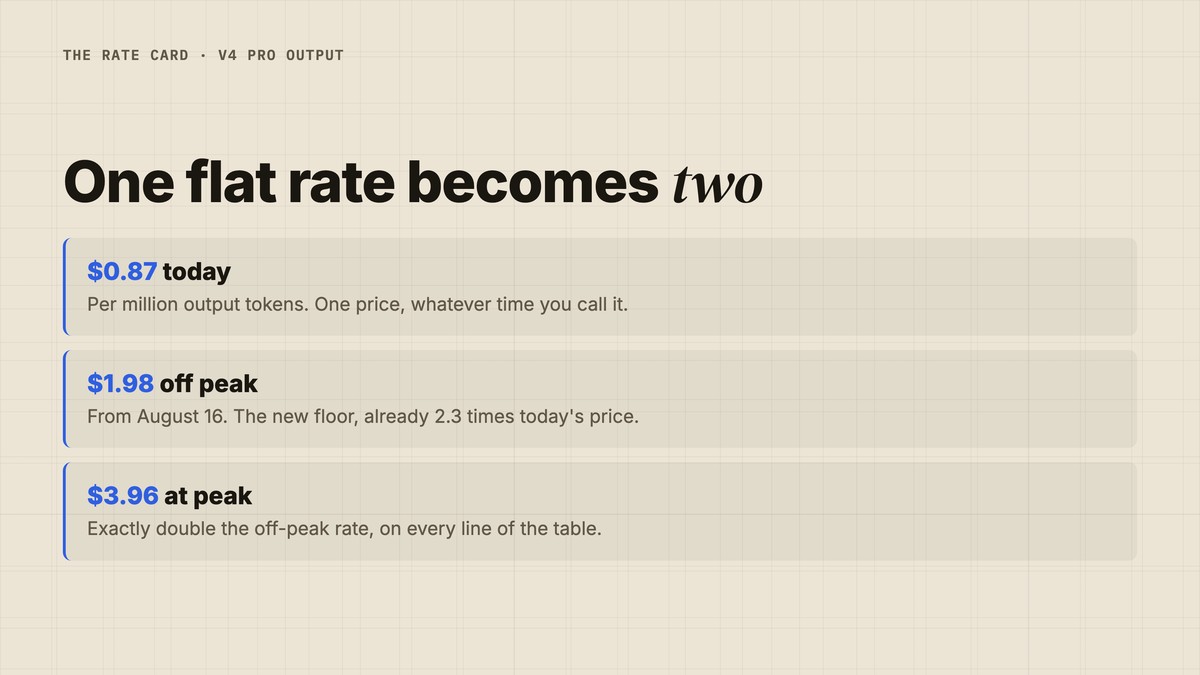
From August 16, DeepSeek moves to peak and off-peak pricing. Output tokens go from $0.87 per million to $1.98 off peak. At peak they go to $3.96. Those figures sit in DeepSeek's own pricing table.
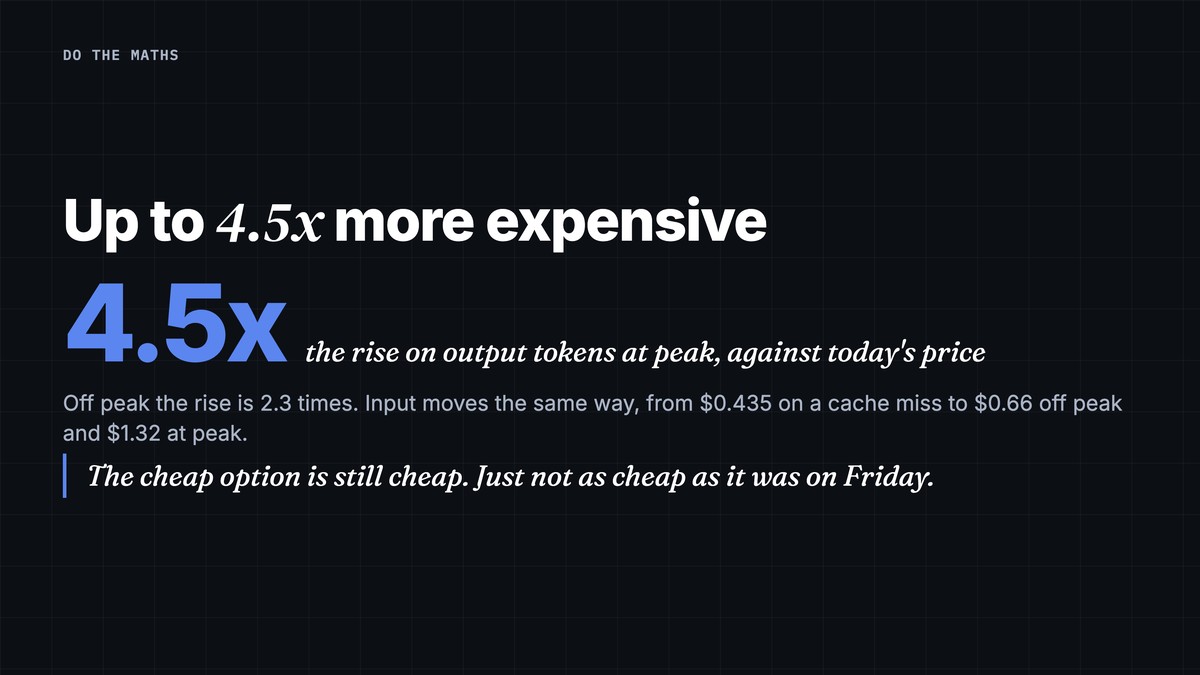
Run the maths. Off peak, output costs 2.3 times what it costs today. At peak, it costs 4.5 times.
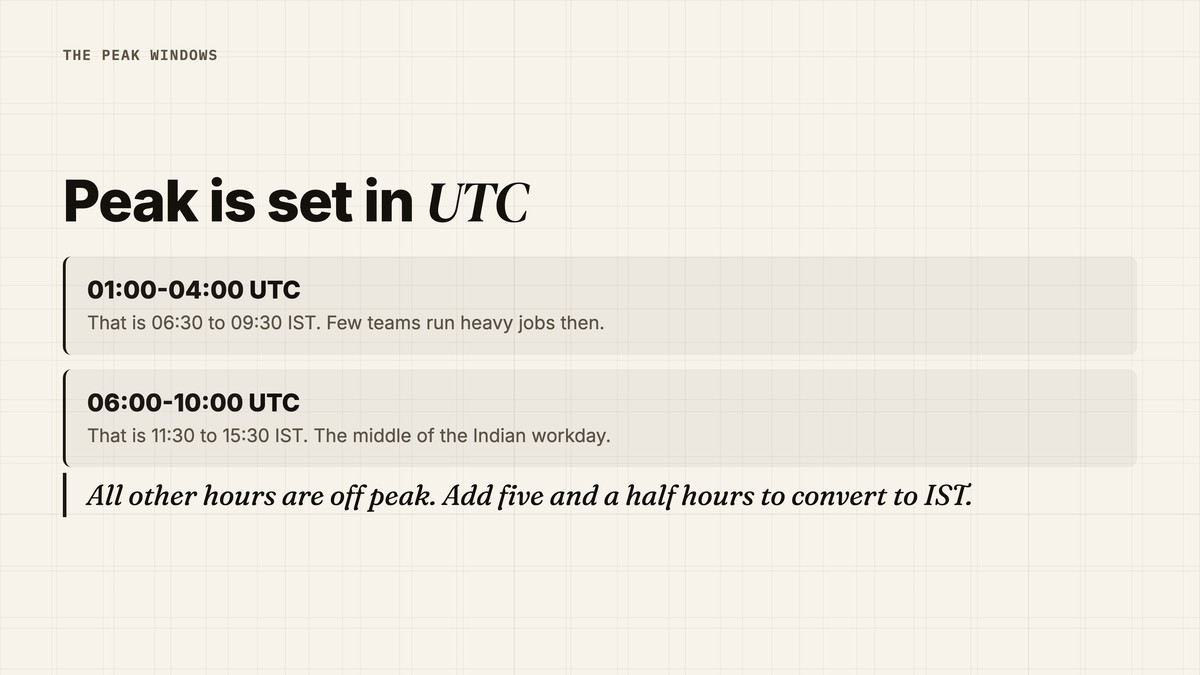
Now the part that matters if you work in India. Peak hours are 01:00 to 04:00 and 06:00 to 10:00 UTC. In IST, that second window is 11:30 to 15:30.
That is the middle of your working day.
Here is what shipped, what the new rate card looks like, and the one scheduling change worth making before Saturday.
What DeepSeek actually shipped
V4 Pro is no longer a preview. The general release is the build tagged 0813.
You call it with the model name deepseek-v4-pro. The preview ran for close to four months before this.
Three things are new in the changelog. Each one points at agents rather than chat.
The company says agent abilities are much improved, with real gains in production. It also added three thinking effort levels. You can pick low, high or max.
The third change is quieter and more useful. V4 Pro now supports the Responses API natively, for Codex compatibility.
Context is large. The model takes one million tokens in and can return up to 384,000.
Quick Facts: DeepSeek V4 Pro at a Glance
- Left preview on August 13, 2026, as build 0813 — (Source: DeepSeek, 2026 — API changelog)
- Priced today at $0.435 per million input tokens on a cache miss and $0.87 per million output — (Source: DeepSeek, 2026 — pricing page)
- From August 16, output costs $1.98 off peak and $3.96 at peak — (Source: DeepSeek, 2026 — pricing page)
- Peak hours are 01:00 to 04:00 and 06:00 to 10:00 UTC — (Source: DeepSeek, 2026 — pricing page)
- Context is 1M tokens with 384K maximum output — (Source: DeepSeek, 2026 — pricing page)
The new rate card, in plain numbers
Today the price is flat. It does not matter when you call the model.
From August 16 that changes. Here is the full table for both models.
| Model and window | Cache hit | Cache miss | Output |
|---|---|---|---|
| V4 Pro — today | $0.003625 | $0.435 | $0.87 |
| V4 Pro — off peak | $0.022 | $0.66 | $1.98 |
| V4 Pro — peak | $0.044 | $1.32 | $3.96 |
| V4 Flash — today | $0.0028 | $0.14 | $0.28 |
| V4 Flash — off peak | $0.007 | $0.22 | $0.66 |
| V4 Flash — peak | $0.014 | $0.44 | $1.32 |
All figures are per million tokens.
Read the V4 Pro rows first. Output rises from $0.87 to $1.98 even at the cheaper rate. That is the floor, not the ceiling.
Peak is exactly double off peak. That holds on every line of the table.
Flash moves the same way. Output goes from $0.28 to $0.66 off peak and $1.32 at peak.
So the cheap option is still cheap. It is just no longer as cheap as it was on Friday.
Why the clock now sits on your invoice
Time-of-day pricing is normal in other industries. Electricity works this way. So does airline seat inventory.
It is new in AI, and it changes how you plan work.
Peak runs 01:00 to 04:00 and 06:00 to 10:00 UTC. Everything else is off peak.
Convert that to IST by adding five and a half hours. The windows become 06:30 to 09:30 and 11:30 to 15:30.
Look at the second one again. For most Indian teams, 11:30 to 15:30 is the busiest stretch of the day.
That is when people run campaign drafts. It is when reports get pulled and decks get built. It is also, from Saturday, the most expensive time to do any of it.
The first window matters less. Few teams are running heavy jobs at 06:30 IST.
So the exposure is concentrated in one four-hour block. That is a narrow problem, which makes it a fixable one.
It is worth understanding why a provider does this. Serving capacity is finite and demand is not flat. When everyone calls the model at once, the provider either buys more hardware or prices the rush.
Pricing the rush is cheaper. It also nudges flexible work into quieter hours, which is the point.
Note that the windows are set in UTC, not in your local time. If your team works across regions, each office sits in a different part of the curve. A London team and a Singapore team will not share the same peak in local terms.
That is worth checking once and writing down. Nobody wants to rediscover it from an invoice.
The scheduling change worth making
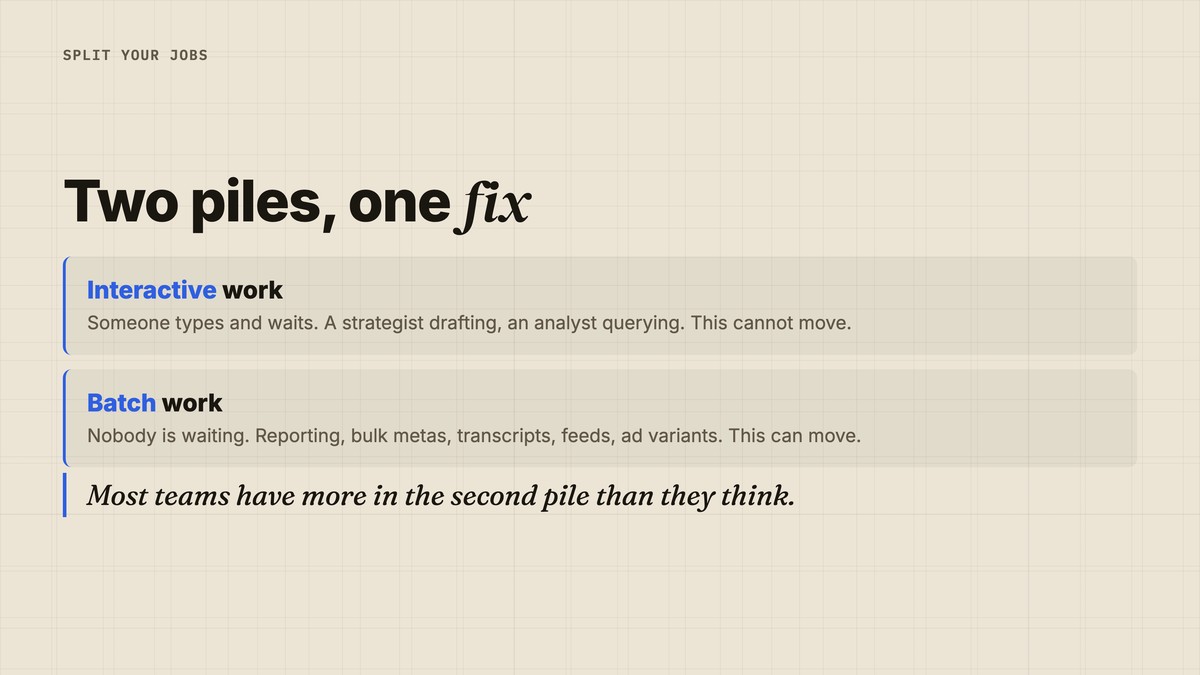
Split your usage into two piles. The split decides how much of this you can avoid.
The first pile is interactive. Someone types a prompt and waits. A strategist drafting copy, an analyst asking a question of a dataset, a writer reworking a headline.
That work has to happen when people are at their desks. You cannot move it, and you should not try.
The second pile is batch. Nobody is waiting on it.
Overnight reporting sits here. So does bulk meta description generation, transcript summarising, product feed enrichment, ad variant production and any scheduled data pull.
Most teams have more in the second pile than they think. It has simply never mattered when it ran.
From Saturday it matters. Anything in the second pile that currently fires at 13:00 IST is paying double for no reason.
Sorting the two piles is the whole exercise. Once a job is labelled, the fix is a scheduler setting.
This is a small change with a real number attached.
Move batch jobs to after 15:30 IST. That is the moment the second peak window closes.
Anything running between 15:30 IST and 06:30 IST the next morning is off peak. That is a fifteen-hour window, and it covers every overnight job you already run.
There is a second safe pocket between 09:30 and 11:30 IST. It is short, but it is off peak.
Put rough numbers on it. Say a team burns twenty million output tokens a month on batch work. At the new peak rate that costs $79.20. Off peak it costs $39.60.
The saving is about $40 a month on that workload. It is not a fortune. It also takes one afternoon to arrange and then never needs doing again.
Scale the numbers to your own volume before you decide it is too small to bother with. Teams running heavy summarisation pipelines will land on a much larger figure.
What the benchmarks say, and what they do not
DeepSeek published agent scores with this release. They sit in the changelog.
Terminal Bench 2.1 comes in at 87.9. HLE scores 42.7 without tools and 60.0 with them. NL2Repo reaches 61.5, AutomationBench (Public) 31.8, and DSBench-Hard 67.2.
Those are strong figures for a model at this price.
The three effort levels matter here too. Low, high and max let you trade depth against spend on a per-call basis.
That control pairs well with the new rate card. A job that has to run at peak can run at a lower effort level to soften the cost. A job that moved off peak can afford more thinking.
Treat effort and timing as two dials on the same budget. Most teams currently use neither.
Now a warning, because this week invites a bad comparison.
SpaceXAI shipped Grok 4.6 a day earlier. Its launch post reports a Terminal-Bench v3.0 score of 26%. DeepSeek reports 87.9 on Terminal Bench 2.1.
Do not put those two numbers side by side. They are different versions of the benchmark, run under different conditions. A v3.0 score and a 2.1 score are not comparable, and treating them as such would tell you the opposite of the truth.
This is the same trap as reading a composite leaderboard. The number is only meaningful next to the exact thing it measured.
If you want to know which model is better for your work, the answer has not changed. Run your own inputs through both.
How this lands next to the rest of the week
Two model stories broke within a day of each other. They point in opposite directions.
Grok 4.6 arrived at $6 per million output tokens, undercutting the models it ties on the headline index. Frontier quality got cheaper. That line has been moving for a while. Grok 4.5 landed at Opus-class quality for a quarter of the price back in July.
DeepSeek went the other way. The cheapest credible option raised its price by between 2.3 and 4.5 times.
Both moves say the same thing about planning. Model pricing is not a fixed input any more.
It changes between releases. It now changes between hours of the day. A budget built on last quarter's rate card is already out of date.
The same pattern showed up when Alibaba's Qwen model was graded on running a shop for a year. The industry keeps moving the thing being measured and the thing being charged for.
The practical answer is unglamorous. Track your rate card the way you track media rates.
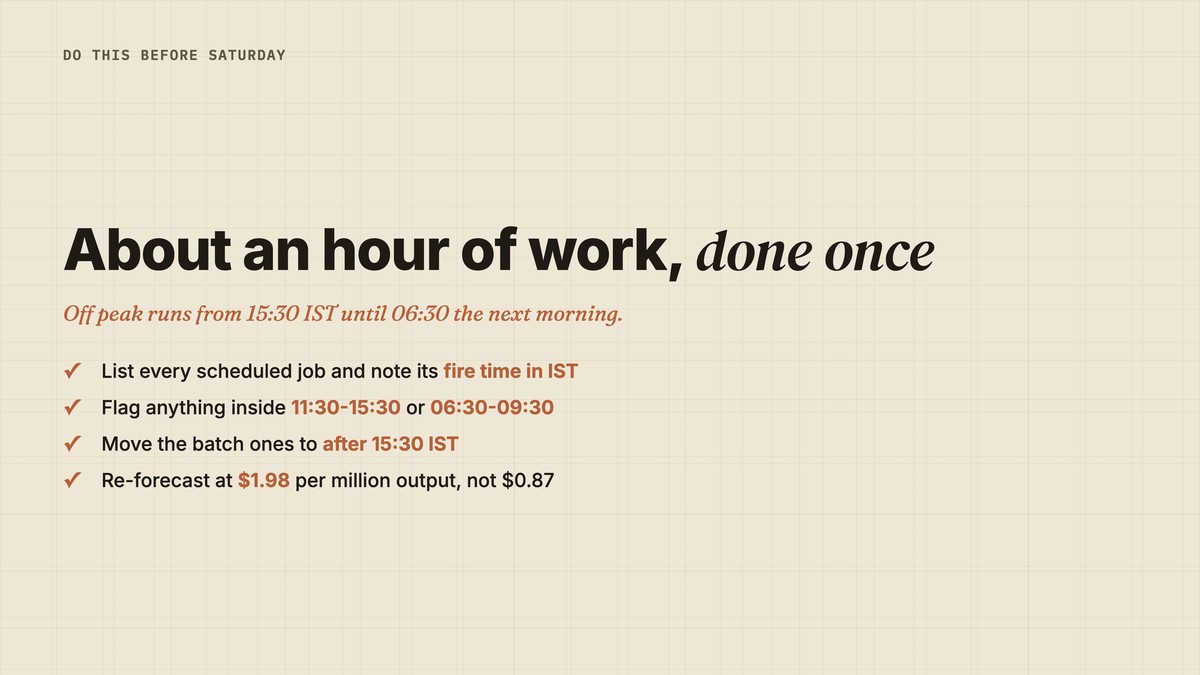
Do this before Saturday
Four steps. It takes about an hour.
- List every scheduled job that calls DeepSeek. Note the time each one fires, in IST.
- Flag anything running between 11:30 and 15:30 IST or between 06:30 and 09:30 IST. Those are your peak jobs.
- Move every batch job on that list to after 15:30 IST. Leave interactive use alone.
- Recalculate your monthly estimate at $1.98 per million output tokens, not $0.87. Share the new figure before the invoice does it for you.
One more thing worth doing while you are in there. Check your cache hit rate.
Cache hits stay dramatically cheaper than misses on the new table. At off peak a hit costs $0.022 against $0.66 for a miss. Stable prompt prefixes are worth real money here.
A cache hit needs the front of your prompt to stay byte for byte identical. Anything that changes every call breaks it.
The usual culprits are small. A timestamp in the system prompt, a session ID, or a freshly shuffled list of examples will each do it. Move those to the end of the prompt and keep the stable part first.
That single change often saves more than the scheduling fix does.
The YARD take
The interesting thing about this release is not the model. It is the rate card.
DeepSeek built its reputation on being the cheap frontier option. That reputation is now three days from being partly out of date, and the company has published exactly how.
Credit where it is due. The pricing page is clear and the change is announced in advance. That is more than some launches manage.
Our view is that this is where the market is heading. As demand concentrates in working hours, more providers will price by the clock. Teams that already know which of their jobs can wait will barely notice.
There is a wider lesson for anyone building on cheap models. A low price is a feature, and features change.
If your business case only works at $0.87 per million output tokens, it is not a business case. It is a bet on someone else's pricing page. Build the maths so it still holds at two or three times the rate.
That is not a reason to avoid cheap models. It is a reason to know your break-even before you scale a workflow onto one.
So do the boring hour of work. Sort your jobs into interactive and batch, move the batch ones after 15:30 IST, and update the forecast.
Then write the new rate into whatever document your team actually reads. A number that lives only in a changelog is a number nobody plans around.
FAQ
Q: What is DeepSeek V4 Pro?
A: It is DeepSeek's flagship model, which left preview on August 13, 2026. The general release is build 0813, called with the model name deepseek-v4-pro.
Q: How much does DeepSeek V4 Pro cost right now?
A: It costs $0.435 per million input tokens on a cache miss, $0.003625 on a cache hit, and $0.87 per million output tokens.
Q: What changes on August 16?
A: Pricing splits into peak and off-peak. Output rises to $1.98 off peak and $3.96 at peak. Input rises to $0.66 and $1.32.
Q: When are DeepSeek's peak hours?
A: Peak is 01:00 to 04:00 and 06:00 to 10:00 UTC. In IST that is 06:30 to 09:30 and 11:30 to 15:30. All other hours are off peak.
Q: How do we avoid the peak rate?
A: Move batch jobs to after 15:30 IST. Interactive work has to stay where your people are, so focus on scheduled jobs only.
Q: How does V4 Pro compare to Grok 4.6 on agent work?
A: You cannot compare them directly from the published numbers. DeepSeek reports Terminal Bench 2.1 and SpaceXAI reports Terminal-Bench v3.0. Different versions, so run your own test instead.
Q: What context window does V4 Pro have?
A: One million tokens, with a maximum output of 384,000 tokens.
Sources
- DeepSeek — API changelog (August 13, 2026; primary source for the release, effort levels and agent benchmarks)
- DeepSeek — API pricing (primary source for current and peak/off-peak pricing, context and peak hours)
- Analysis from Unite AI — DeepSeek ships V4 Pro as its flagship model leaves preview (August 12, 2026; architecture and licence detail)
- Reuters — DeepSeek releases official V4 Pro model as it steps up expansion (August 13, 2026)
Insights from Our Experts
Explore our latest articles on digital marketing strategies.