

In fintech, trust is not a brand value. It is the product.
A customer hands you their money, their data, or both. One misleading ad can undo years of goodwill. So can one pushy loan screen, or one creator who promises too much.
AI raises the stakes. It lets a team make ten times more ads, messages and pages. It also lets a team ship ten times more mistakes. In finance, mistakes draw the attention of regulators.
This playbook covers why trust is fragile in Indian fintech. It sets out what the rules now ask of your marketing, for loans, investments and insurance. It covers the checks Google and Meta run, and where AI is safe to use. It ends with a trust-first process you can start this quarter.
One note first. This is general information for marketers, not legal advice. Take anything specific to your compliance team.
Quick Facts: Fintech Marketing in India at a Glance
- Some 84% of Indians trust companies in the financial services sector, against a 63% global average — (Source: Edelman Trust Barometer, 2026 — edelmansmithfield.com).
- UPI handled about 24.51 billion transactions in August 2026 — (Source: NPCI, 2026 — npci.org.in).
- Google has checked financial services advertisers in India since 24 January 2023 — (Source: Google, 2026 — support.google.com).
- ASCI found 97.3% of the influencer ads it processed in FY 2025-26 needed changes — (Source: ASCI, 2026 — ascionline.in).
- Only 20.8% of the RBI-regulated firms surveyed were using or building AI systems — (Source: RBI FREE-AI Report, 2025 — rbidocs.rbi.org.in).
Why trust is the whole game in fintech
Indians trust their money firms more than most people do. In the 2026 Edelman Trust Barometer, 84% of Indians said they trust companies in the financial services sector. The average across 28 countries was 63% (Source: Edelman Trust Barometer, 2026 — edelmansmithfield.com).
That is an asset. It is also a high place to fall from.
The digital money habit is huge. UPI handled about 24.51 billion transactions in August 2026, worth about ₹29.82 lakh crore (Source: NPCI, 2026 — npci.org.in). People trust digital payments enough to use them every day.
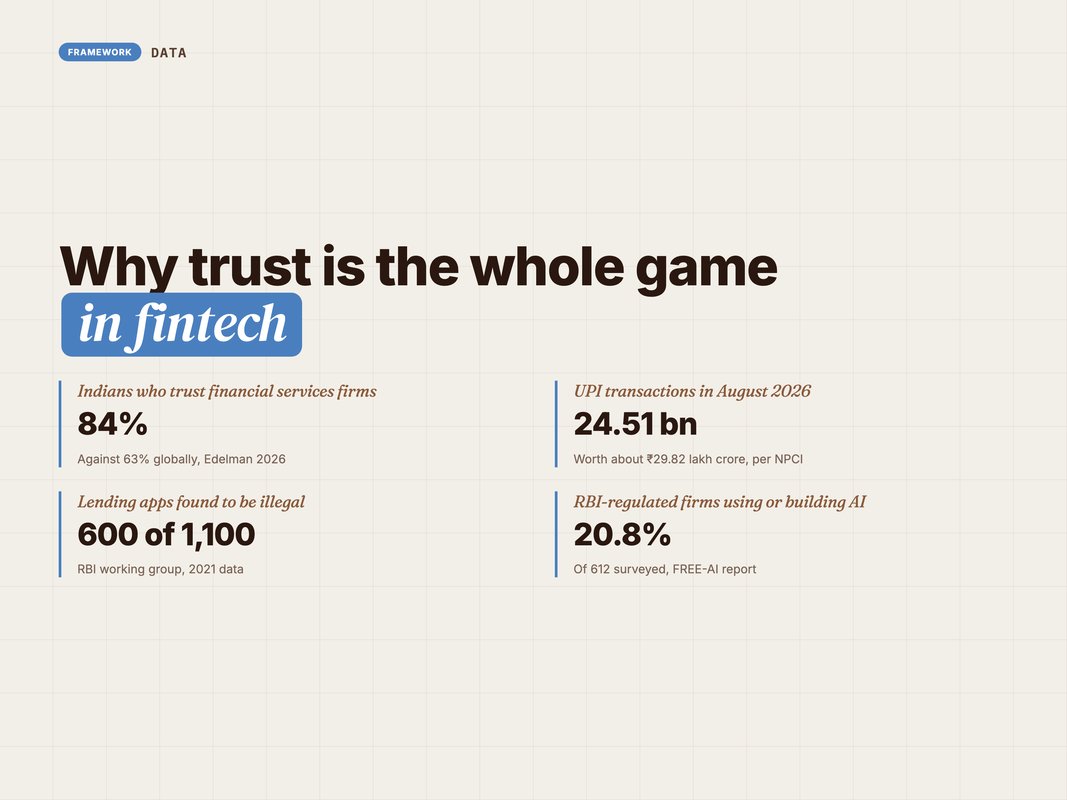
But the sector has a memory of bad actors. In 2021, an RBI working group found that 600 of the roughly 1,100 lending apps then available were illegal (Source: RBI Working Group on Digital Lending, 2021 — rbidocs.rbi.org.in). That data is old. But it shaped the rules that came after.
So every fintech ad is read against that past. A claim that sounds too good raises doubt. So does a screen that feels like a trap, or a creator who sounds like a tout.
The brands that win here treat clarity as a way to grow. Clear prices. Clear lenders. Clear risks. It converts better, because it feels safe.
What RBI's lending rules mean for your marketing
RBI pulled its lending conduct rules into new directions in November 2025. They now sit in each type of lender's own rules for credit, and several parts reach into marketing (Source: RBI, 2025 — rbi.org.in).
Here is what they mean in practice.
| RBI requirement | What it means for marketing |
|---|---|
| Show all matching loan offers side by side | A loan marketplace cannot show only its favourite lender |
| Name every lender, with amount, tenor, APR and charges | The offer view must carry lender names and full terms |
| Content must be fair, with no dark patterns | No design tricks that steer people to one offer |
| A place in RBI's app directory is not approval | Never write "RBI approved" because you are listed |
| Key facts in a language the borrower understands | Regional ads need key facts in that language too |
The first four rows come from RBI's credit rules (Source: RBI, 2025 — rbi.org.in). The last comes from RBI's rules for NBFCs (Source: RBI, 2025 — rbi.org.in).
The dark-pattern rule matters most for growth teams. RBI says what a lending app shows must be unbiased and objective. It must not push one lender's product, directly or indirectly. That includes dark or deceptive patterns.
That rules out a lot of common growth tricks. Think of these:
- An offer that is ticked by default.
- A "recommended" badge that is really a paid slot.
- A countdown timer on a loan offer.
- A cheaper option hidden behind an extra click.
If a design exists to steer rather than to inform, treat it as a risk.
Recovery messages have rules too. Under the NBFC rules, recovery must not involve abusive messages on mobile or social media, or threats. It must not involve calls before 8 a.m. or after 7 p.m. either (Source: RBI, 2025 — rbi.org.in). If your team sends automated reminders, those limits apply to the automation.
Q: Do these rules apply to a marketing agency?
A: They bind the lender and its lending partners. But the agency builds the ads and screens that must follow them. In practice, anyone who designs a loan journey needs to know them.
Investment, insurance and finfluencers
Investment and insurance ads have their own rules. Creators sit at the centre of them.
SEBI's 2023 ad code for investment advisers and research analysts bans any promise of assured or risk-free returns. It also bars the SEBI logo from ads (Source: SEBI, 2023 — sebi.gov.in).
In October 2024, SEBI went further. Firms it regulates may not work, directly or indirectly, with anyone who gives advice without being registered. The same applies to anyone who makes claims about returns or performance (Source: SEBI, 2024 — sebi.gov.in).
That is the finfluencer rule. It changes who a broker, fund or wealth app can pay to promote it.
There is a rule for educators too. SEBI's clarification was updated in May 2026. It bars them from naming a security using the last 30 days of market prices (Source: SEBI, 2026 — sebi.gov.in).
ASCI adds its own layer. Its guidelines say finance creators who talk about stocks or investments should be registered with SEBI. They should also show their SEBI number (Source: ASCI, 2023 — ascionline.in). In April 2025, ASCI narrowed that rule to cases where technical advice is given (Source: ASCI, 2025 — ascionline.in).
ASCI is active on this. In FY 2025-26, it processed 1,609 ads for influencer breaches, and 97.3% needed changes (Source: ASCI, 2026 — ascionline.in).
Insurance has its own limits. IRDAI's rules bar insurance ads that show the benefits without a fair view of the risks. Unit-linked plans must not be sold as investment products (Source: IRDAI, 2024 — irdai.gov.in).
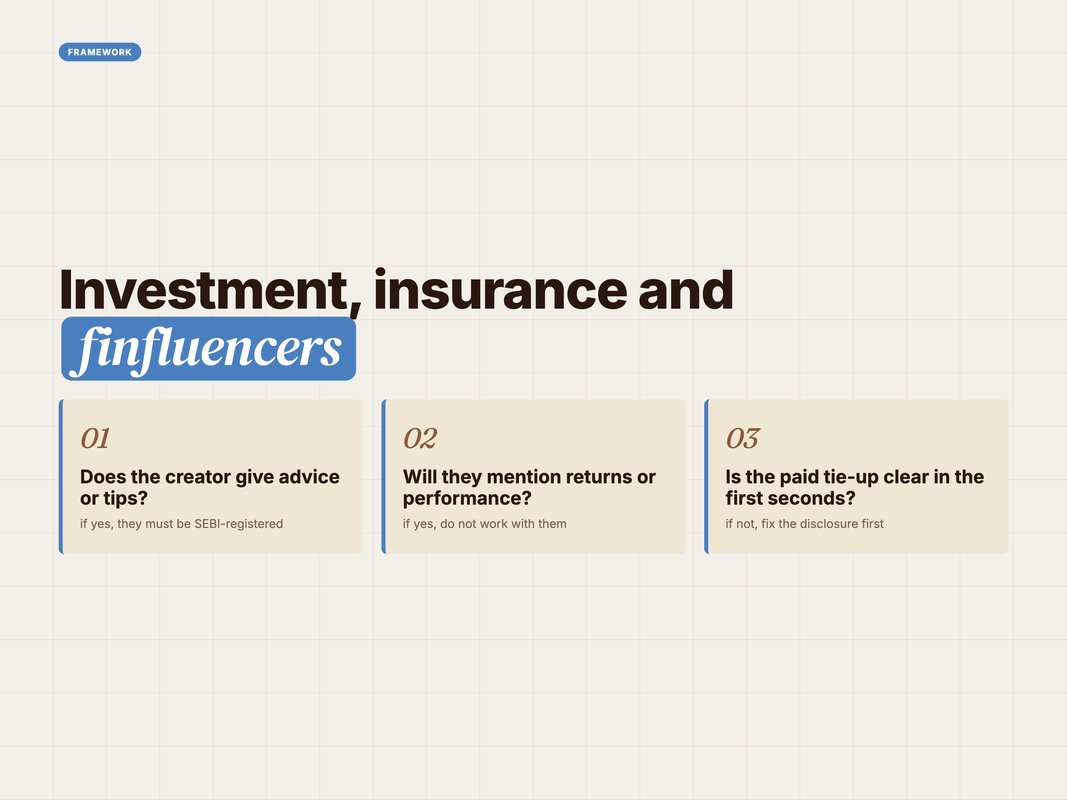
If you do work with creators, the brief does most of the work. Write it before you sign anyone.
Say what the creator can talk about: the app, the features, how it felt to use. Say what they cannot talk about: returns, tips on what to buy, and anything that sounds like advice.
Ask for the post before it goes live. Check it against your claims sheet, the same way you would check an ad.
And keep the disclosure clear. A viewer should know in the first few seconds that the post is paid.
Google and Meta will check you first
Before a regulator sees your ad, a platform will.
Google checks advertisers before they can run financial services ads in India. That covers ads shown to Indian users who seem to be looking for financial services. Google has enforced this since 24 January 2023 (Source: Google, 2026 — support.google.com).
Personal loans have extra conditions on Google. It only allows loans that must be repaid in full over 61 days or more. The landing page must show the maximum APR. It must also show a sample total cost of the loan, with all fees (Source: Google, 2026 — support.google.com).
Meta has its own gate for investment ads. Advertisers running securities and investment ads in India must confirm who is behind the ad with their SEBI details. Meta said it would enforce this from as early as 28 July 2025 (Source: Meta, 2025 — developers.facebook.com).
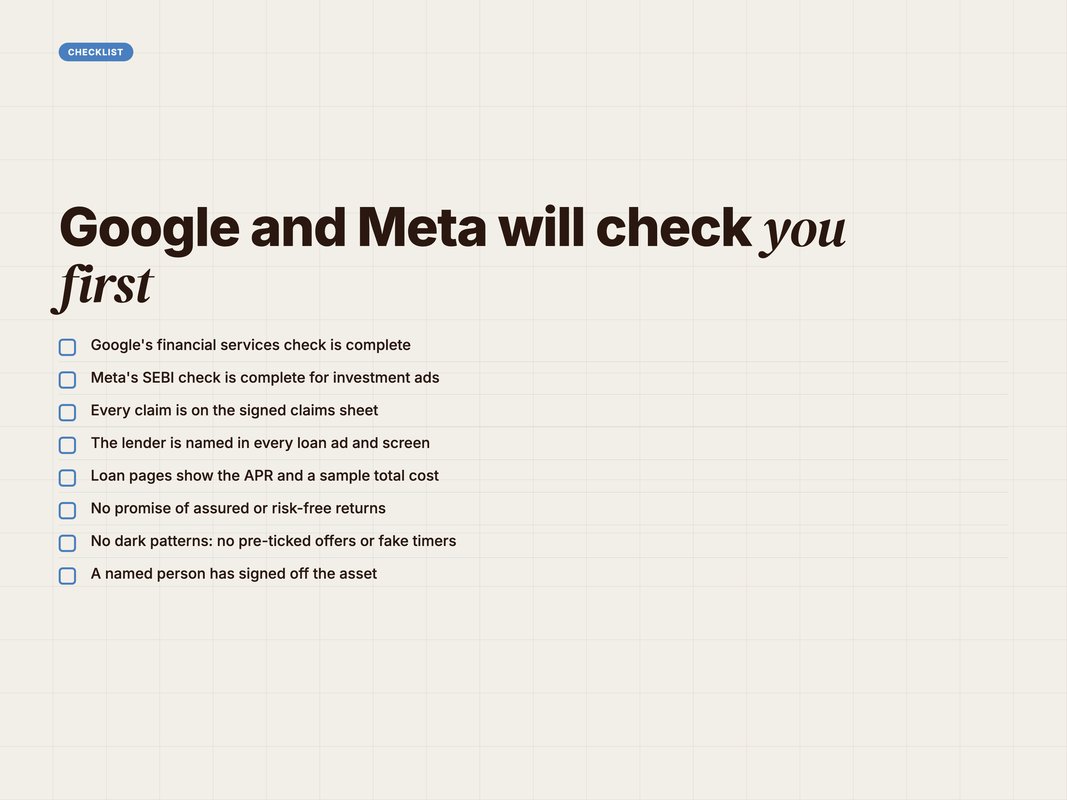
The lesson is to get checked before you plan. A campaign that cannot run because checks are pending is a wasted launch. Start the paperwork weeks before the ads.
Build your landing pages to the strictest standard too. If Google wants the APR and a sample total cost for loans, put them near the top. It keeps you within the rules. It is also what careful borrowers want to see first.
Our note on Google's new ad terms explains why AI-written ad copy needs extra care in finance.
How to write a fintech ad that passes
Most fintech ad problems come down to a few risky phrases. They are easy to spot once you know them.
| Risky line | Safer line |
|---|---|
| Guaranteed approval | Check if you are eligible in minutes |
| Zero charges, when other fees apply | No processing fee. Other charges are in the key facts |
| RBI approved app | Loans are provided by [lender name] |
| Earn high returns, risk free | Returns are not guaranteed. Read the risks first |
| Only 2 hours left for this rate | Remove it unless the deadline is real |
These are examples of wording, not legal sign-off. Your compliance team should approve the final lines.
A few habits make this easier.
Say who the lender is, every time. People trust a named bank or NBFC more than a vague brand promise.
Put the cost near the claim. If an ad talks about a fast loan, the rate and fees should be one click away, not five.
Keep urgency honest. A real deadline is fine. A fake timer is a dark pattern.
Test ads on a real phone, in the language they will run in. A key fact that is clear in English can get lost in a quick translation.
Keep a record of every approved ad and the claims sheet it came from. If a regulator or a platform asks, you can show your work in minutes.
Write for the reader who is worried, not the one who is excited. The worried reader is the one who complains, and the one who stays if you treat them well.
Where AI fits, and where it must not
AI is useful in fintech marketing. It is also where the new risks sit.
Use is still early among regulated firms. RBI's FREE-AI committee surveyed 612 of them. Only 20.8% were using or building AI systems (Source: RBI FREE-AI Report, 2025 — rbidocs.rbi.org.in). Sales and marketing made up 11.8% of the AI uses it found.
The blame is clear. Under a 2025 SEBI rule, a firm that uses AI is solely responsible for what those tools produce (Source: SEBI, 2025 — sebi.gov.in). It is also responsible for keeping to the law. Saying the AI wrote it is no defence.
Investment advisers must also tell clients how much they use AI in their advice (Source: SEBI, 2025 — sebi.gov.in).
RBI's FREE-AI report points the same way for customer chats. It says people should be told when they are dealing with AI. They should always be able to switch to a human (Source: RBI FREE-AI Report, 2025 — rbidocs.rbi.org.in). That is advice from a committee, not yet a binding rule.
ASCI is moving on AI in ads too. Its draft guidelines say fake endorsements or testimonials break its code, even with an AI label (Source: ASCI, 2026 — ascionline.in). The guidelines are still a draft.
So here is where we draw the line.
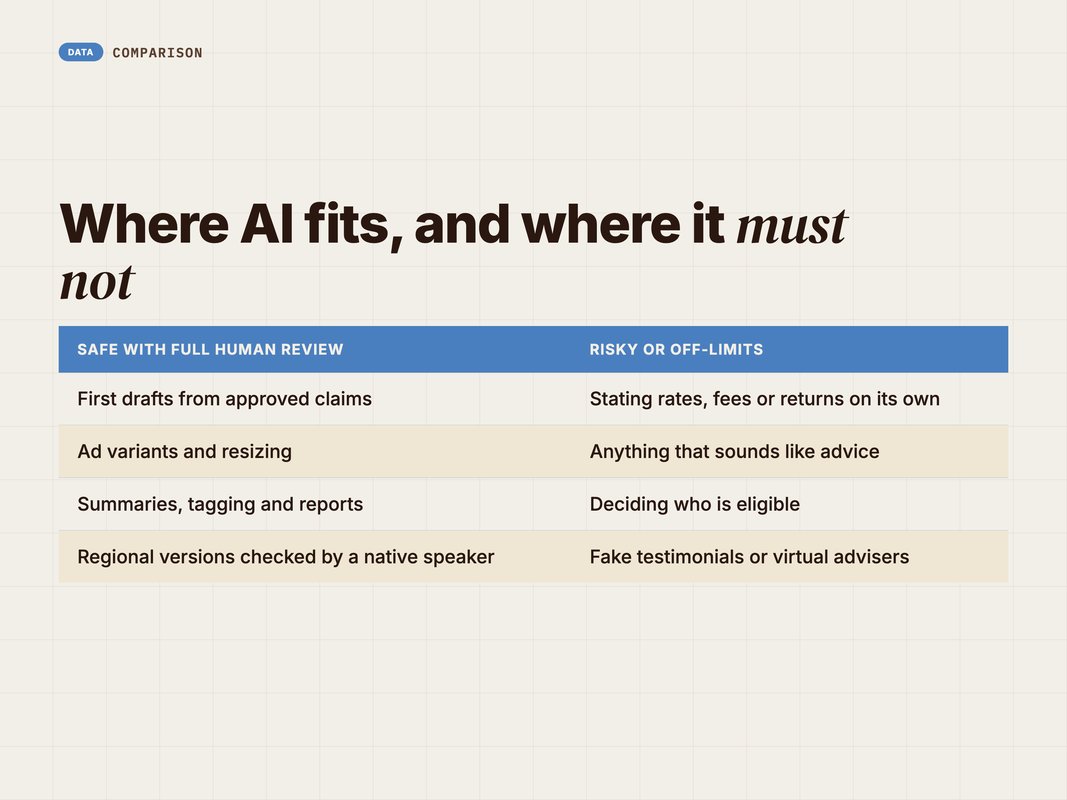
AI is safe for work a person will fully check. First drafts. Ad variants. Summaries. Tagging. Reports.
AI is risky anywhere it makes a claim a customer relies on. Rates. Fees. Returns. Who is eligible. Anything that sounds like advice.
And AI must never invent people. No fake customers giving testimonials. No virtual advisers shown as real ones. In a trust business, a fake face is the fastest way to lose everything.
Our note on Claude watermarking AI content shows where content labels are heading.
A trust-first marketing process
None of this means moving slowly. It means building the checks into the process, so speed does not create risk.
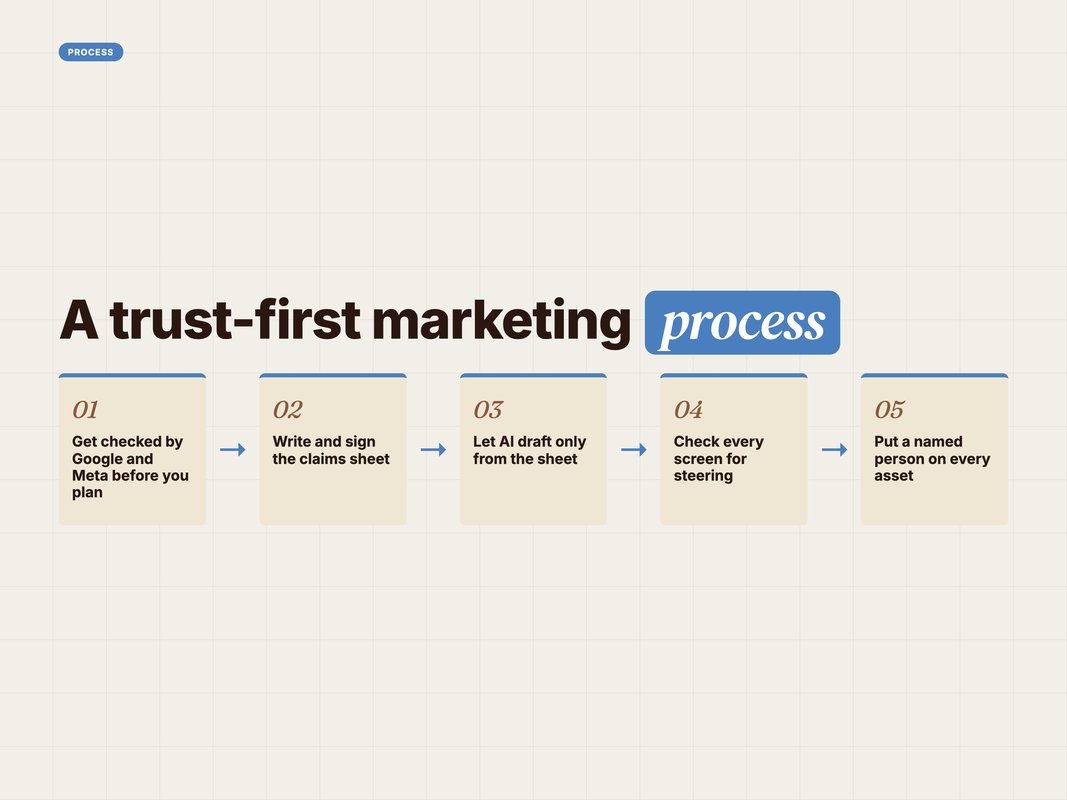
Step one: get checked before you plan. Finish Google's and Meta's checks before the campaign dates are set.
Step two: write the claims sheet first. List every rate, fee, return and eligibility claim the campaign will make. Get compliance to sign the sheet before any ad is drafted.
Here is what a claims sheet looks like.
| Claim | Approved wording | Where it may appear |
|---|---|---|
| Interest rate | Rates from X% a year, based on your profile | Ads and landing page |
| Fees | Processing fee up to Y% of the loan | Landing page and key facts |
| Speed | Decision in minutes for most applicants | Ads, only if true for most users |
| Lender | Loans are provided by [lender name] | Every loan ad and screen |
Swap in your own approved numbers. The point is that nothing reaches a customer unless it is on this sheet.
Step three: let AI draft only from the sheet. Give the model the approved claims and nothing else. Anything off the sheet does not ship.
Step four: check every screen for steering. Review loan journeys for dark patterns. No pre-ticked offers, fake urgency or hidden paid slots.
Step five: put a name on every asset. One person signs off each ad, page and message, and owns it if something goes wrong.
This is also how you move fast. A team with a signed claims sheet can make variants all week without waiting on legal for each one.
What we do at YARD
We are an AI-first growth marketing agency. We run performance marketing, LLM SEO, AI creative and AI funnels for D2C and B2B brands.
Finance needs a different rhythm from the rest of our work. We start with the checks. Platform approval. The claims sheet. A review of every loan or investment journey for steering.
Then we use AI where it is safe. Variants drawn only from approved claims. Regional versions checked by native speakers. Reports that show rule-checks next to results.
We plan creator work around the rules too. We confirm registration where advice is involved. We write briefs that rule out return claims before a creator starts filming.
The result is growth without new risk. In fintech, that is the only kind worth having.
For paid social, our guide to Meta's off-platform data change covers how it affects targeting.
The takeaway
Trust is the product in fintech, and AI makes it easier to lose.
RBI's loan rules call for clear, fair displays with every lender named. SEBI and ASCI police investment claims and creators. Google and Meta check you before you can run. And under SEBI's rules, you own whatever your AI tools produce.
So get checked first. Write the claims sheet before the ads. Let AI draft only from approved claims. Remove any design that steers. And keep a named person on every asset.
Do that, and speed stops being a risk.
If you want help building a trust-first process for your fintech brand, you can book a call with our team.
FAQ
Q: Do I need Google's verification to run fintech ads in India?
A: Yes. Google checks advertisers before they can run financial services ads in India. That includes ads shown to Indian users who seem to be looking for financial services. It has enforced this since 24 January 2023.
Q: Can a lending app say it is RBI approved because it is listed with RBI?
A: No. RBI's rules say a lending app's place in its directory must not be misrepresented in any ad or marketing material. Being listed is not the same as being approved.
Q: Can a fintech brand work with finfluencers?
A: Carefully. Firms that SEBI regulates cannot work with people who give advice without being registered, or who make claims about returns. ASCI also asks finance creators who give technical advice to show their SEBI number.
Q: Who is responsible when AI gets a financial claim wrong?
A: The company. Under a 2025 SEBI rule, a firm that uses AI is solely responsible for what those tools produce. The same logic applies to any marketing claim.
Q: Must customers be told when they are talking to AI?
A: RBI's FREE-AI committee says they should be told, and should always be able to reach a human. It is advice, not yet a rule. But it shows where the rules are going.
Q: Can lending apps promote one lender over others?
A: No. RBI's rules say what a lending app shows must be fair and unbiased. It must not push one lender's product, and that includes using dark patterns.
Insights from Our Experts
Explore our latest articles on digital marketing strategies.