

Diwali 2026 falls on Sunday, 8 November. Last year it fell on 20 October.
That 19-day shift sounds like a detail. It is not. It moves the sale season, the gifting window, the shipping cut-offs and the point where ad costs peak.
Brands that copy last year's calendar will spend at the wrong time. They will be loud before shoppers are ready and quiet when they are buying.
This playbook sets out the 2026 festive calendar. It covers what the 2025 season taught D2C brands and where the growth really is. Then it shows how to plan for rising ad costs. It ends with a phase-by-phase plan you can start eight weeks out.
It is written for Indian D2C founders and the performance marketers who run their festive budgets.
Quick Facts: Diwali 2026 at a Glance
- Diwali falls on Sunday, 8 November 2026 — (Source: DoPT holiday list via GConnect, 2025 — gconnect.in).
- In 2025, the first 11 days of festive sales brought in more than ₹60,000 crore — (Source: Redseer, 2025 — redseer.com).
- Some 60% to 65% of those shoppers came from Tier 2+ cities — (Source: Redseer, 2025 — redseer.com).
- Orders on brand sites rose 33% in the 2025 Diwali season — (Source: Free Press Journal, 2025 — freepressjournal.in).
- Meta says 77% of festive shoppers were inspired to buy by a personalised ad on its apps — (Source: Meta, 2025 — about.fb.com).
The 2026 calendar is 19 days later
Start with the dates, because everything else hangs off them.
| Festive moment | 2026 date |
|---|---|
| Navratri begins | Sunday, 11 October |
| Dussehra | Tuesday, 20 October |
| Dhanteras | Friday, 6 November |
| Diwali | Sunday, 8 November |
Diwali and Dussehra come from the central government's 2026 holiday list (Source: DoPT holiday list via GConnect, 2025 — gconnect.in). Navratri comes from Drik Panchang, set to New Delhi (Source: Drik Panchang, 2026 — drikpanchang.com). So does Dhanteras (Source: Drik Panchang, 2026 — drikpanchang.com).
For comparison, Lakshmi Puja in 2025 fell on Monday, 20 October (Source: Drik Panchang, 2025 — drikpanchang.com).
Three things follow from that shift.
The runway is longer. There are nearly three extra weeks between Navratri and Diwali. Shoppers will spread their buying across a longer season, not bunch it into one week.
Delivery cut-offs move. Gifting orders need to arrive before 6 November for Dhanteras. Set your shipping dates back from that date, not from last year's.
The ad peak moves. With Diwali on 20 October last year, the gifting peak landed in mid-October. This year it lands in early November. Plan your biggest creative push for then.
One caution. Big marketplace sale dates for 2026 were not confirmed when we checked. Plan around the festivals, which are fixed, rather than rumoured sale dates, which move.
Q: Why does a later Diwali matter for ads?
A: Because shoppers buy relative to the festival, not the calendar month. A later Diwali shifts peak demand, delivery deadlines and ad auction pressure into November. Budgets set on last year's dates will peak too early.
What last season taught D2C brands
The 2025 data has lessons that are easy to miss in the headline numbers.
Redseer tracked the first 11 days of the 2025 sales. They brought in more than ₹60,000 crore in sales, nearly 3.5 times normal levels. About 90 million shoppers took part, spending close to ₹7,000 each on average (Source: Redseer, 2025 — redseer.com).
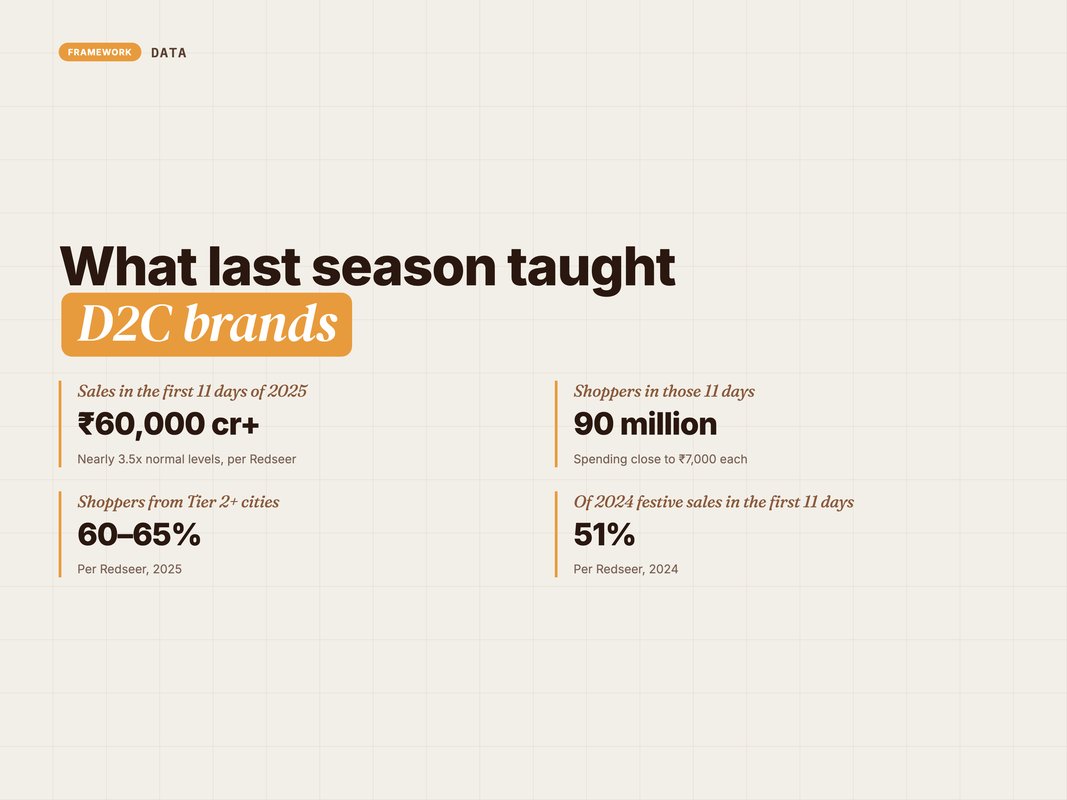
The opening matters most. In 2024, Redseer found 51% of festive sales came in the first 11 days (Source: Redseer, 2024 — redseer.com). If you are not visible when the season opens, you miss half of it.
The shoppers are not where many brands assume. In 2025, Redseer found 60% to 65% of shoppers came from Tier 2+ cities (Source: Redseer, 2025 — redseer.com).
And two categories behaved differently from the usual story. Fashion, normally the lead driver of festive sales, saw only low single-digit growth. Quick commerce kept growing at its usual pace of over 120%, but showed no festive spike.
That last point is worth a pause. Fast delivery is a habit now, not a festive treat. Shoppers use it every week, so Diwali does not change their behaviour on it much.
One more caution on comparisons. In 2025, a GST change and the start of Navratri both landed on 22 September. That gave the season an unusual early lift. Do not expect 2026 to repeat that pattern.
Where the growth actually is
The big marketplaces take most of the headlines. The growth for a D2C brand is more specific.
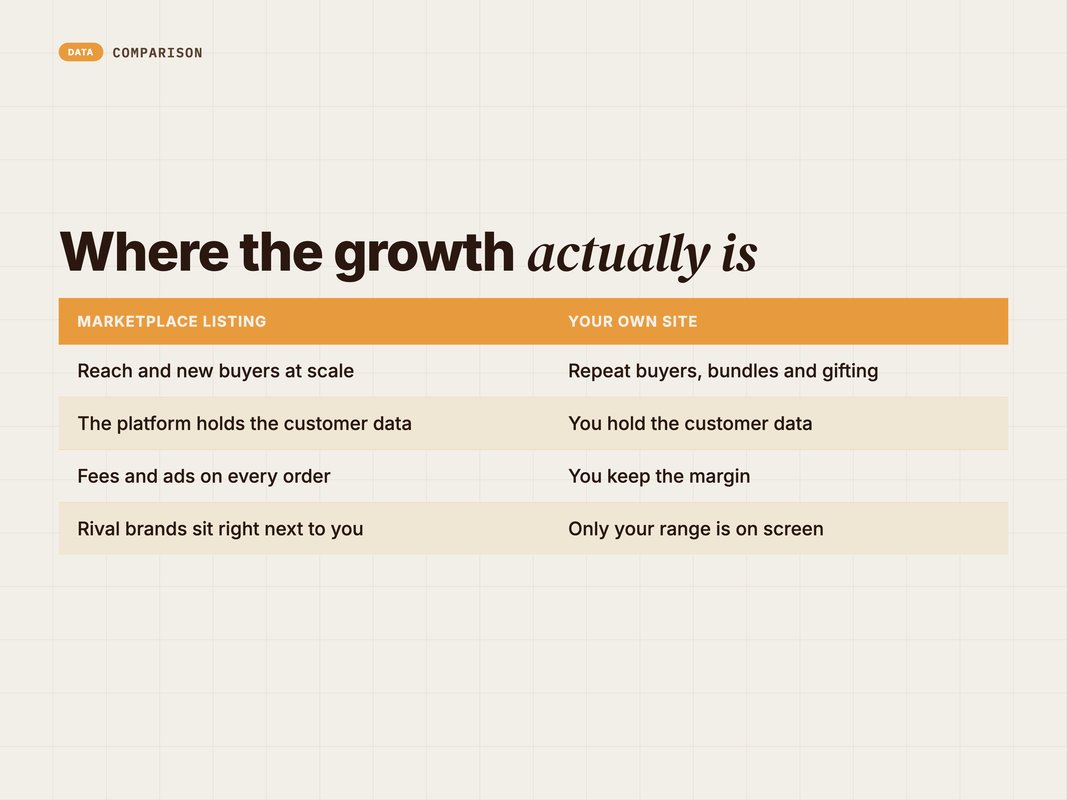
Unicommerce data, reported by the Free Press Journal, showed quick commerce order volumes grew 120% in the 2025 Diwali season. Brand websites came next, up 33%. Tier II and III cities made up about 55% of all orders (Source: Free Press Journal, 2025 — freepressjournal.in).
That 33% is the number a D2C founder should care about. Your own site keeps the customer, the data and the margin. A marketplace order does not.
The 2026 forecast points the same way. Datum Intelligence, reported by Deccan Chronicle, expects online festive sales of ₹1,50,000 to ₹1,55,000 crore this year. That would be up 25% to 29% on ₹1,20,000 crore in 2025 (Source: Deccan Chronicle, 2026 — deccanchronicle.com).
But the same study expects the average order to fall slightly, from ₹1,578 to ₹1,554. More shoppers, smaller baskets.
That changes the maths on new buyers. If each order is worth a little less, you cannot afford to pay more for it. Tighten your target cost per order before the season, not during it.
This is where offer design matters more than discount depth. A bigger discount shrinks a smaller basket even further. A good bundle does the opposite.
Build gifting sets that lift the order value. Pair a bestseller with an add-on. Offer a ready-to-gift box. Add a free gift note or wrap. These raise the basket without cutting your price.
Keep it simple for the shopper. One clear offer. One clear price. One clear date it will arrive.
Keep one simple entry product too. First-time festive buyers often want a low-risk way to try you. A small, well-priced gift is how many of them become regulars.
Payments are not a barrier. In October 2025, UPI handled a record ₹27.28 lakh crore across 20.7 billion transactions. That is NPCI data, as reported by Business Standard (Source: Business Standard, 2025 — business-standard.com). Make UPI the easiest option at checkout.
Q: Should D2C brands skip marketplaces during Diwali?
A: No. Marketplaces bring reach and new buyers at scale. Use them for discovery, and use your own site for repeat buyers, bundles and gifting, where you keep the relationship.
Plan for ad costs to rise
Every brand wants the same shopper in the same few weeks. Prices go up.
Agency heads quoted by exchange4media put CPMs 25% to 30% higher in peak festive weeks, with CPCs relatively stable. Regional-language ad CPMs in Tier 2 and 3 cities were also reported up 25% to 30% year on year (Source: exchange4media, 2025 — exchange4media.com). Those are agency estimates, not platform data, but they match what most buyers see.
Quick commerce ads are pricier too. Industry executives told Storyboard18 that premium slots cost 30% to 40% more during Diwali than in a normal month. That covers homepage banners and top-of-search placements (Source: Storyboard18, 2026 — storyboard18.com).
The answer is not to spend less. It is to spend earlier and more precisely.
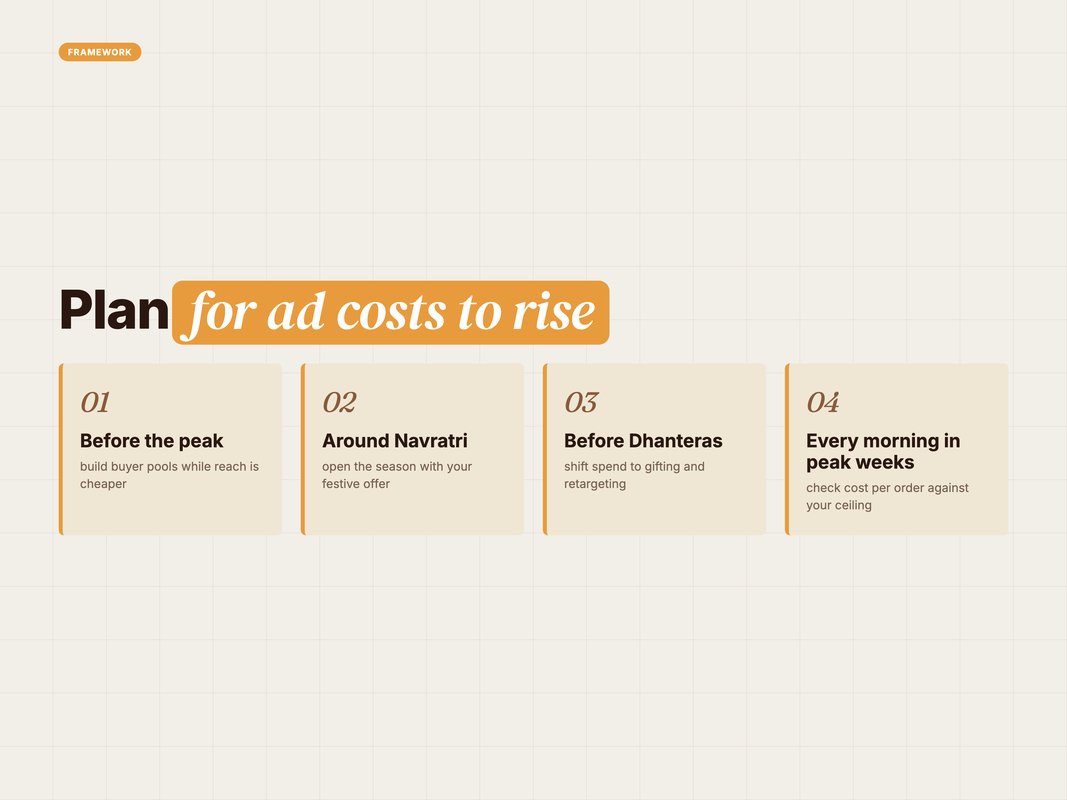
Build buyer pools before the auction heats up. Reach is cheapest before the peak. Spend on video and awareness early, when CPMs are lower, and build the pools you will retarget later.
Tell Google your sale is coming. Google Ads seasonality adjustments let you warn Smart Bidding about a short spike in conversion rates. Google says they suit events of one to seven days. They work with Performance Max, and with Search and Shopping campaigns on target ROAS or target CPA bidding (Source: Google Ads Help, 2026 — support.google.com).
Keep your best creative ready. In peak weeks, creative that is already proven wins. Do not test brand-new ideas when every impression costs a third more.
Protect margin with a ceiling. Set the highest cost per order you will accept before the season starts. When a campaign crosses it, pause it. Festive pressure makes it tempting to chase volume at a loss.
A simple way to set that ceiling is to work back from your margin. Take the average order value and subtract product and delivery costs. Then decide how much of what is left you can spend to win the order. Write the number down. Share it with everyone who touches the budget.
Then check it every morning in the peak weeks. Costs move fast in a crowded auction. A campaign that was fine on Monday can be losing money by Thursday.
Our guide to structuring a Meta ad account covers the campaign setup side.
The creative that wins festive attention
Festive shoppers are not browsing aimlessly. Most of them already know what they are shopping for.
Think with Google found 82% of shoppers plan festive purchases in advance. Search interest in "Diwali sales" began climbing as early as August (Source: Think with Google, 2024 — business.google.com).
Meta ran festive research with Ipsos. It found 77% of shoppers said a personalised ad on its apps inspired their purchase (Source: Meta, 2025 — about.fb.com). The same research found 78% of festive shopping conversations happen on Meta's platforms, particularly WhatsApp.
Creators matter more at festive time too. Think with Google reported 87% of surveyed viewers in India agree YouTube has the most trusted creators for product advice (Source: Think with Google, 2025 — business.google.com).
Brands are already spending there. Qoruz expects India's festive creator spend to reach ₹900 crore in 2026, as reported by Marketing Mind. That is up from about ₹700 crore last year. Diwali accounts for 49% of that collaboration activity (Source: Marketing Mind, 2026 — marketingmind.in).
So the festive creative that works has three jobs.
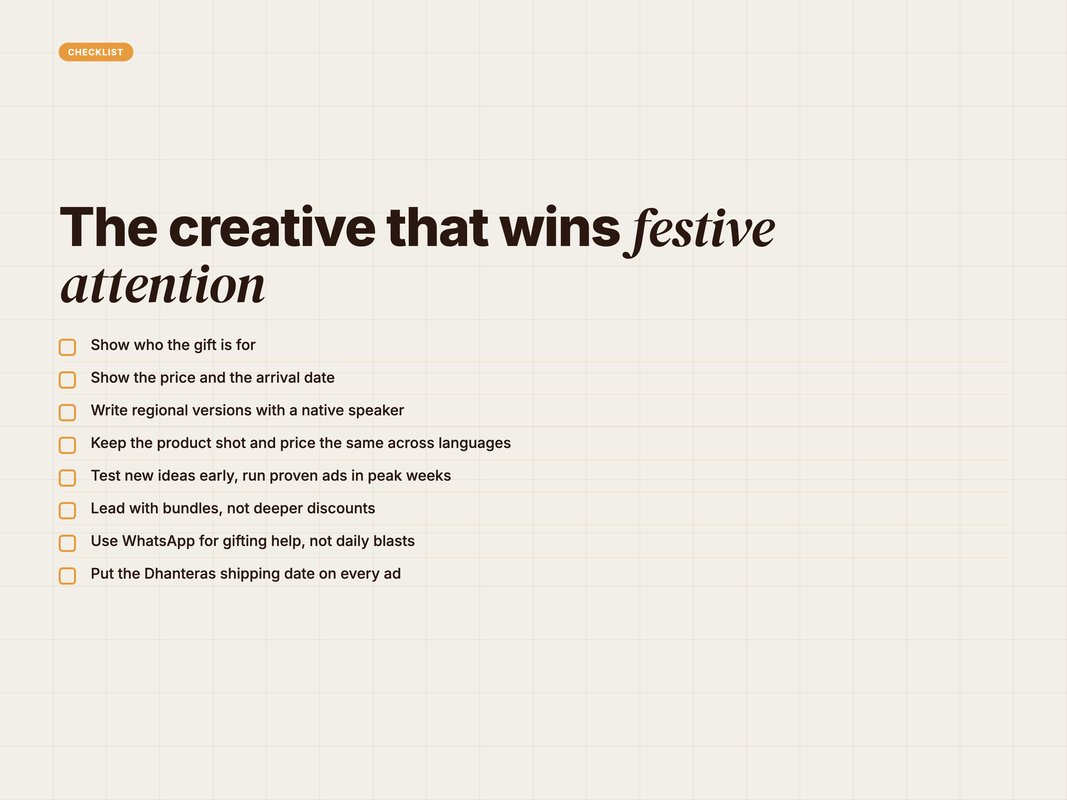
Answer the gifting question. Most festive buying is for someone else. Show who the product is for, what it costs, and when it will arrive.
Speak the shopper's language. With most festive shoppers outside the metros, regional language creative is not a nice extra. It is where the volume is.
Do it properly, not with a quick machine translation. Write the ad in the language first, then check it with a native speaker. Words for gifts, blessings and family carry different weight in each language.
Start with the two or three languages where your orders already come from. Your order data will show you which states and cities buy most. Match the language to the map.
Keep the product shot and the price the same across versions. Change the words, the voice and the festive cues. That keeps production fast and the brand consistent.
Make WhatsApp part of the plan. Use it for gifting help, delivery updates and restock alerts. Do not use it for daily discount blasts. People mute noisy chats quickly.
For producing variants at festive speed, see how we generate 100 ad creatives in 10 minutes.
A phase-by-phase plan, working back from Diwali
Here is the plan we use, set against the 2026 dates. Count every phase back from Sunday, 8 November.
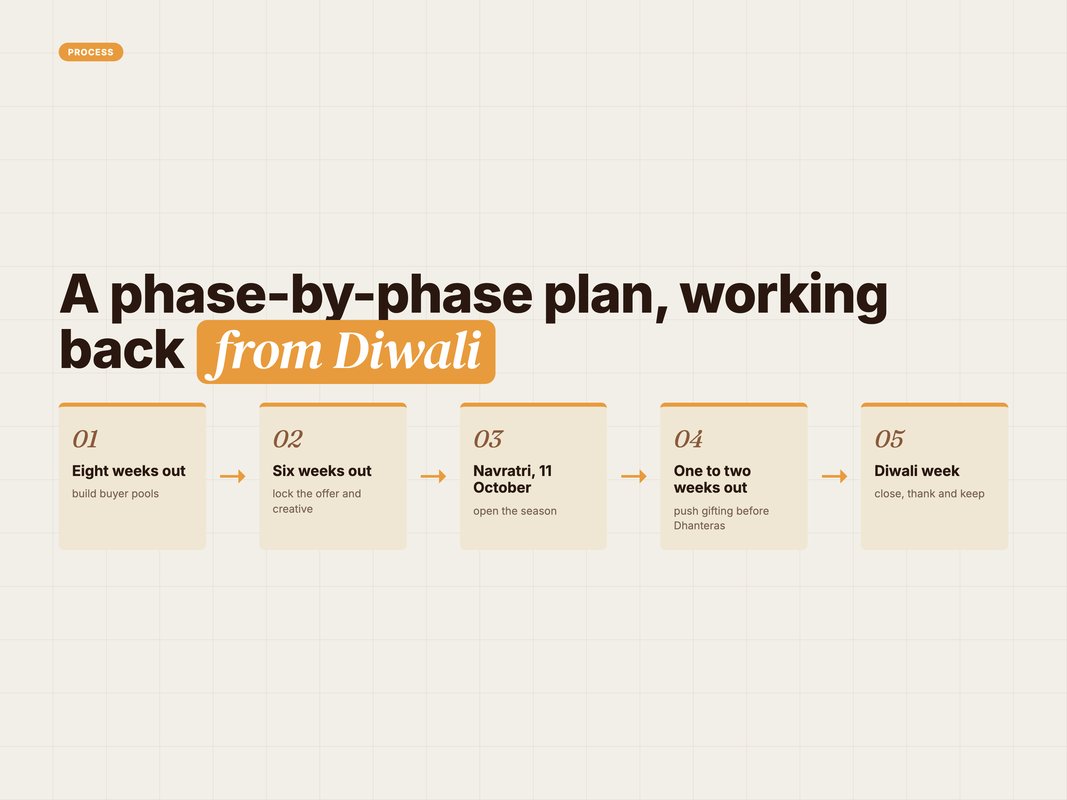
Eight weeks out: build buyer pools. Launch awareness and video campaigns while reach is cheaper. Start collecting WhatsApp opt-ins with clear consent.
Six weeks out: lock your offer and creative. Decide your hero products, bundles and gifting sets. Produce regional language versions. Test creative now, before costs rise.
Four weeks out, around Navratri: open the season. Navratri begins on 11 October. Go live with your festive offer across your own site, marketplaces and quick commerce. This is when the first big wave of buying begins.
One to two weeks out: push gifting. Shift spend to gifting creative and retargeting. Set Google seasonality adjustments for your sale days. Make shipping dates for Dhanteras unmistakable on each ad and product page.
Diwali week and after: close and keep. Stop spend on new buyers once delivery before Diwali is no longer possible. Switch to thank-you messages, reviews and a reason to come back after the festival.
The after-Diwali step is the one most brands skip. The buyers you won in November are your cheapest buyers in December. Do not let them go quiet.
Send a thank-you within a week of delivery. Ask for a review while the gift is still fresh. Then give them one good reason to return before the year ends. A new product works. So does an early wedding-season edit.
Keep one more date in mind. Many shoppers who bought for Diwali will buy again for weddings and year-end gifting. The brands that stay useful between the two moments win both.
Before the season opens, also check your own website. Pages should load fast on a mobile data connection. UPI should be the first payment option. Shipping dates for Dhanteras and Diwali should appear on every product page. And a WhatsApp link should answer gifting questions in minutes, not hours.
Starting late? Here is the short version
Not every brand starts eight weeks out. If you are reading this with less time, do fewer things well.
Pick three hero products. Not your whole range. The three that sell best and gift best.
Build one gifting bundle around them. Price it so the basket grows.
Make two ads per product. One that shows the product. One that shows who it is for.
Put your Dhanteras delivery date on every product page and every ad.
Set your cost-per-order ceiling today. Pause anything that crosses it.
Then spend the rest of your time on your own site. Fast pages, UPI first, clear dates. A late start with a clean site beats an early start with a slow one.
What we do at YARD
We are an AI-first growth marketing agency. We run performance marketing, LLM SEO, AI creative and AI funnels for D2C and B2B brands.
Festive season is where D2C brands feel the difference between a plan and a scramble. We start by setting the calendar from the real festival dates, not last year's. Then we build the budget in phases, with a clear cost-per-order ceiling agreed before anything goes live.
On the creative side, we produce regional language variants and gifting-led ads at the volume festive season needs. We keep proven creative in reserve for the peak weeks, when testing is too expensive.
We also make sure the brand's own site is ready, because that is where the margin lives. Fast pages, UPI-first checkout, clear shipping dates and a WhatsApp flow for gifting questions.
After the season, we do the part most teams forget. We turn festive buyers into repeat buyers with a simple post-festival plan.
Our D2C guide to Google Ads versus Meta Ads covers how we split spend between the two.
The takeaway
Diwali 2026 falls on 8 November, 19 days later than last year. That shift moves your whole festive plan.
The 2025 season showed that half the sales can land in the opening days. Most shoppers sit outside the metros. And brand sites are growing. It also showed that ad costs rise in peak weeks and baskets are getting slightly smaller.
So build buyer pools early, lock creative before costs rise, and open strongly around Navratri. Push gifting before Dhanteras. Protect your margin with a cost-per-order ceiling. And keep the customers you win.
You can book a call with our team if you want help planning your Diwali 2026 campaigns.
FAQ
Q: When is Diwali in 2026?
A: Diwali falls on Sunday, 8 November 2026, according to the central government holiday list. Dhanteras is on Friday, 6 November. Diwali 2025 was on 20 October, so this year's festival is 19 days later.
Q: When should D2C brands start Diwali ads?
A: Start building audiences at least eight weeks before Diwali. Think with Google found 82% of shoppers plan festive purchases in advance. Search interest in Diwali sales began climbing as early as August.
Q: How much do ad costs rise during Diwali?
A: Agency estimates reported by exchange4media put CPMs 25% to 30% higher in peak weeks, with CPCs relatively stable. Budget for higher reach costs and lock your creative early.
Q: Should D2C brands sell on their own website during Diwali?
A: Yes. Unicommerce data reported by the Free Press Journal showed orders on brand websites rose 33% in the 2025 Diwali season. Your own site keeps the customer data and the margin.
Q: Do Google Ads need special settings for Diwali sales?
A: Use seasonality adjustments for short sale events. Google says they suit events of one to seven days. They work with Performance Max, and with Search campaigns on target ROAS or CPA bidding.
Q: Is WhatsApp important for Diwali marketing?
A: Yes. Meta says 78% of festive shopping conversations happen on its platforms, particularly WhatsApp. Use it for order updates, restock alerts and gifting help, not daily discount blasts.
Insights from Our Experts
Explore our latest articles on digital marketing strategies.