

Indian weddings are a year-round business that gets paid in a few weeks.
That single fact shapes everything. Couples plan for nine months. Vendors compete for twelve. And the money lands inside a handful of dated windows nobody controls.
Miss that window and you do not get a slower quarter. You get no quarter at all.
This is the playbook we use with hospitality, venue, jewellery and service brands in this category. The season calendar. The channel mix. The creative that converts. And the four mistakes that cost vendors more than any ad budget ever saves.
It is written for India, but the timing logic works anywhere a season is fixed by a calendar rather than a campaign.
Quick Facts: The Indian Wedding Market at a Glance
- Weddings are India's fourth-largest industry at about US$130 billion a year — (Source: IBEF, 2024 — ibef.org).
- India hosts roughly 10 million weddings a year — (Source: IBEF, 2024 — ibef.org).
- CAIT valued the 2025 peak season at ₹6.5 lakh crore across 46 lakh weddings — (Source: CAIT, 2025 — cait.in).
- That season ran just 44 days, from 1 November to 14 December 2025 — (Source: CAIT, 2025 — cait.in).
- Delhi alone accounted for 4.8 lakh weddings and ₹1.8 lakh crore — (Source: CAIT, 2025 — cait.in).
The number that should set your budget
Start with the size. Weddings are India's fourth-largest industry, worth about US$130 billion a year across roughly 10 million weddings (Source: IBEF, 2024 — ibef.org).
Now start with the shape, which matters more.
CAIT valued the 2025 peak season at ₹6.5 lakh crore across 46 lakh weddings. That ran from 1 November to 14 December 2025 (Source: CAIT, 2025 — cait.in).
Forty-four days. One and a half months of trading that carries the year.
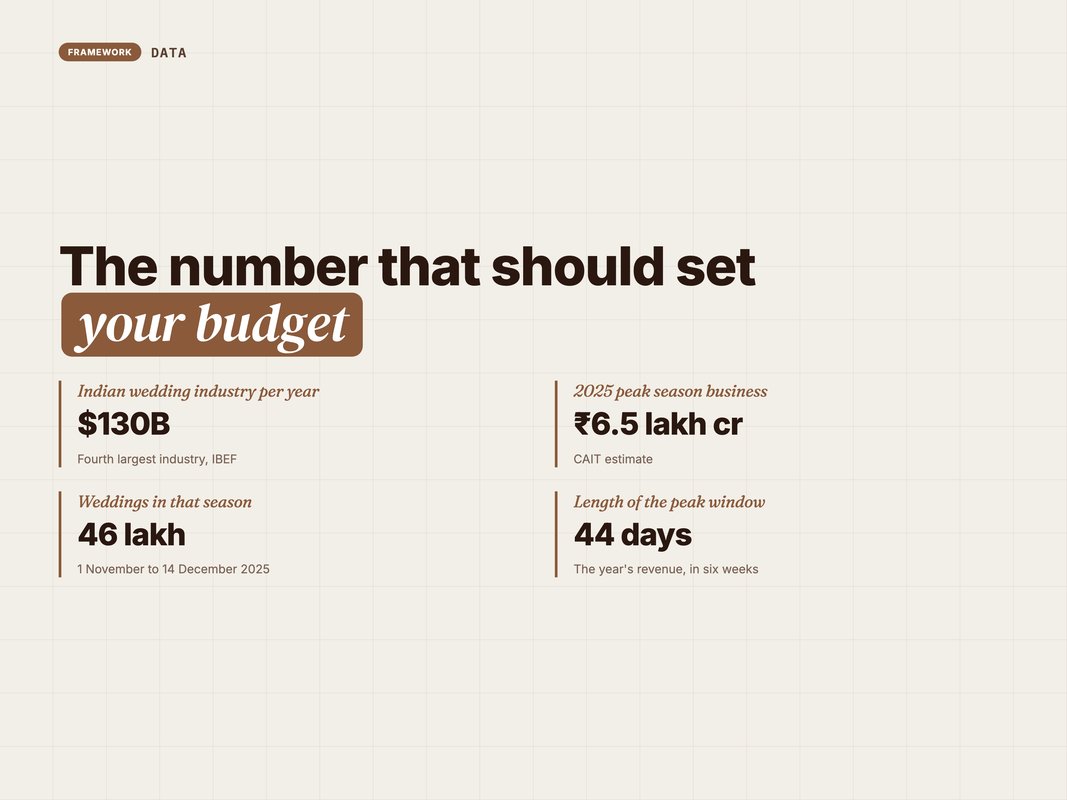
Delhi alone held 4.8 lakh weddings worth ₹1.8 lakh crore in that window.
The lesson is not that the market is big. Everyone knows that. The lesson is that your marketing calendar has to be nine months longer than your revenue calendar.
Think about what that means for cash. You spend for most of the year. You earn in six weeks.
Most vendors get this backwards. They cut marketing in the quiet months to protect cash, then bid hard in November against everyone else doing the same thing.
The result is predictable. You pay peak rates for buyers who already chose. And you were invisible in the months when the choice was still open.
Flip it. Spend most in the quiet months. Spend least, and most precisely, in the peak.
Q: When does the 2026-27 season actually start?
A: The winter season resumes after Dev Uthani Ekadashi, which falls on 21 November 2026. Exact muhurat dates vary by panchang and region, so pull your own list rather than working from a national one.
Where the money actually goes
Most vendors have no idea what share of the pot their category holds. CAIT broke the 2025 season down, and the split is useful.
Here is CAIT's estimate, category by category (Source: CAIT, 2025 — cait.in).
| Category | Share of season spend |
|---|---|
| Jewellery | 15% |
| Apparel and sarees | 10% |
| Catering | 10% |
| Electronics and electricals | 5% |
| Dry fruit and sweets | 5% |
| Grocery and vegetables | 5% |
| Event management | 5% |
| Gift items | 4% |
| Floral decoration | 4% |
| Travel and hospitality | 3% |
| Musical groups | 3% |
| Light and sound | 3% |
| Photography and videography | 2% |
Two things jump out.
Jewellery is the single biggest line at 15%. Photography and video, which dominates social feeds, is 2% of actual spend.
That gap between visibility and value is worth sitting with. The loudest categories are not the richest ones.
If you sell in a small-share category, your marketing has to work harder per rupee of market. If you sell in jewellery or catering, your problem is competition, not demand.
Those are two completely different jobs.
In a crowded category, the win comes from being chosen faster. Clear pricing, fast replies, easy booking. Nobody needs to be convinced the category matters.
In a small category, the win comes from being thought of at all. You are fighting for a slot in the plan, not for the booking. That means showing up earlier and beside the bigger vendors, not against them.
Venue tie-ups do more for a small-category vendor than any ad. The venue already has the couple's attention nine months out. You do not.
The buying journey, in order
Wedding buying does not follow a normal funnel. It follows a fixed sequence, and each step locks the one after it.
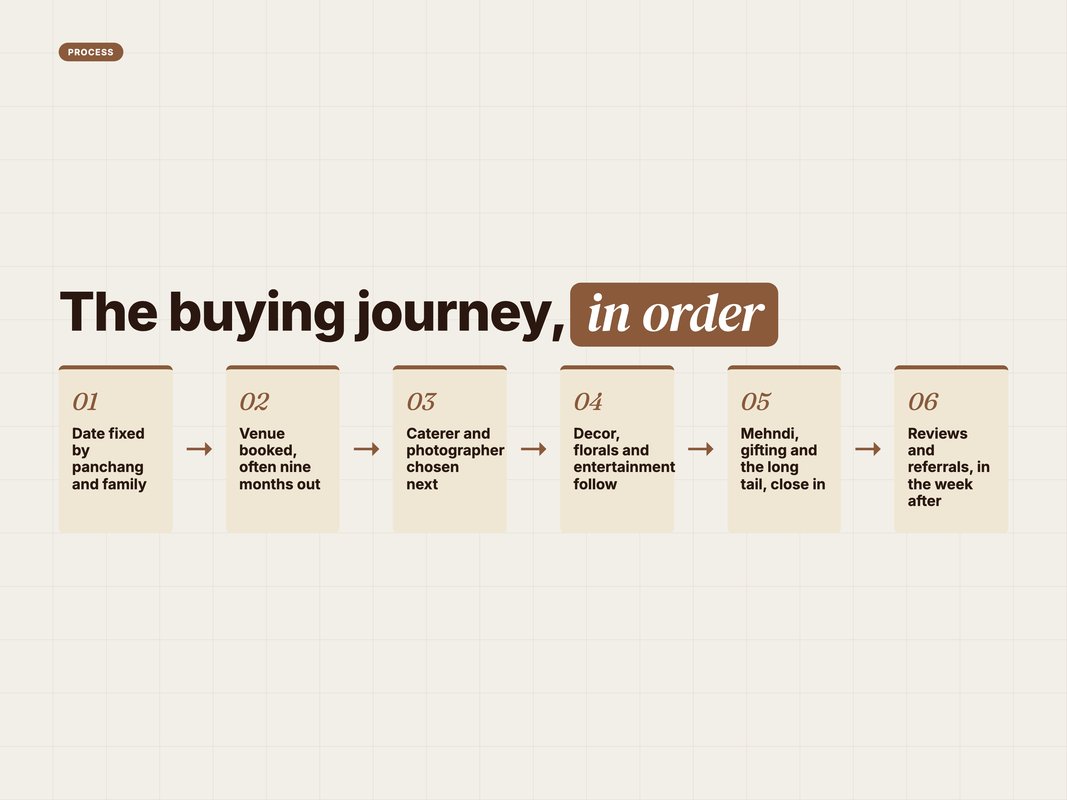
Date first. Then venue. Then the big-ticket vendors, usually caterer and photographer. Then decor and entertainment. Then the long tail of smaller purchases, which happen fastest and latest.
This order is why timing beats budget in this category.
A venue that starts marketing in October is selling to couples who fixed their venue in March. A florist that starts in October is right on time.
So the first question is not "what should my campaign say". It is "how many months before the wedding does my category get chosen".
Answer that honestly and your calendar writes itself.
There is a second reason this order matters. Each step brings a referral chance with it.
The venue knows who booked. The planner knows the caterer. The photographer meets every other vendor on the day. In this market, your best lead source is another vendor two steps ahead of you in the sequence.
So build the vendor relationships that sit just before you in the chain. A caterer with five venue relationships needs far less ad spend than one with none.
Q: How far ahead do couples book?
A: Venues and photographers go earliest, often nine to twelve months out. Decor, mehndi, entertainment and gifting are chosen much closer in, sometimes inside four weeks.
The channel mix that actually works
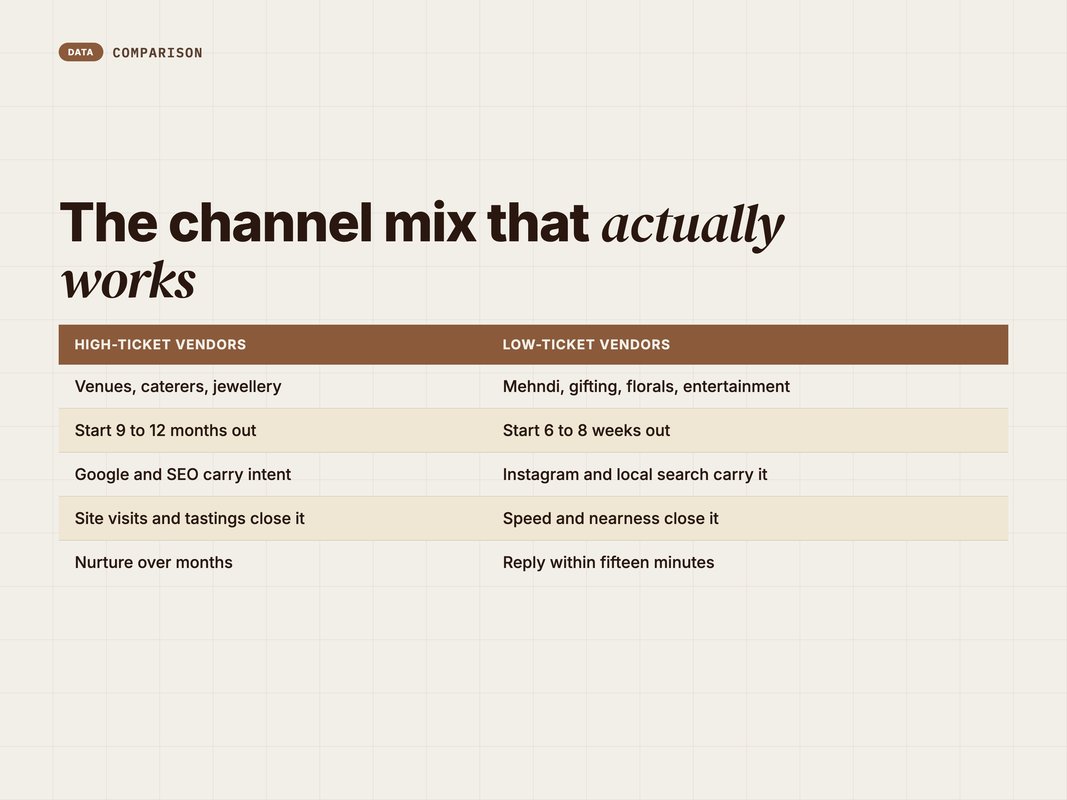
There is no single best channel here. There is a right weighting for your ticket size and lead time.
Referrals convert best and scale worst. Every serious vendor in this category gets most of their business this way. The mistake is treating it as luck rather than a system.
Instagram builds the shortlist. Couples browse for months before they enquire. Your feed is your portfolio, and saves matter more than likes here.
Google catches the ready buyer. Someone searching "banquet hall in [city] for 400 guests" is weeks from booking, not months. This traffic is expensive and worth it.
Marketplaces deliver volume at thin margin. Useful for filling gaps. Dangerous as your only source, because you never own the customer.
WhatsApp is where the deal actually closes. Almost every enquiry in this market moves there within one exchange. Treat it as a sales channel with targets, not an inbox.
That last point is worth spelling out. Set a reply-time target and post it where the team can see it. Fifteen minutes in working hours is achievable. Four hours is not a target, it is a leak.
Build three saved replies. One that answers price band and capacity. One that offers two site-visit slots. One that follows up after 48 hours of silence.
Those three cover most of what a first exchange needs. Everything after them is a real conversation, which is where your team should be spending its time.
Weight these by ticket. Say a venue booking runs to lakhs: that is worth months of nurture. A mehndi booking in the tens of thousands needs speed and nearness, not a funnel.
A simple rule helps here. Divide your average booking value by 100. That is roughly what you can afford to pay per qualified enquiry and still make money.
Run that number before you set any budget. Most vendors discover their Google spend is fine and their marketplace spend is not.
And check where your best bookings actually came from last season. Not the most enquiries. The best bookings. Those two lists are rarely the same.
The twelve-month calendar
Here is the plan we run. Months are relative to the peak window, not to the financial year.
| Phase | Focus | What you are actually doing |
|---|---|---|
| Months 12 to 9 | Build the shortlist | Portfolio content, real weddings, venue tie-ups |
| Months 9 to 6 | Capture intent | Google Ads, SEO on city and capacity terms |
| Months 6 to 3 | Convert the shortlist | Site visits, tasting sessions, sample shoots |
| Months 3 to 1 | Close and upsell | Package offers, referral asks, add-on selling |
| Peak weeks | Deliver and document | Shoot everything, collect reviews same-week |
| Post-season | Harvest | Publish the work, request reviews, re-book vendors |
The post-season block is the one everyone skips. It is also the cheapest lead source you will ever have.
Every wedding you deliver is next year's marketing asset. Shoot it properly, get the couple's permission in writing, and publish it while the season is still fresh.
Vendors who do this build a portfolio that grows on itself. Vendors who do not start from zero every year.
Set the rule now, before the season. Every event gets photographed for your own use, not just the client's. Every couple signs a short permission line at booking, not after the wedding.
Chasing permission in January is a losing game. Nobody replies. Put it in the contract in August and it is never a conversation.
The same goes for reviews. Ask on the day, while the room is still full and the couple is happy. A review request sent six weeks later gets ignored by almost everyone.
The creative that converts here
Wedding creative fails in a specific way. It looks beautiful and says nothing.
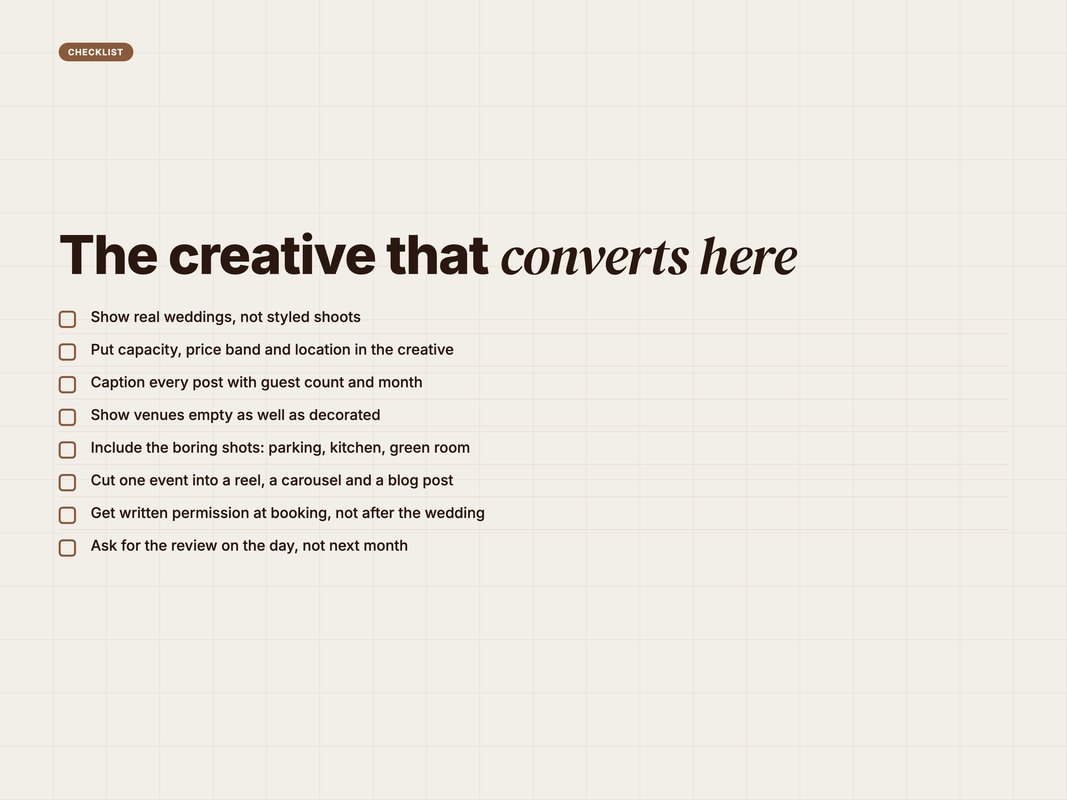
Three rules matter most.
Show real weddings, not styled shoots. Couples can tell. A real event with real guests and imperfect light beats a staged set almost every time.
The reason is simple. A styled shoot shows what your work looks like at its easiest. A real wedding shows what it looks like under pressure. Only one of those answers the question a couple is actually asking.
Put capacity, price band and location in the creative. Not hidden on a form. The fear of "scaring people off" costs you far more in wasted enquiries than it saves.
Show the same event across formats. One wedding gives you a reel, a carousel, a blog post and six stories. Shooting more events is expensive. Cutting one event better is not.
There is a fourth that matters most for venues. Show the space empty as well as decorated.
Planners need to picture their own event in the room. A heavily styled photo makes that harder, not easier.
Add the boring shots too. The parking. The kitchen access. The green room. Nobody books on those photos, but a planner who cannot find them will call the venue that shows them.
One more habit worth building. Caption every post with the guest count and the month. Those two details do more filtering than any hashtag set. They help you show up in AI answers as well as in search.
Q: Should we publish prices?
A: Publish a band, not a number. "Weddings from ₹X per plate" filters hard and builds trust. Vendors who do this get fewer enquiries and more bookings.
Four mistakes that cost real money
These come up on nearly every audit we run in this category.
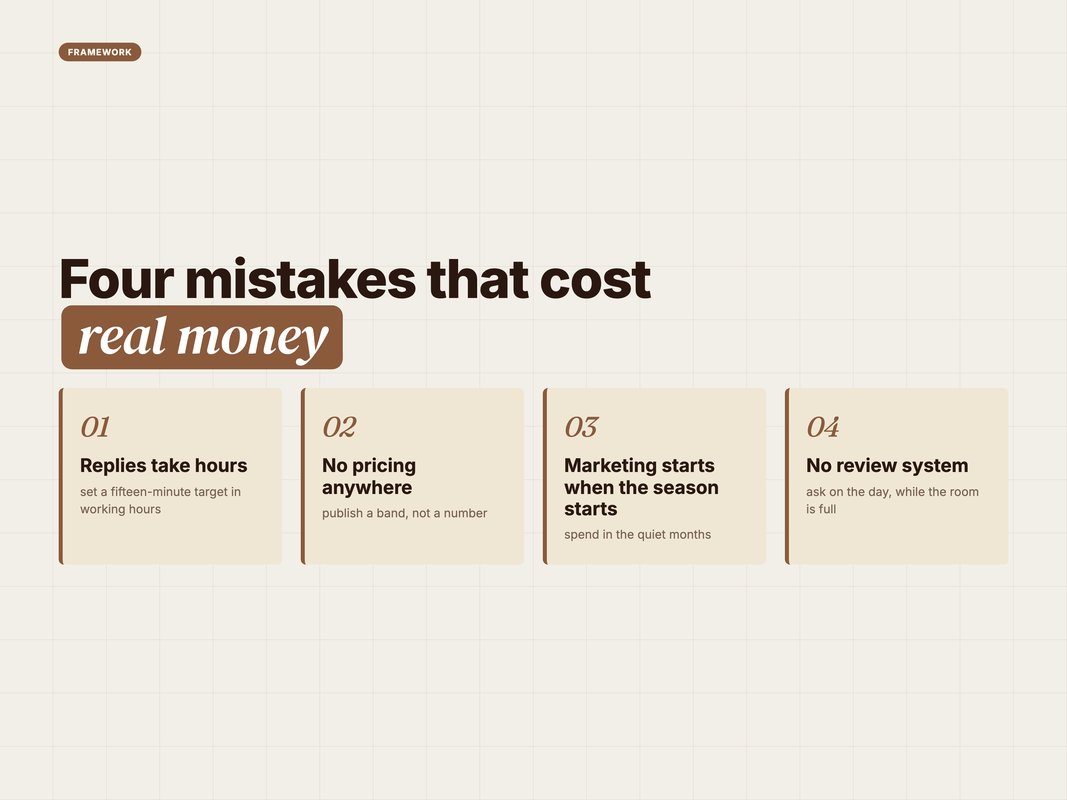
Slow replies. A wedding enquiry that waits four hours is usually gone. Couples message five vendors at once. The first useful reply shapes the shortlist.
No pricing anywhere. You think you are protecting margin. You are actually paying to attract people who cannot afford you, and repelling people who can.
Marketing that starts when the season starts. By November the decisions that matter are made. Your ad spend in peak season should be closing, not prospecting.
No system for reviews. Ask on the day, not next month. A same-week request gets a warm review. A request in February gets silence.
Fix those four before you touch your ad budget. They cost nothing and they move more revenue than a bigger media spend.
There is a fifth that is harder to see. Most vendors have no idea which enquiry sources produce bookings, because nobody tags them.
So an ad budget gets set on gut feel and defended on gut feel. Tag every enquiry at the point it arrives. Source, category, budget band, wedding date.
Three months of that data is worth more than any benchmark report. It tells you exactly where your next rupee should go.
What we do at YARD
We are an AI-first growth marketing agency. We run performance marketing, LLM SEO, AI creative and AI funnels for D2C and B2B brands.
Seasonal categories like this are where the standard agency model breaks. A monthly retainer with a flat plan does not match a business that earns most of its revenue in six weeks.
So we build the calendar backwards from the peak window. Prospecting months, conversion months, and a peak plan that is almost entirely closing and delivery.
The other half of the work is response speed. We wire enquiries from every source into one place. We route them by category and value. Then we track time-to-first-reply as a headline metric. For a hospitality client, that single change moved more revenue than any creative test we ran that year.
We also build the content engine that runs on delivered work. Every event becomes a set of assets. That is what turns a good season into a better one next year.
None of this needs a big team. It needs the calendar to be right and the replies to be fast.
The takeaway
The Indian wedding market is enormous and brutally concentrated. CAIT valued one 44-day window at ₹6.5 lakh crore.
Your revenue calendar is six weeks. Your marketing calendar is twelve months. Confusing the two is the most expensive mistake in this category.
Work out how far ahead your category gets chosen. Build backwards from there. Reply faster than everyone else. Publish a price band. Then turn every delivered wedding into next year's proof.
The 2026-27 season starts in late November. The work that decides it starts now.
Pick three things from this piece and do them this month. Not ten. Three.
If you only do one, make it reply speed. It costs nothing, it needs no agency, and it moves more bookings than any other change on this list.
You can book a call with our team if you want the season calendar built for your category.
FAQ
Q: How big is the Indian wedding market?
A: It is India's fourth-largest industry, with spending of about US$130 billion a year across roughly 10 million weddings, according to IBEF. CAIT put the 2025 peak season alone at ₹6.5 lakh crore.
Q: When should wedding vendors start marketing?
A: Nine to twelve months before the season. Venues and photographers get booked earliest. If you start when the season starts, you are selling to couples who already chose someone else.
Q: Which channel gives wedding vendors the best leads?
A: Referrals convert best but do not scale. Instagram builds the shortlist. Google captures ready buyers. Marketplaces bring volume at low margin. Most vendors need all four, weighted by ticket size.
Q: Which services take the biggest share of wedding spend?
A: Catering leads at 10% of the 2025 season's spend, by CAIT's estimate. Event management takes 5%, floral decoration 4%, and photography and video 2%.
Q: What breaks most wedding vendor marketing?
A: Slow replies. A wedding enquiry that waits four hours is usually lost. The second is pricing that never appears anywhere, which filters out serious buyers along with the browsers.
Q: Does the wedding season pause in winter?
A: Yes. There is a Kharmas pause from mid-December to mid-January when weddings are not scheduled. Exact muhurat dates vary by panchang, so pull your own regional list.
Insights from Our Experts
Explore our latest articles on digital marketing strategies.