

"AI versus human" is the wrong question. Nobody serious is running marketing with one and not the other.
The useful question is narrower. For each task, who should do it, and who should check it?
We get this wrong in both directions. Some teams keep people on work a model does faster and better. Others hand a model work it quietly gets wrong, and ship the result.
The best research on this has a finding that should change how every marketing team works. AI makes people faster and better at some tasks. At others, it makes them wrong, and makes the wrong answer look more convincing.
This piece covers that research and where marketing stands on AI in 2026. Then it sets out the three-question test we use at YARD to split the work. It ends with the disclosure rules now arriving in India and abroad.
Quick Facts: AI and Marketers at a Glance
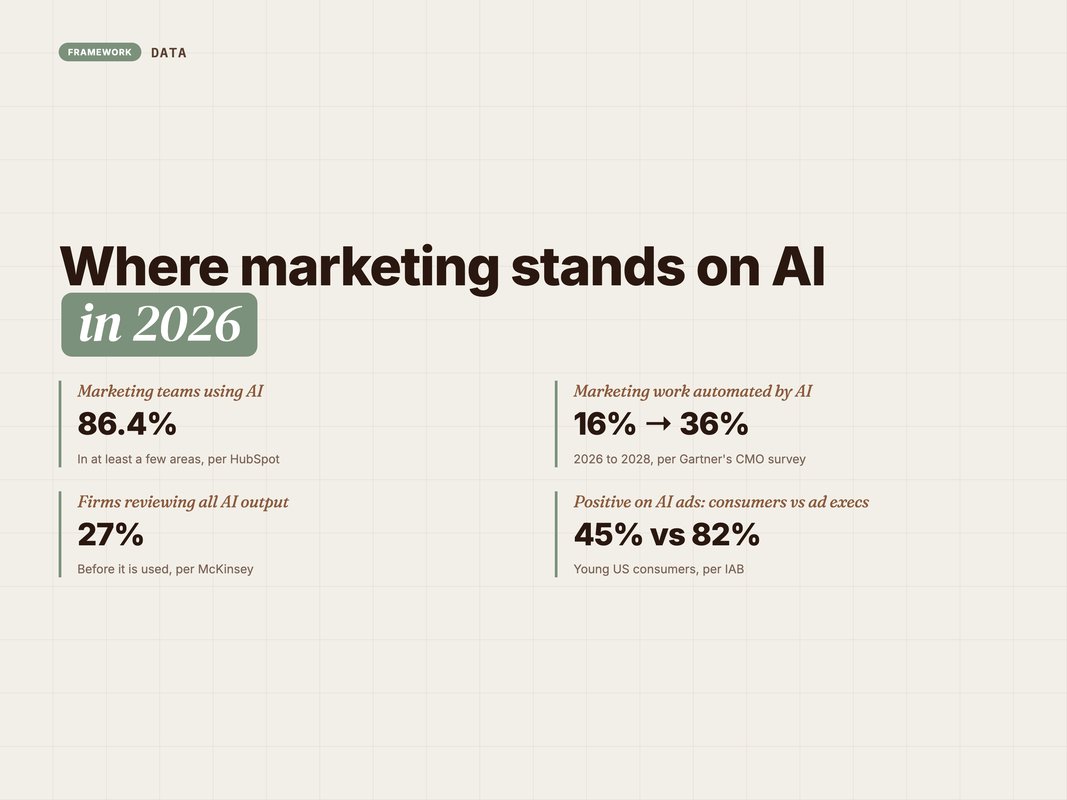
- Most marketing teams now use AI in at least a few areas, at 86.4% in HubSpot's survey — (Source: HubSpot, 2026 — blog.hubspot.com).
- Marketing leaders expect AI to automate 36% of marketing work by 2028, up from 16% in 2026 — (Source: Gartner, 2026 — gartner.com).
- Only 27% of organisations using generative AI review all of its output before use — (Source: McKinsey, 2025 — mckinsey.com).
- Ad executives are almost twice as likely as consumers to think young people like AI ads — (Source: IAB, 2026 — iab.com).
- The EU's AI transparency rules have applied since 2 August 2026 — (Source: European Commission, 2026 — digital-strategy.ec.europa.eu).
What the best study actually found
The most rigorous study on this is a field experiment with 758 consultants at Boston Consulting Group. It was published in the journal Organization Science in 2026 (Source: Organization Science, 2026 — pubsonline.informs.org).
The researchers call AI's capability edge a "jagged frontier". Some tasks sit inside it and some sit just outside. It is hard to tell which is which by looking.
Inside the frontier, the results were strong. Across 18 realistic tasks, consultants using AI completed 12.2% more tasks and finished them 25.1% more quickly. Their work was also rated significantly higher in quality.
Outside the frontier, the picture flipped.
| Result | Without AI | With AI |
|---|---|---|
| Correct answers on a task outside AI's strengths | About 84.5% | 60% and 70.6% in the two AI groups |
| Rated coherence of the answer | Lower | Higher, whether right or wrong |
Those figures come from the same study (Source: Organization Science, 2026 — pubsonline.informs.org).
Read the second row carefully. People using AI wrote answers that graders found more coherent, regardless of whether the answer was correct.
That is the risk in one line. AI does not just make mistakes. It makes mistakes that read well.
For marketing, that is the worst kind of error. A clumsy wrong claim gets caught in review. A polished wrong claim gets approved.
Q: What is the jagged frontier?
A: It is the uneven edge of what AI does well. Tasks just inside it get faster and better with AI. Tasks just outside it get worse, and the shift between the two is not obvious from the outside.
Where marketing stands on AI in 2026
Adoption is no longer the question. Most teams are already in.
HubSpot found 86.4% of marketing teams use AI in at least a few areas. Most marketers, 73.4%, see AI working alongside them rather than replacing them (Source: HubSpot, 2026 — blog.hubspot.com).
The pressure is volume. Salesforce found 78% of marketers need more personalised content than they can produce. Some 75% are turning to AI to close the gap (Source: Salesforce, 2026 — salesforce.com).
The share of work handed to AI is set to rise fast. Gartner surveyed 402 CMOs. They expect AI-driven automation of marketing work to more than double, from 16% in 2026 to 36% by 2028 (Source: Gartner, 2026 — gartner.com).
And marketing is where the returns show up. McKinsey's 2026 State of AI found revenue gains are most often attributed to AI used in marketing and sales (Source: McKinsey, 2026 — mckinsey.com).
So the case for using AI is settled. The open question is the one most teams skip: who checks the work?
The review gap
Here is the uncomfortable number. In an earlier McKinsey survey, only 27% of firms using generative AI said staff review all of it before use (Source: McKinsey, 2025 — mckinsey.com). A similar share said they check a fifth of it or less.
Put that next to the jagged frontier, and the risk is clear. Most organisations are shipping AI output that nobody fully read, on tasks where the tool may be quietly wrong.
The models themselves are candid about this. On OpenAI's SimpleQA fact test, one of its 2025 models gave a wrong answer 75% of the time. A newer model that declined to answer more often got that down to 26% (Source: OpenAI, 2025 — openai.com).
The public has noticed. Gartner surveyed shoppers who used AI for a recent purchase. Some 54% said they had to double-check everything it told them (Source: Gartner, 2026 — gartner.com).
Even the biggest names get caught. An early version of Google's Gemini Super Bowl ad made a false claim about Gouda cheese. It was later edited (Source: Fortune, 2025 — fortune.com).
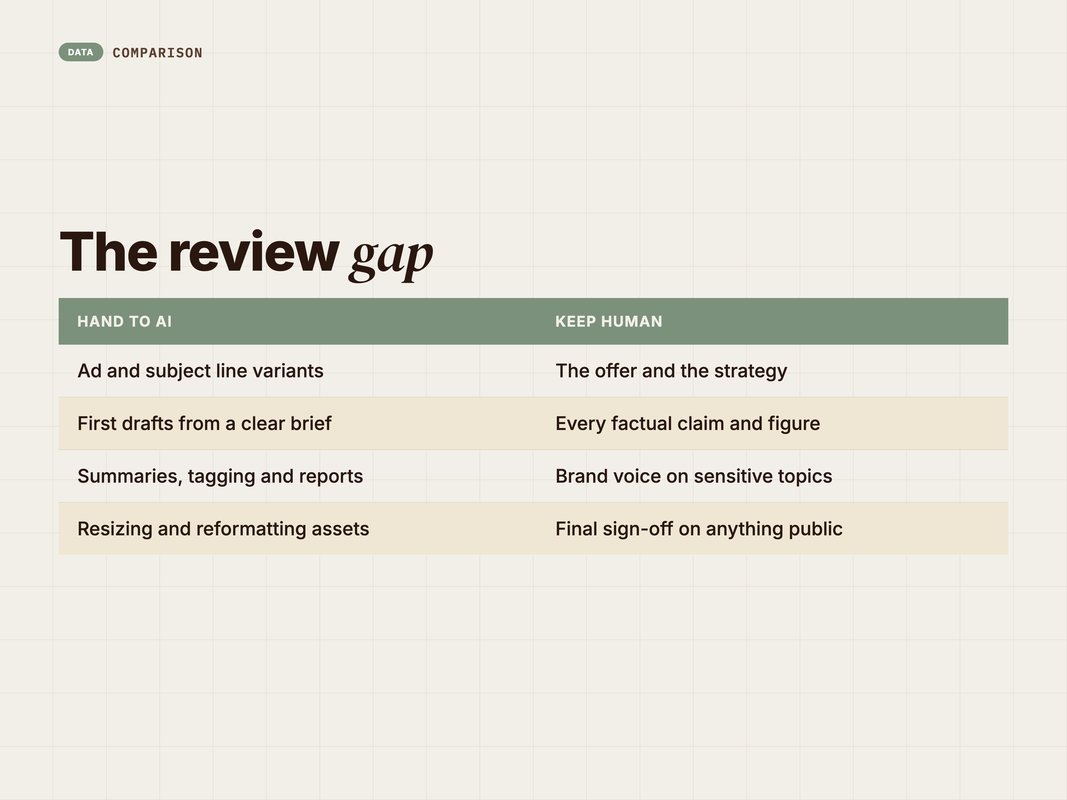
The lesson is not to use less AI. It is to put a human exactly where the frontier is jagged. Our own test of what 53 AI-written blogs did to our traffic is a case in point.
The YARD test: three questions that decide who does what
Fixed lists of "AI tasks" and "human tasks" date quickly. The tools change every quarter. So we use a test instead, and run every task through it.
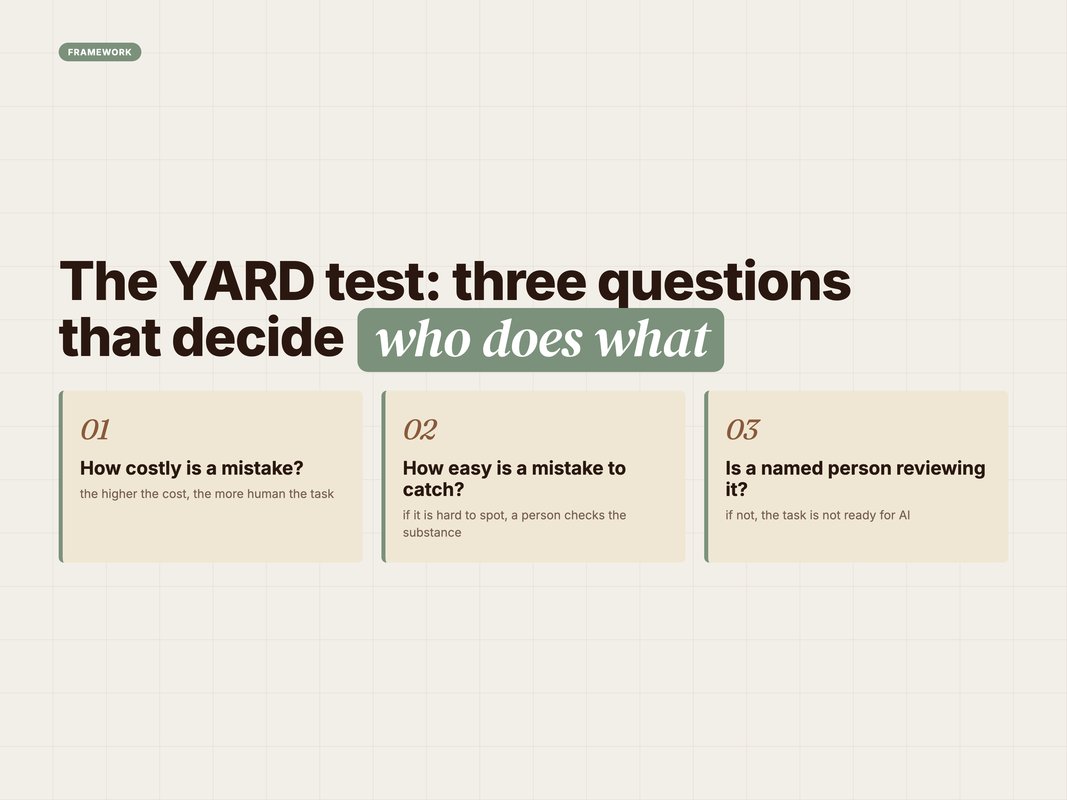
Question one: how costly is a mistake? A weak subject line costs a few opens. A wrong claim in an ad can cost a regulator's attention and a customer's trust. The higher the cost, the more human the task.
Question two: how easy is a mistake to catch? A broken layout is obvious. A plausible but false statistic is not, which is exactly what the jagged frontier study found. If errors are hard to spot, a human must check the substance, not just the surface.
Question three: is anyone actually reviewing it? A process that says "human in the loop" but ships unread output is not a review. It is a label. If no named person reads it before it goes out, the task is not ready for AI.
Put a task through all three. Low cost, easy to catch, and a real reviewer means AI can own the draft. High cost or hard to catch means a human owns it, with AI as an assistant at most.
Most marketing work splits cleanly once you ask. Ad variants, first drafts, summaries, tagging and reporting pass easily. Strategy, the offer, factual claims and anything sensitive do not.
Here is how three real tasks come out.
Twenty ad headline variants. A mistake costs a few clicks. A weak line is easy to spot. A person picks the best five. Verdict: AI drafts, a person chooses.
A pricing page. A wrong number here costs money and trust, and a slightly wrong figure can look fine. Verdict: a person writes and checks it. AI can tidy the layout.
A reply to an angry customer post. A mistake can become a screenshot that follows the brand for years. Tone errors are hard to catch in the moment. Verdict: a person writes it. AI can suggest a first draft, never the final one.
Notice that the tool never changed. The same model could do all three. What changed was the cost of being wrong, and how easy it was to notice.
Q: Can AI do strategy?
A: It can help you think. It can list options, pressure-test a plan and spot gaps. But the strategy has to be owned by someone who understands the business and will answer for it.
How a piece of work actually ships
Here is the flow we use for anything a customer will see. It is simple on purpose.
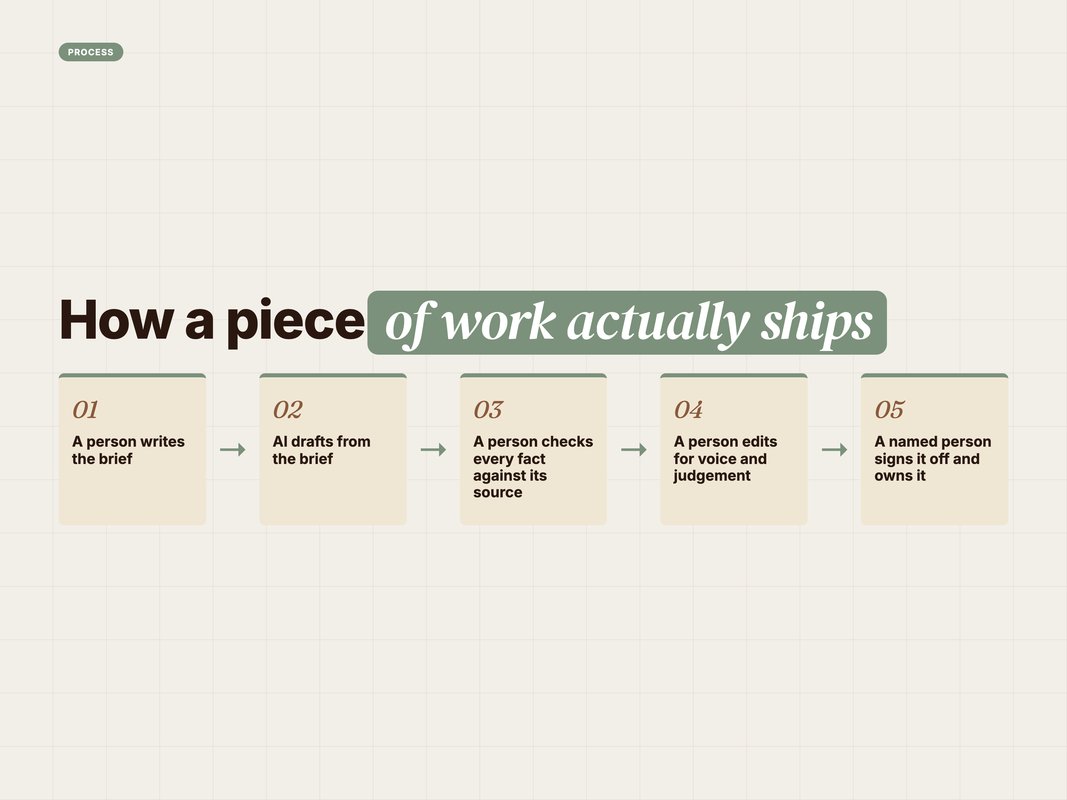
A person writes the brief. That is where the judgement lives: who it is for, what we want them to do, and what is true.
AI drafts from the brief. This is where the speed comes from, and it is real.
A person checks every fact against its source. Not against memory and not against the draft. Against the original page. This is the step that catches the persuasive wrong answer.
A person edits for voice and judgement. Is this how we would say it? Is it fair? Would we be comfortable defending it?
A named person signs it off and owns it. If something is wrong later, there is a name, not a shrug.
We learned the fact-check step the hard way. It is now a hard rule across our content, and it is the reason we trust AI drafts at all. We show the creative side of this in our AI versus human ad creative test.
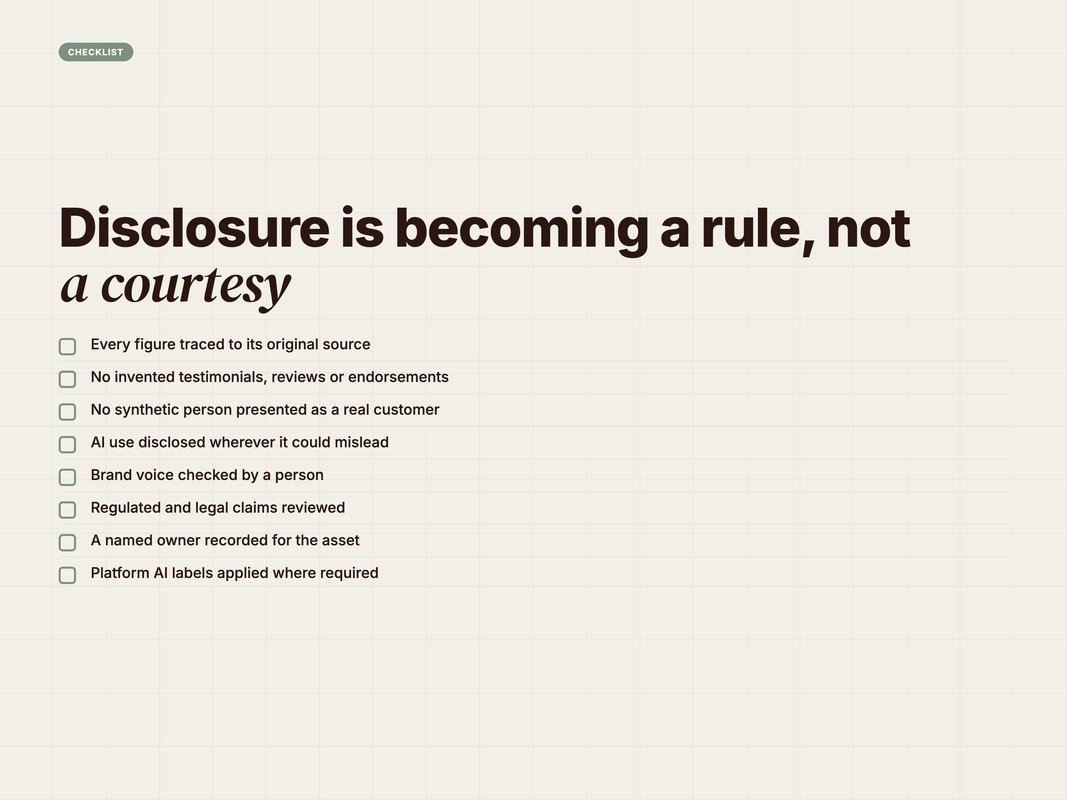
Disclosure is becoming a rule, not a courtesy
There is a trust problem forming, and the industry is misreading it.
The IAB found 82% of ad executives believe young consumers feel positive about AI-generated ads. Only 45% of those consumers actually do. And fewer than half of advertisers always disclose AI use (Source: IAB, 2026 — iab.com).
People want to know. Pew found 76% of Americans say it matters a great deal to know if content was made by AI. But 53% are not confident they could tell (Source: Pew Research Center, 2025 — pewresearch.org).
Regulators are moving to close that gap.
In Europe, the AI Act's transparency rules apply from 2 August 2026. Chatbots must tell users they are talking to AI, and deepfakes must be labelled (Source: European Commission, 2026 — digital-strategy.ec.europa.eu).
In India, amended IT Rules from February 2026 require large social media platforms to label synthetically generated content (Source: MeitY, 2026 — meity.gov.in). That duty sits with the platforms, but it will shape what advertisers can run.
ASCI has also published draft AI labelling guidelines for ads. Under the draft, fabricating an endorsement or testimonial breaks the ASCI code even if it carries an AI label (Source: ASCI, 2026 — ascionline.in). It is still a draft, but the direction is clear.
In the US, the FTC's rule on fake reviews explicitly covers AI-generated fake reviews (Source: FTC, 2024 — ftc.gov).
Search is the one area that is relaxed. Google says appropriate use of AI or automation is not against its guidelines (Source: Google Search Central, 2023 — developers.google.com). It judges the content, not the tool.
Our note on Claude watermarking AI content covers where labelling tech is heading.
What we do at YARD
We are an AI-first growth marketing agency. We run performance marketing, LLM SEO, AI creative and AI funnels for D2C and B2B brands.
AI-first does not mean AI-only. It means we use models wherever they make the work faster or better. And we put people exactly where the jagged frontier bites.
In practice, that looks like this. Models draft, vary, summarise, tag and report. People set the strategy and own the offer. They check every fact against its source, and sign off on anything a customer sees.
That split is why we can move fast without shipping the persuasive wrong answer. It is also why clients get a named owner for every asset, not a black box.
If you are working out where AI fits in your own team, the three-question test is the place to start. Run your ten most common tasks through it. The answer is usually clearer than the debate.
The takeaway
AI is not replacing marketers. It is replacing tasks, and it is making some tasks worse while making others far better.
The best evidence says the danger is not obvious failure. It is confident, coherent, wrong work that gets approved because it reads well.
So ask three questions of every task. How costly is a mistake? How easy is it to catch? And is a named person actually reviewing it?
Hand AI the work that passes. Keep people on the work that does not. And disclose AI use before a regulator makes you.
You can book a call with our team if you want help drawing that line inside your own marketing team.
FAQ
Q: Will AI replace marketers?
A: Not the job, but a large share of the tasks. Marketing leaders surveyed by Gartner expect AI to automate 36% of marketing work by 2028, up from 16% in 2026. The judgement, the checking and the accountability stay human.
Q: Which marketing tasks should stay human?
A: Anything where a mistake is costly and hard to spot. That covers the strategy, the offer and every factual claim. It also covers brand voice on sensitive topics, and the final sign-off.
Q: Does AI make marketing work better or worse?
A: Both, depending on the task. In a peer-reviewed study of 758 consultants, AI users finished more tasks faster and at higher quality within AI's strengths. Outside them, AI users got the right answer less often.
Q: Does Google penalise AI-written content?
A: No. Google says appropriate use of AI or automation is not against its guidelines. It judges content on quality and helpfulness, not on how it was made.
Q: Do I have to label AI-generated ads in India?
A: The rules are forming. India's amended IT Rules require large platforms to label synthetic content, and ASCI has published draft AI labelling guidelines. Under the draft, a fake testimonial breaks the code even if it is labelled.
Q: How much AI content should a human review?
A: All of it, if a customer will see it. McKinsey found only 27% of organisations using generative AI review all of its output before use. That gap is where most AI embarrassments come from.
Insights from Our Experts
Explore our latest articles on digital marketing strategies.