
On August 11, 2026, Anthropic published a support page explaining how Claude marks AI-generated content. Claude will weave an invisible watermark into text it generates, and attach signed provenance data to files it makes.
The Verge reported it as a compliance story. It is. But there is a line in Anthropic's own page that most coverage skipped. It is the line that matters to anyone who ships client work.
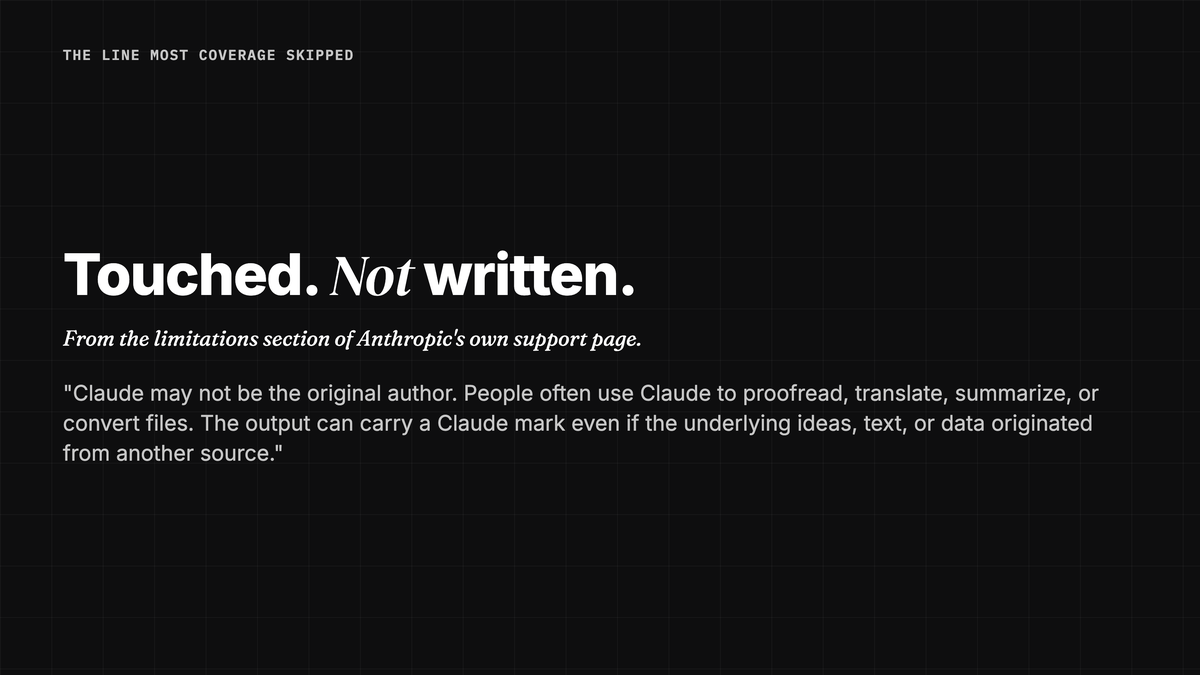
Here it is: "Claude may not be the original author. People often use Claude to proofread, translate, summarize, or convert files. The output can carry a Claude mark even if the underlying ideas, text, or data originated from another source."
Read that again. The mark records that Claude touched the content. It does not record that Claude wrote it.
That gap is where your next awkward client conversation lives.
What Anthropic actually committed to
Anthropic has signed the EU AI Act's Article 50(2) Code of Practice on Transparency of AI-Generated Content. It signed as a provider of both generative AI models and generative AI systems.
Article 50 became enforceable on August 2, 2026. Its transparency and labelling rules split obligations between the companies that build AI and the companies that deploy it. This announcement is the provider half landing.
It is not the first EU rule to reach Indian and global agencies through the back door this year. Meta's new location fees did the same thing to media costs in July.
Four commitments are listed.
New Claude models launched in the EU on or after August 2, 2026 will support machine-readable marking at launch. Generated text carries embedded watermarks. Generated files carry digitally signed provenance metadata where supported.
Marking works everywhere you use Claude. That includes the Claude Platform API, Claude, Claude Code, Claude Cowork and Claude Tag.
Anthropic will help people detect the marks. It says it will support users and third parties in checking content, and will publish technical documentation later.
Existing models are still in progress. The law gives a transition period for models launched before August 2, and Anthropic is working to add marking to those.
The Verge adds useful context here. The EU's new labelling obligations took effect on August 2. There is a four month grace period for AI products that launched before that date. So this is a commitment with a clock on it, not a switch that flipped yesterday.
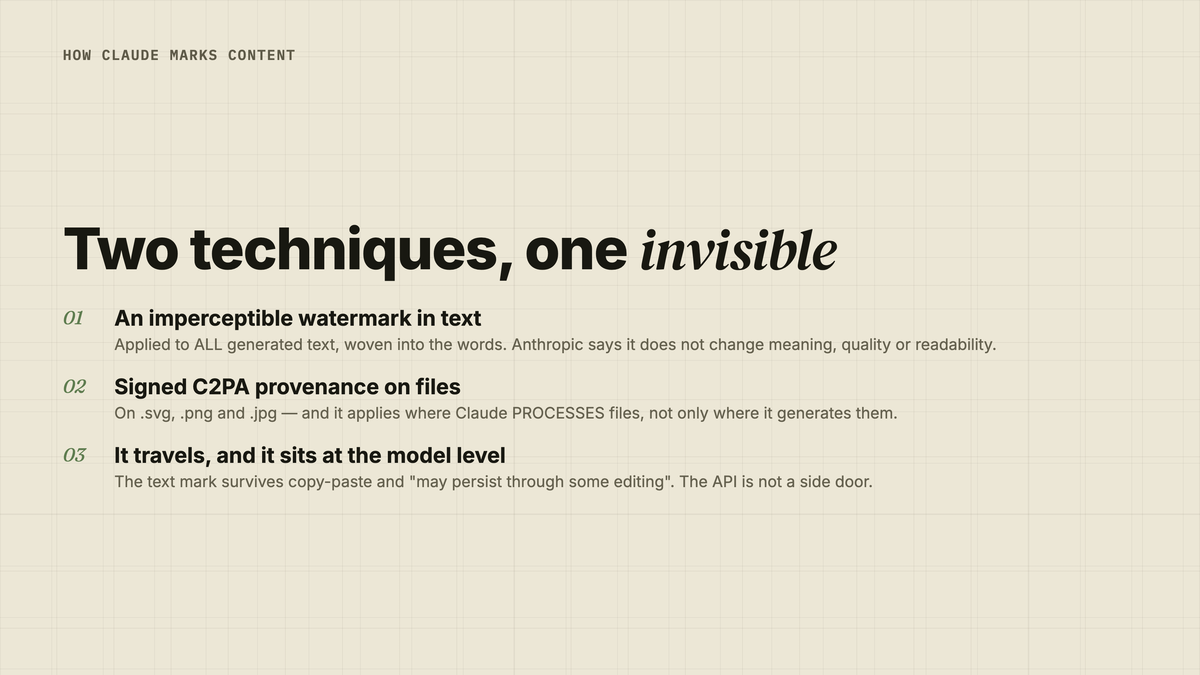
Two techniques, one for text and one for files
Anthropic uses two complementary methods.
Embedded watermarks in text. Anthropic says embedded watermarks will apply to all generated text. When a supported model generates text, it weaves an imperceptible watermark into the words. You will not see it. Anthropic says it does not change the meaning, quality or readability of the response.
Two properties matter. The watermark is part of the text, so it travels when the text is copied and pasted. And Anthropic says it "may persist through some editing".
Signed provenance metadata on files. When Claude generates a supported file type, such as an .svg, .png or .jpg, it attaches signed metadata. This follows C2PA, the Coalition for Content Provenance and Authenticity standard. Adobe, OpenAI and Google already use it.
One word in Anthropic's page widens this. It says provenance metadata will apply "where Claude supports processing files". Processing, not only generating. So a client image you hand to Claude to work on sits in scope too, not just an image Claude invents.
A signed label does two jobs. It signals the file was processed by Claude, and it lets someone check whether the file was tampered with afterwards.
Quick Facts: Claude Content Marking at a Glance
- Anthropic signed the EU AI Act Article 50(2) Code of Practice on transparency — (Source: Anthropic, 2026 — Claude support page)
- Models launched on or after August 2, 2026 mark content from day one — (Source: Anthropic, 2026 — Claude support page)
- Marking applies worldwide, not only in the EU — (Source: Anthropic, 2026 — Claude support page)
- Files use the C2PA provenance standard, already used by Adobe, OpenAI and Google — (Source: The Verge, Aug 11 2026 — report)
- EU labelling rules took effect Aug 2, with a four month grace period for older products — (Source: The Verge, Aug 11 2026 — report)
The sentence marketers need to read twice
Back to the line at the top.
A Claude mark means Claude processed the content. It does not mean Claude authored it.
This is not a reading between the lines. Anthropic's own heading says the techniques mark content "generated and processed by Claude". Both words are load-bearing.
Think about how your team actually uses these tools. Someone writes a case study, then asks Claude to tighten it. A strategist drafts a deck, then asks Claude to check the grammar. A team translates an approved English campaign into Hindi. Someone converts a document into a cleaner format.
Every one of those outputs can carry the mark.
The work was human. The label is not going to say so.
Now add the second half of the problem. Detection is coming, and Anthropic says it will help third parties do it. Platforms will build checks. Clients will buy tools. Procurement teams will run them.
Most of those tools will report a binary. Mark found, or no mark found. Very few will explain the difference between "Claude wrote this" and "Claude proofread this".
So the risk is not that you get caught doing something wrong. The risk is that ordinary, disclosed, perfectly normal use gets read as something else.
It is worldwide, and it sits at the model level
Two details close off the easy escape routes.
First, this is not an EU-only feature. Anthropic says marking applies "wherever Claude is offered, worldwide". A team in Gurugram or Chicago is covered the same as a team in Berlin.
Second, watermarking is applied at the model level. That means it is present no matter which Claude product or surface the text comes from. The API is not a side door. Anthropic also says embedded watermarks apply when supported models are accessed through AWS, Google Cloud or Microsoft Foundry.
There is one gap worth noting. Anthropic says signed provenance metadata may not be supported on every cloud platform, depending on what each one offers. So file marking is less uniform than text marking.
What a detected mark does not prove
Anthropic publishes a limitations section, and it is unusually honest. Marketers should read it before writing any policy.
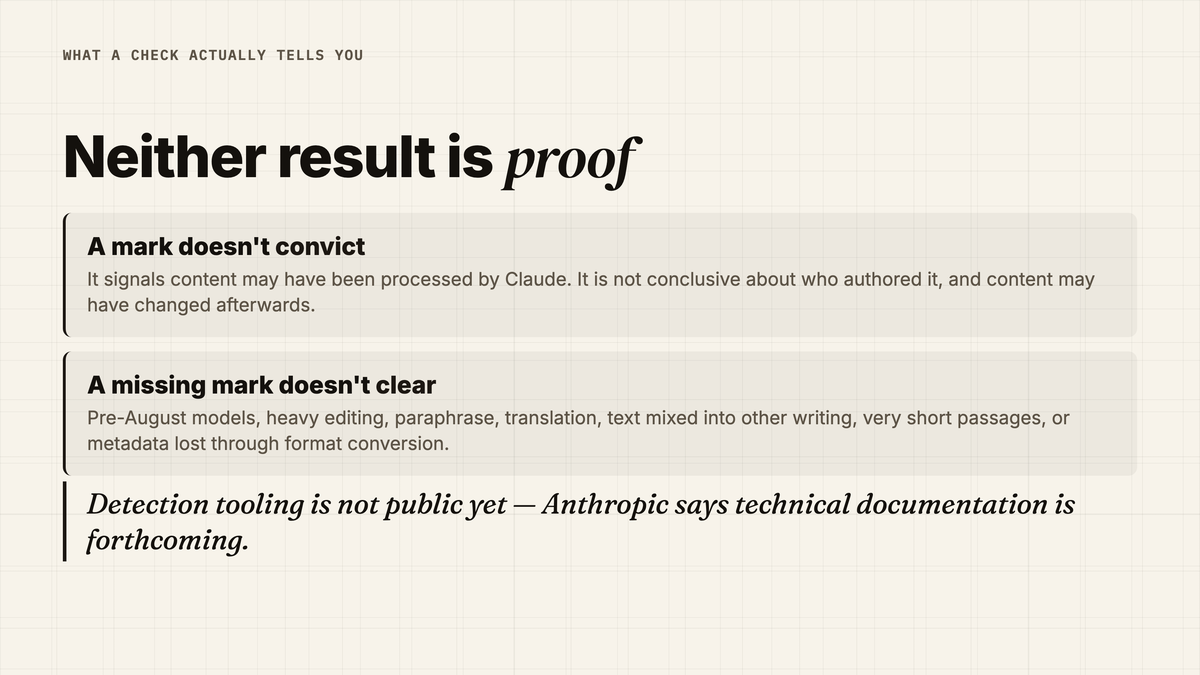
A detected mark is a signal, not a conclusion. As covered above, Claude may not be the author, and content may have been changed after Claude touched it.
The reverse is also true. No mark does not mean no AI. Anthropic lists several reasons a mark might be missing:
- The content came from a model released before marking was supported.
- The text was heavily edited, paraphrased, translated, or mixed into other writing.
- The passage was too short to carry a reliable signal.
- The file's metadata was lost through format conversion, re-saving or a screenshot.
- The platform or file type did not support that marking type.
So neither result is proof. A mark does not convict. A missing mark does not clear.
One thing to say plainly. That list describes how reliable these signals are. It is not a workflow. Building a process designed to strip marks off client deliverables would be a bad idea on every axis. It breaks client trust. It probably breaches the AI-use clause in your own contracts. And it puts you on the wrong side of a rule that is only going to tighten.
Disclose instead. It is cheaper and it lasts.
What this changes for an agency
Three things change, and none of them are technical.
Your AI-use disclosure stops being optional. Until now, telling a client how you use AI was a values decision. Once a detector can flag a deliverable, silence starts to look like concealment even when nothing was concealed. Get ahead of the tool.
Your proofreading step becomes a disclosure question. This is the sharpest one. Most agencies would not describe a grammar check as "AI-generated content". The mark does not care about that distinction. Decide now how you describe light-touch use, and put it in writing before somebody asks.
Image deliverables inherit provenance. Any .png, .jpg or .svg Claude produces carries signed C2PA data. If you supply creative assets, that data travels with the file into the client's systems. From there it may reach a platform that reads it. We saw the same direction of travel when Google started generating images inside Search. Provenance is becoming part of the asset, not metadata nobody looks at.
Who feels this first
Not every team is equally exposed. Three groups should move now.
Agencies and freelancers. You ship work under someone else's name. That is the exact case where a mark on a deliverable raises a question you did not choose to answer. Your exposure is highest and your control is lowest.
Regulated and public-sector clients. Legal, health, finance, government. These buyers already have disclosure rules, and they are the most likely to run checks early. If you serve them, your policy needs to exist before their procurement asks for it.
Anyone publishing at volume. Programmatic pages, product descriptions, localisation, bulk social. High-volume work is where light AI touches are most common and least documented. It is also the work most likely to be scanned in bulk.
Two groups can relax slightly. Internal-only content does not travel, so a mark on it changes little. And teams who already publish an AI-use statement have done the hard part. They just need to check that it covers proofreading, translation and file conversion, not only drafting.
The disclosure policy to write this week
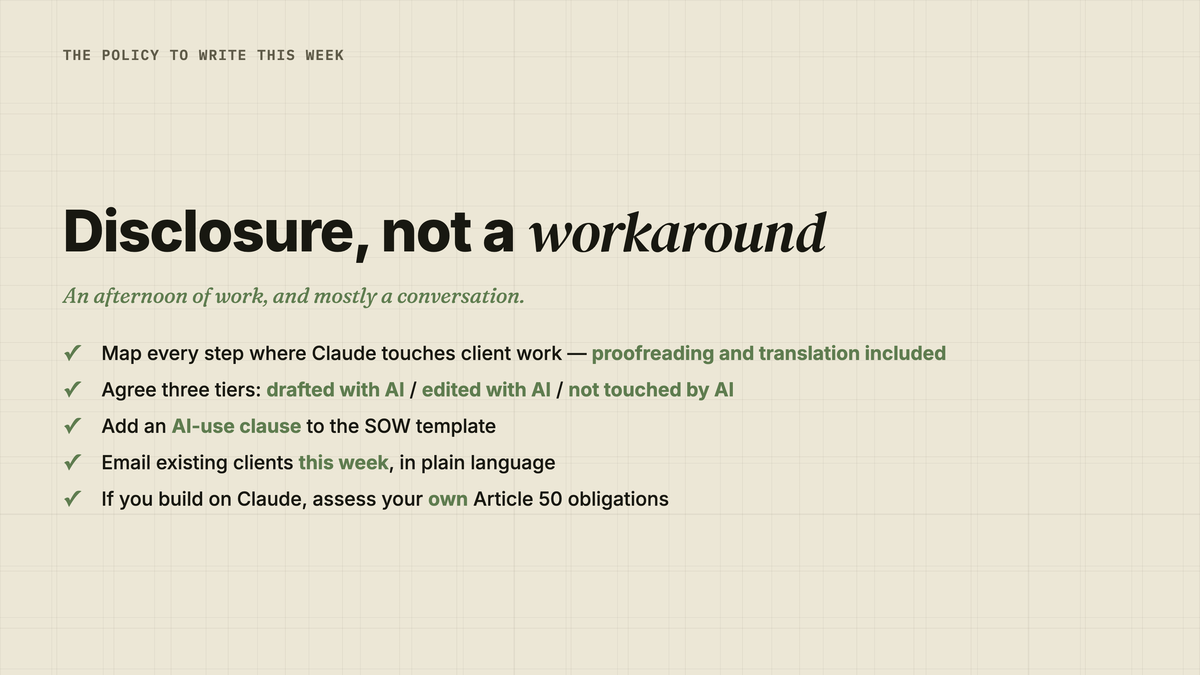
Six steps. It takes an afternoon, and it is mostly a conversation rather than a build.
- Map where Claude touches client work. Include the boring steps: proofreading, translation, summarising, reformatting. Those are the ones that will surprise you.
- Write three tiers of use. Drafted with AI. Edited with AI. Not touched by AI. Agree what each means internally before you use the words with a client.
- Add an AI-use clause to your SOW template. State which tiers you use, on what, and how you will tell them.
- Tell your existing clients now, in plain language. A short note today is worth far more than an explanation after a detector fires.
- Brief the account team on the processing-versus-authorship gap. They will be the ones asked, and they need one clear sentence ready.
- If you build a product on Claude, read Anthropic's note to developers. It says you should independently assess what Article 50 requires of your own products and services. That obligation is yours, not Anthropic's.
The limits to keep in mind
Be honest about what is not settled.
Detection tooling does not exist publicly yet. Anthropic says documentation is forthcoming. Until it ships, nobody can tell you exactly what a check will report.
Older models are not covered yet. Marking applies at launch to models released on or after August 2, and support for earlier models is still being added.
File marking is uneven. Signed metadata depends on the file type and the platform.
And this is one vendor. Anthropic has signed a code of practice. Other providers are on their own timelines, so a mixed toolchain will produce mixed signals for a while.
None of that is a reason to wait. The policy work is useful whatever the tooling ends up looking like.
The YARD take
For three years the AI conversation in marketing has been about capability. What can it make, how fast, how cheap.
This story is about a different question: what does your work carry with it.
Content is starting to travel with a record of what happened to it. That is a good thing for a web drowning in unlabelled output. It is also an awkward thing for the ordinary, sensible, half-human workflows that most good teams actually run.
The teams that will handle this well are not the ones with the cleverest tooling. They are the ones who already told their clients how they work. For everyone else, the fix is not technical. It is a page in the SOW and one honest email.
Write the email this week. The detectors are coming, and they will not be nuanced.
FAQ
What did Anthropic announce? That Claude will mark AI-generated content, as described on its support page. Text gets an invisible embedded watermark. Files get signed C2PA provenance metadata.
When does it start? Claude models launched on or after August 2, 2026 support marking at launch. Support for older models is still being added, under the EU's transition period.
Does this only apply in the EU? No. Anthropic says marking applies wherever Claude is offered, worldwide, and across the API, Claude, Claude Code, Claude Cowork and Claude Tag.
If I only use Claude to proofread, does my text get marked? It can. Anthropic states plainly that output can carry a mark even when the ideas or text came from somewhere else. That includes proofreading, translation and summarising.
Does a detected mark prove content was AI-written? No. Anthropic says a mark signals the content may have been processed by Claude, and is not conclusive about who authored it.
Does the absence of a mark prove no AI was used? No. Marks can be missing for several reasons. Older models, heavy editing, very short passages, or metadata lost through format conversion or screenshots.
What should an agency do first? Write down every step where Claude touches client work. Include proofreading and translation. Then agree a disclosure tier for each, and add an AI-use clause to your SOW.
Sources
- Anthropic — How Claude marks AI-generated content (primary source; commitments, techniques and limitations)
- The Verge — Claude will apply invisible watermarks to AI text and images (Jess Weatherbed, August 11, 2026; EU grace period and C2PA context)
- The Verge — EU AI Act transparency labels and rules on deepfakes
- The Verge — C2PA, the standard used to verify AI-generated images
Insights from Our Experts
Explore our latest articles on digital marketing strategies.