

Education marketing got harder in a very specific way. Leads still arrive. Fewer of them turn into students.
That gap is the whole story of 2026. Costs are climbing while conversion slips, and the two are not the same problem.
This is a working playbook. What the numbers say. Which channels still earn their budget. Where the funnel actually leaks. And a 90-day plan you can run without a new tool stack.
Where the Journey Changes Hands
Start with the shift that already happened.
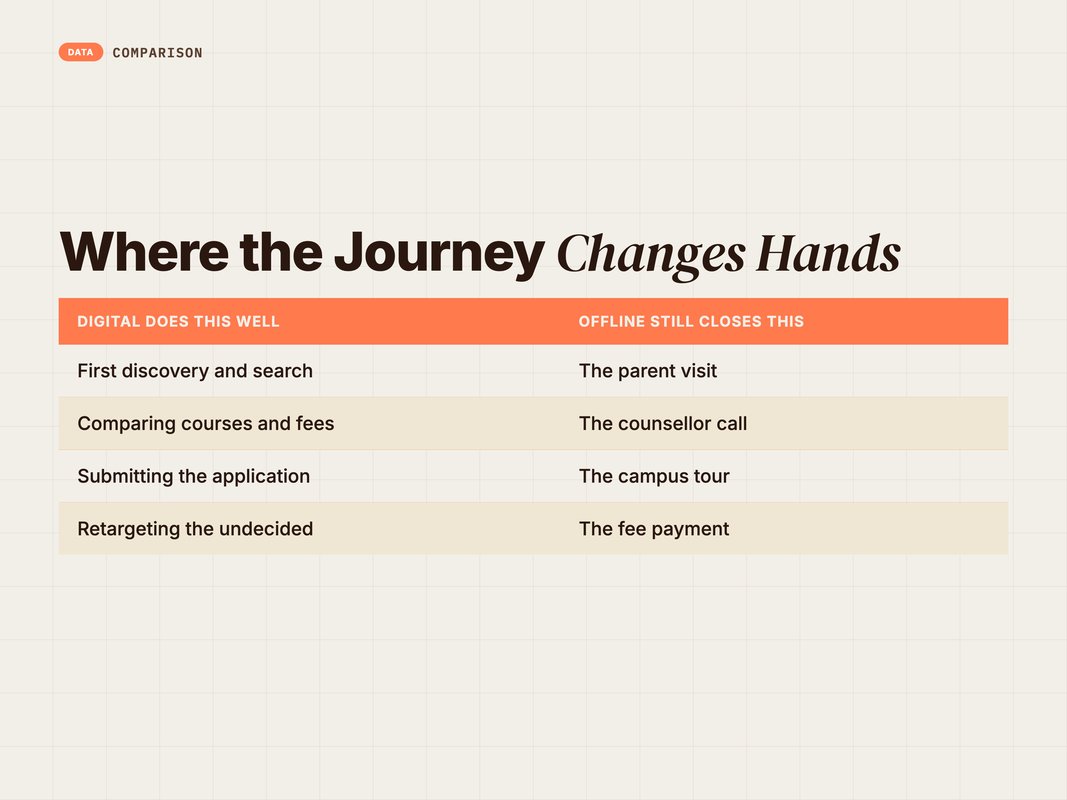
In India, most education journeys now start online. Discovery, comparison and the application itself happen on a phone. The enrolment decision is where that changes.
Notice where the journey changes hands. Applications are more digital than enrolments.
That gap is where offline still wins. The parent visit. The counsellor call. The campus tour. Digital gets them to apply. Something human gets them to pay.
The cost side is moving too. Education lead costs are rising on three fronts. More competition, AI-led ad auctions, and falling organic reach. Conversion rates are slipping even as spend goes up (Source: Wildnet Technologies, 2026 — wildnettechnologies.com).
So you are paying more per lead and converting fewer of them. Two separate leaks, and most teams only patch the first.
Q: Is this a spend problem or a funnel problem?
A: Usually a funnel problem wearing a spend problem's clothes. If your cost per lead rose 20 percent but cost per enrolment rose 60 percent, the leak is after the form.
Why Cost Per Lead Is the Wrong Target
The most expensive habit in education marketing is optimising to the form fill.
A form fill is not a student. It is a request for information, and the distance between the two is where the money lives.
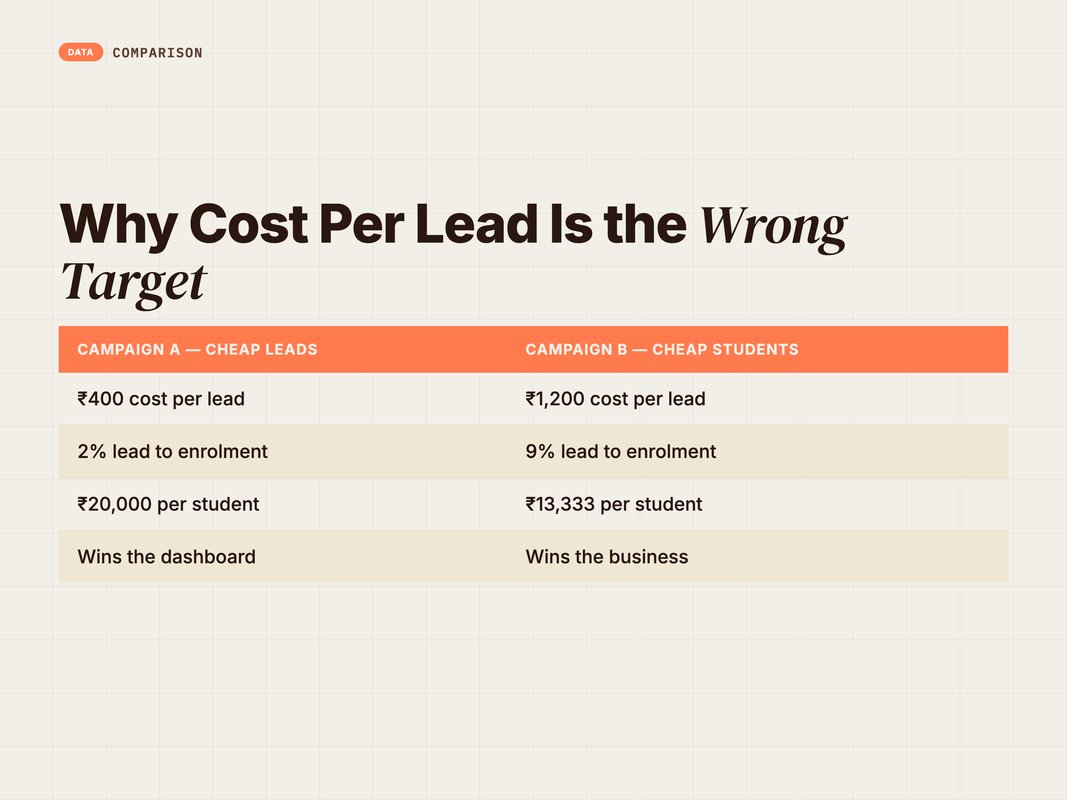
Here is the arithmetic that changes behaviour. Take two campaigns.
Campaign A delivers leads at 400 rupees and converts 2 percent to enrolment. That is 20,000 rupees per student.
Campaign B delivers leads at 1,200 rupees and converts 9 percent. That is 13,333 rupees per student.
Campaign B looks three times worse on the dashboard everyone reports. It is meaningfully cheaper on the only number that matters.
To use this, you need the enrolment event flowing back to your ad platforms. Not the form fill. The paid enrolment.
Most institutes have this data in a CRM and never send it back. That single connection changes what the bidding algorithms optimise toward.
Q: What if enrolment takes three months?
A: Then send back the strongest mid-funnel signal you have. A counsellor-qualified lead or a completed application. Anything closer to money than a form fill.
The Channels That Still Earn Their Budget
Channel debates are usually pointless because the channels do different jobs. Here is the honest split.
Search still converts best on intent. Someone typing a course name plus a city is the closest thing to a ready buyer in this category. Protect this budget first.
Social builds the demand search later captures. Reels and Shorts have replaced static posts as the main format for student acquisition (Source: Wildnet Technologies, 2026 — wildnettechnologies.com). Judge it on assisted conversions, not last click.
Counsellor follow-up converts more than either. It is not a marketing channel on most org charts. It should be, because it is where the enrolment is won or lost.
Referral and alumni is the cheapest source almost everyone underuses. It needs a system, not a hope.
Organic and AI search is the slow compounder. Course pages, fee pages and career-outcome pages are what people actually search for.
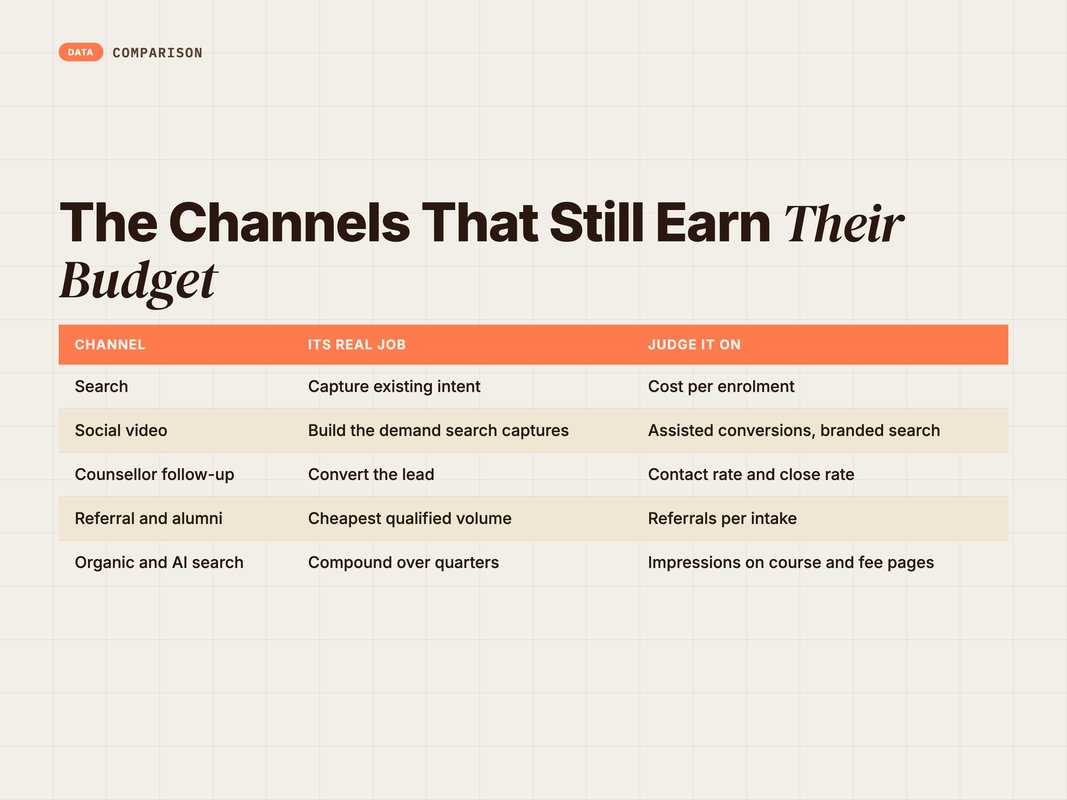
The mistake is running these as separate scoreboards. Social gets judged on last-click conversions, loses, and gets cut. Six weeks later, search volume falls and nobody connects the two.
Q: Should I cut social if it shows no direct conversions?
A: Not before you check branded search volume and assisted paths. In this category, social usually shows up in someone else's conversion report.
Where the Funnel Actually Leaks
We audit a lot of education accounts. The leaks repeat.
Leak one: speed to contact. Leads sit for hours. In a category where a student is filling five forms in one evening, hours is a loss. Minutes is the standard.
Leak two: the fee page. Prospects hunt for price. If your fee structure is vague, gated or missing, they leave to find it somewhere else and often do not come back.
Leak three: mobile forms. Long forms on phones lose people at every extra field. Ask for less, then qualify on the call.
Leak four: counsellor scripts. The same lead handled by two counsellors converts very differently. That variance is usually the biggest single number in the whole funnel.
Leak five: nothing after the no. A prospect who says "next intake" gets marked lost and never contacted again. That is a warm list being thrown away.
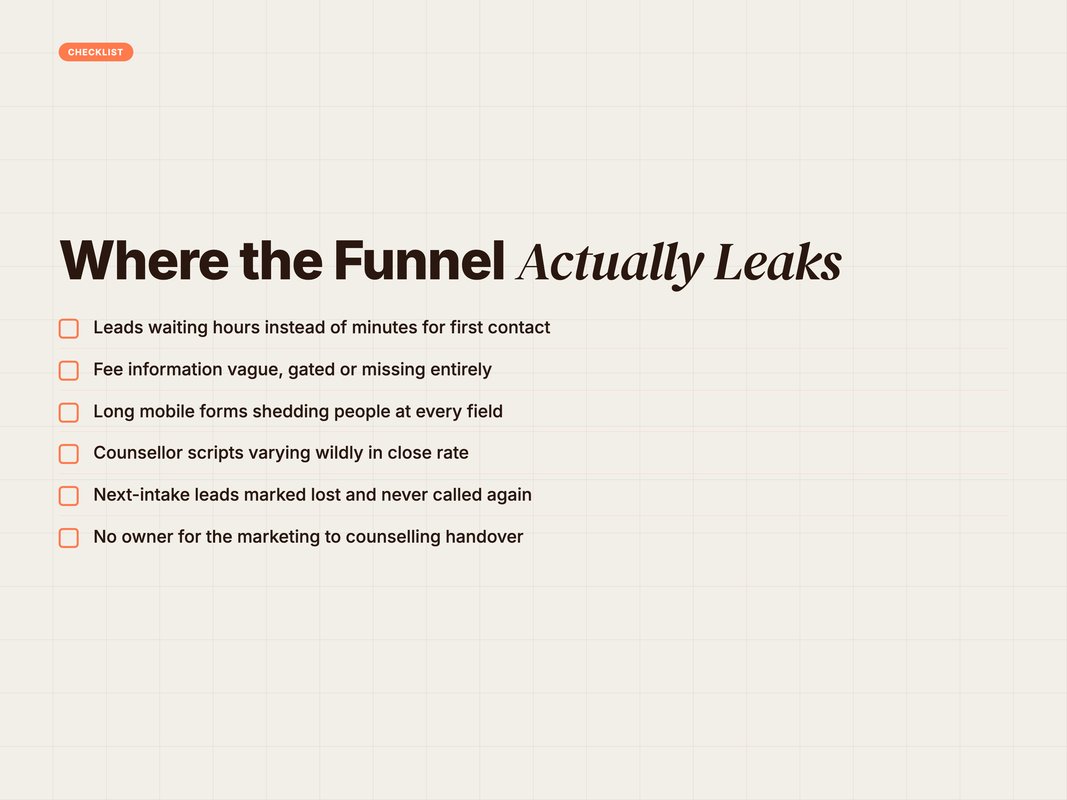
Fix these in order of cost. Speed to contact and follow-up cost almost nothing and move more than any bidding change.
There is a sixth leak worth naming, because it hides inside the other five. Nobody owns the handover.
Marketing owns the lead. Counselling owns the call. In between sits a gap where leads go cold, and neither team feels responsible for it.
Give that gap an owner and a number. Contact rate within five minutes, reported weekly, in the same meeting as ad spend. Shared metrics fix handovers faster than new tools do.
Q: What is a realistic speed to contact?
A: Under five minutes for a call attempt, with an instant automated acknowledgement. That combination alone lifts contact rates in most accounts we see.
What AI Actually Helps With Here
Skip the hype and look at where it earns its place in an education account.
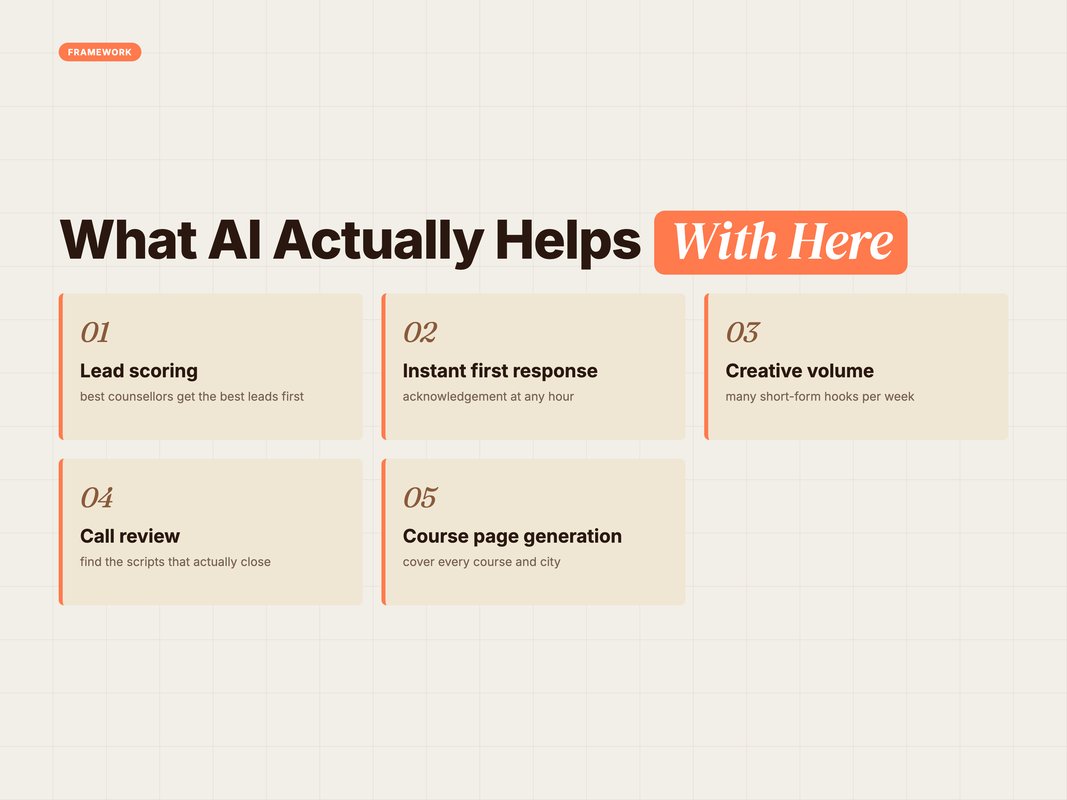
Lead scoring. Ranking today's leads by likelihood to enrol, so counsellors call the best ones first. This is the highest-value use and the least glamorous.
First-touch response. An instant, useful reply at 11pm on a Sunday. Not a chatbot pretending to be a counsellor. A fast, honest acknowledgement with the fee page and the next intake date.
Creative volume. Short-form video needs constant new hooks. AI-assisted variants let a small team test many angles a week instead of two.
Call review. Transcribing and scoring counsellor calls surfaces which scripts convert. Most teams have never looked at this data because listening to 200 calls is nobody's job.
Course page generation. If you run 40 courses across 6 cities, that is a lot of pages nobody has time to write well.
What AI does not fix is a weak offer, an unclear outcome or a fee nobody can find. No model saves a course page that will not say what job it leads to.
It also will not fix a course nobody wants. If a programme converts badly across every channel and every counsellor, the problem is the programme.
That is an uncomfortable finding to deliver. It is also the most valuable one an audit can produce, because it saves a year of media spend.
Q: Will AI replace counsellors?
A: No, and trying will cost you enrolments. Use it to get the right lead to the right counsellor faster, with better context on the screen.
What the Pages Have to Say
Most education sites are written for the institute, not the student. That shows up in conversion rate.
A prospect arrives with four questions. What will this cost. How long will it take. What job does it lead to. When does it start.
Answer all four above the fold and your form fill rate moves. It is that blunt.
Fees. Publish a real number or a real range. "Contact us for fees" reads as expensive. It pushes people to a competitor who was willing to say.
Duration and format. Weeks or months, online or on campus, weekend or weekday. Ambiguity here creates unqualified leads that waste counsellor time.
Outcome. Not "industry-ready professionals". A job title, a salary band you can defend, and the names of the roles graduates actually take.
Next intake. A date. Urgency in this category is genuine, not manufactured, and most sites hide it.
Add the proof underneath. Placement numbers you can stand behind, a few named outcomes, and a syllabus people can actually read.
One caution on numbers. Every placement or salary claim you publish should be verifiable, because prospects and their parents will check. An unsupported figure costs you more trust than it buys.
Q: Should we really publish fees?
A: Yes, in almost every case. Hiding fees does not stop price comparison. It just moves the comparison to a page you do not control.
The 90-Day Plan
If you do nothing else this quarter, do this in order.

Days 1 to 15. Fix measurement. Connect enrolment, not form fills, back to your ad platforms. Agree one definition of a qualified lead with the counselling team.
Days 16 to 30. Fix speed. Route every lead to a human or an instant acknowledgement within five minutes. Measure contact rate before and after.
Days 31 to 45. Fix the fee and outcome pages. Publish fees plainly. State the career outcome in the first two lines. Add the next intake date.
Days 46 to 60. Rebuild the creative engine. Move budget from static to short form. Ship at least ten new hooks a month and kill the losers weekly.
Days 61 to 75. Score and route. Turn on lead scoring so your best counsellors get your best leads.
Days 76 to 90. Reopen the lost list. Re-contact every "next intake" lead from the last two cycles with the new dates.
Nothing here needs a platform migration. Most of it needs a decision and a fortnight.
The order matters more than the speed. Measurement first, because every later decision leans on it. Speed second, because it is nearly free.
Creative comes fourth on purpose. Shipping more assets into a leaking funnel just makes the leak more expensive.
How We Run Education Accounts
Education is a category where the marketing and the sales floor cannot be separated. Most agencies stop at the form fill. That is the wrong place to stop.
The reason is simple. The form fill is the last event a marketing team can see without help. Everything past it needs the CRM, the counsellors and a shared definition of a good lead.
That is a coordination problem before it is a marketing one.
YARD is an AI-first growth marketing agency. We run performance marketing, LLM SEO, AI creative and AI funnels for D2C and B2B brands, including education and skilling clients.
Three habits define how we work an education account.
We report on cost per enrolment from week one. If the enrolment data is not connected yet, connecting it is the first project, not a later one.
We treat the counsellor floor as part of the funnel. Call review, script testing and routing rules sit inside the marketing plan, not outside it.
And we build the creative engine for volume. In a category driven by short-form video, a team shipping four assets a month cannot compete with one shipping forty.
If your leads are up and your enrolments are flat, the answer is almost never a new channel. It is usually four fixes between the form and the fee payment. For the wider paid picture, see State of Performance Marketing in India — 2026.
The Short Version
Digital now drives most education leads, applications and a majority of enrolments. It is the funnel, not a channel.
Costs are rising and conversion is slipping. Those are two different leaks and they need different fixes.
Stop optimising to cost per lead. Send enrolment data back to your platforms and optimise to cost per enrolment instead.
Give each channel the right job. Search for intent, social for demand, counsellors for conversion, referral for cheap volume, organic for compounding.
Then fix the five leaks. Speed to contact, the fee page, mobile forms, counsellor scripts, and the lost list you never call again.
Want that audit run on your funnel before the next intake? Talk to the YARD team and bring three months of lead and enrolment data.
FAQ
Q: Why are EdTech lead costs rising in 2026?
A: Three forces at once. More brands bidding, AI-led ad auctions concentrating demand, and organic reach falling on social. Spend goes up while conversion rates slip.
Q: Is digital now the main enrolment channel?
A: For discovery and applications, yes. The final enrolment decision still leans on the parent visit, the counsellor call and the campus tour. Digital is no longer a channel. It is the front of the funnel.
Q: Which channel converts best for EdTech?
A: Search converts best on intent. Social builds the demand that search later captures. Counsellor-led follow-up converts more than either. Judge them together, not separately.
Q: How fast should you call an education lead?
A: Minutes, not hours. Speed to first contact is the single biggest lever most institutes leave unpulled. Route leads to a human or a bot within five minutes.
Q: Does short-form video actually drive enrolments?
A: It drives consideration, rarely direct enrolment. Reels and Shorts have replaced static posts as the main format. Measure them on assisted conversions and branded search lift.
Q: What is the right metric for EdTech marketing?
A: Cost per enrolment, not cost per lead. A cheap lead that never enrols is a cost. Track the whole path from click to fee payment.
Insights from Our Experts
Explore our latest articles on digital marketing strategies.