

On 12 October 2026, Meta launched two new AI models. They are called Muse Wonder and Muse Wonder Full.
Meta calls them its most capable models so far (Source: Meta, 2026 — Introducing Muse Wonder).
Most launch posts lead with a test score. This one leads with two habits.
The first is memory. The model keeps what matters to you from one chat to the next.
The second is focus. When a task gets hard, it tries another way and keeps going.
Those two habits are the story for a marketing team. A tool that forgets your brand every morning costs you time. A tool that gives up halfway costs you more.
This piece is a read of Meta's own launch material. Where a number comes from Meta, we say so. Where it comes from someone else, we name them.
What Meta actually shipped
Two models. One family.
Muse Wonder is the main model. Muse Wonder Full is the bigger version, built for the hardest work.
Meta says both are built for real tasks. Its own examples are plain ones. Sorting out an insurance claim. Making sense of a lease. Building a working app.
They build on Muse Spark, Meta's earlier model line. Meta says it began a full rebuild of its AI work fourteen months ago.
It also says the new models were trained at its gigawatt-scale Prometheus data centre (Source: Meta research blog, 2026 — Muse Wonder).
That detail matters for one reason. Meta is no longer a fast follower in this race. On its own chart, it now sits close to the top.
Here is who can use what, today:
- Muse Wonder is out now for builders through the Meta Model API.
- Muse Wonder is also out now in Muse Code.
- Muse Wonder Full is out now for paid Muse Code users.
- The Muse app gets Muse Wonder soon. Paid users get it first.
So if you are not a builder, you are waiting. If your team has a developer, you can test it this week.
Active Memory: it keeps your context
Meta calls the first habit Active Memory.
In plain words, the model carries what matters to you across chats. Then it pulls back the right details when a new task needs them.
Think about how your team uses AI today. Every new chat starts from zero.
You paste the brand book again. You explain the client again. You remind it that the founder hates the word "solutions".
That is wasted time, and it is also where mistakes creep in. Someone forgets to paste the tone guide, and the copy drifts.
A model that remembers removes that step. Tell it the background once. Then check whether it still knows it next week.
Meta tested this on a benchmark called MemoryBench. It checks long-term memory of context.
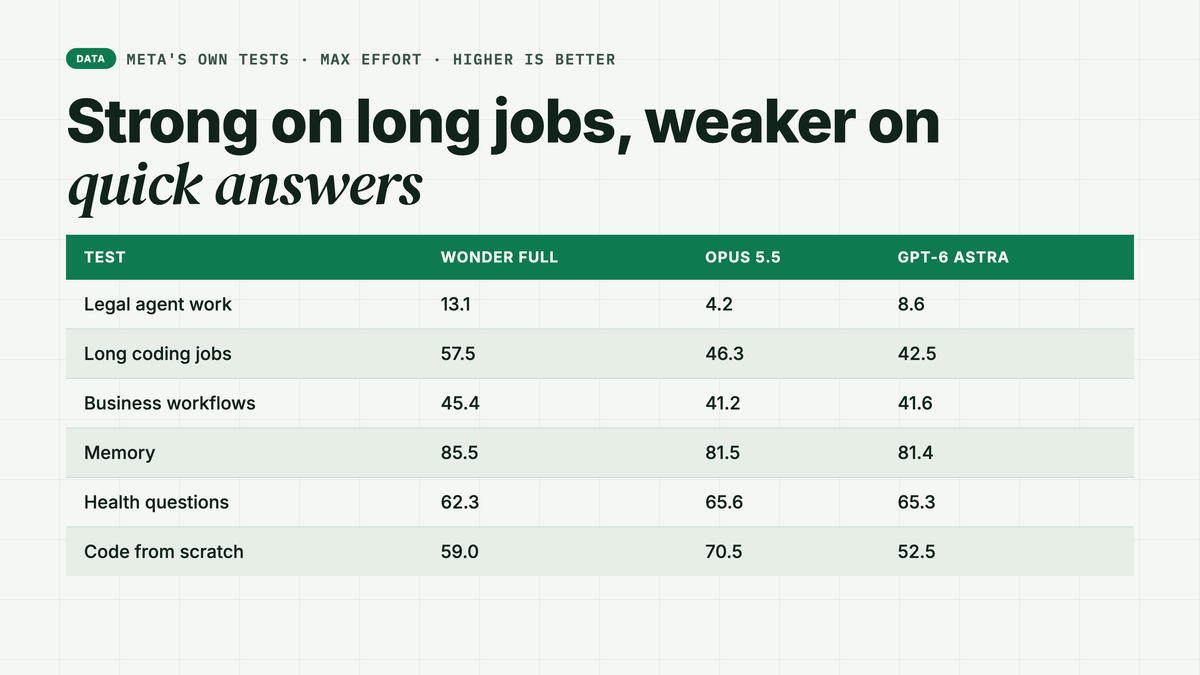
Muse Wonder Full scored 85.5. The smaller Muse Wonder scored 85.6. Claude Opus 5.5 scored 81.5, and GPT-6 Astra scored 81.4 (Source: Meta research blog, 2026 — evaluation table).
That is a clear lead on Meta's own test. It is still Meta's own test.

Active Focus: it keeps going
The second habit is Active Focus.
Meta describes it like this. When a task gets hard, the model tries other approaches. It works through blockers. It recovers from its own errors.
It also asks for clarity when it needs to. And it checks in with you before it does anything important.
That last part is the one to hold on to. An agent that acts on your behalf needs a brake. Meta says it built one in.
Why does focus matter to a marketer? Because most real marketing work is long.
A monthly report is not one question. It is pulling data, cleaning it, spotting the change, writing it up and checking the numbers.
A campaign launch is not one headline. It is a brief, ten variants, a review round and a final set.
Older models did the first step well and then wandered off. Focus is the fix for wandering.
Meta's best proof here is a coding test called SWE-Marathon. It checks very long software jobs.
Muse Wonder Full scored 57.5 at its highest effort setting. Claude Opus 5.5 scored 46.3, and GPT-6 Astra scored 42.5 (Source: Meta research blog, 2026 — evaluation table).
That is the biggest gap on Meta's whole table. Long jobs are where this model is strongest.
The demo that matters: it worked across apps
Meta showed several demos. One is worth a close look.
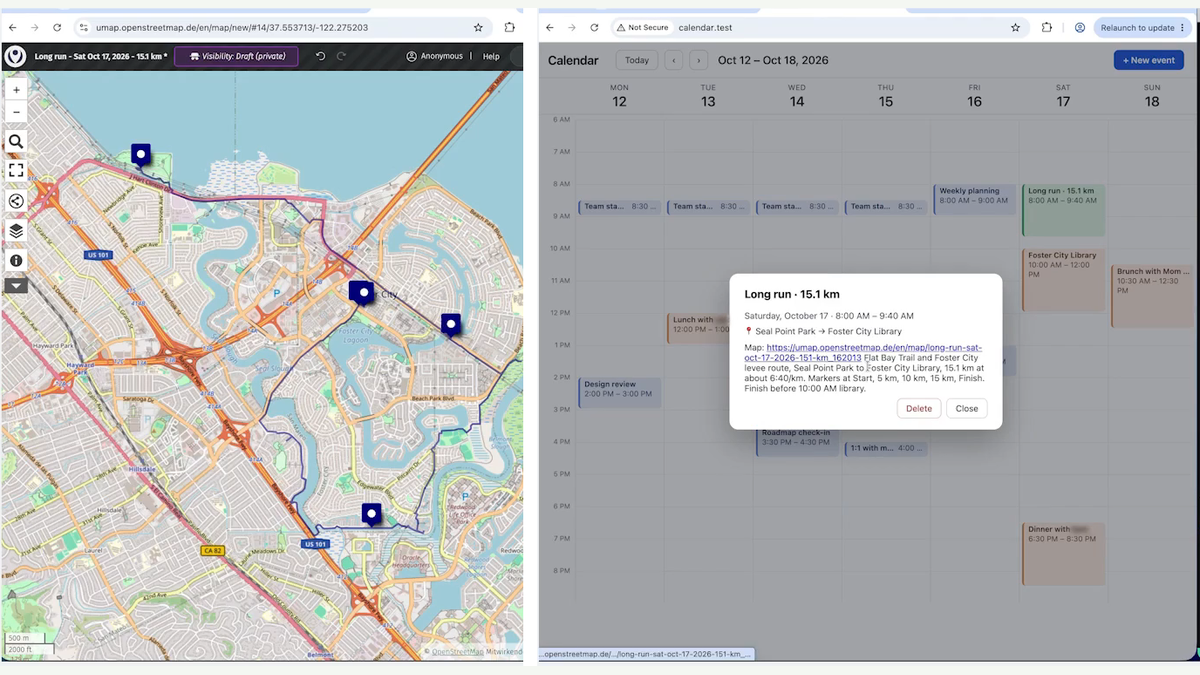
It is called Saturday Run Planning. Meta says the model worked in a browser and across apps to build a running plan around a person's needs.
In the screen recording, it reads a calendar. It maps a 15.1 km route. Then it puts the long run into the calendar for Saturday morning.
Read that as a marketer, not as a runner. The model did not just answer a question. It finished a job across three tools.
Now swap the run for your work. Read the campaign calendar. Check the asset folder. Book the review slot.
That is the shape of task that eats a coordinator's week. It is also the shape of task this model is built for.
A second demo is even closer to home. Meta says the model designed and ordered custom swag using real photos from a personal Instagram profile.
That is brand merch, built from a social feed, with no designer in the loop. Treat it as a demo, not a promise. But it shows where this is heading.
Where it wins, and where it does not
Meta published a full table of test results. It compares Muse Wonder Full with three rivals. Each model ran at its maximum effort.
Here is the short version.
It wins clearly on legal work. On Harvey's Legal Agent Benchmark, Muse Wonder Full scored 13.1. Claude Opus 5.5 scored 4.2, and GPT-6 Astra scored 8.6.
It wins on business workflows. On AutomationBench-AA, it scored 45.4, against 41.6 for GPT-6 Astra and 41.2 for Claude Opus 5.5.
It wins on long coding jobs, as you saw above. And it wins on memory.
It does not win on health. On HealthBench Pro, Claude Opus 5.5 scored 65.6, GPT-6 Astra scored 65.3, and Muse Wonder Full scored 62.3.
It does not win on coding from scratch either. On ProgramBench, Claude Opus 5.5 scored 70.5 against 59.0 for Muse Wonder Full.
All of these figures come from Meta's own evaluation table (Source: Meta research blog, 2026 — Muse Wonder).
So the pattern is simple. It is strongest on long jobs and on remembering context. It is weaker on short, expert answers.
That should shape what you hand it first. Give it the long, messy task. Keep the quick specialist question with the tool you trust now.
The outside scores
Vendor tables are useful. Outside scores are better.
The first one is the Artificial Analysis Intelligence Index. Meta printed it on its own launch page.
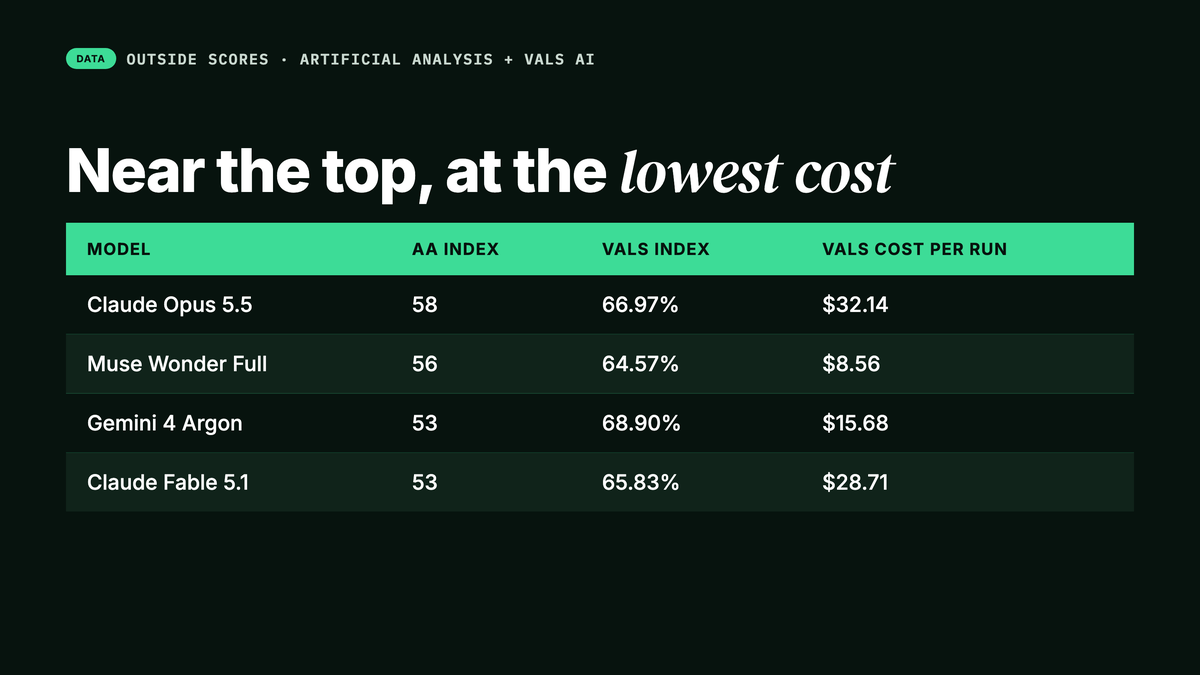
On that chart, Muse Wonder Full scored 56. Only Claude Opus 5.5 scored higher, with 58. Claude Fable 5.1, GPT-6 Astra and Gemini 4 Argon all scored 53 (Source: Artificial Analysis, 12 October 2026, via Meta).
The smaller Muse Wonder scored 52. That puts it level with GPT-6.1 Sol on the same chart.
The second outside score is the Vals Index. It tests models on finance, coding, legal and tax work.
There, Muse Wonder Full placed fifth with 64.57% (Source: Vals AI, 2026 — Vals Index). Gemini 4 Argon led with 68.90%.
On the same board, Claude Opus 5.5 scored 66.97% and Claude Fable 5.1 scored 65.83% (Source: Vals AI, 2026 — Vals Index).
So on one outside test it is second. On another it is fifth. Both are true, and both belong in your deck.
There is one more number on the Vals page worth a look. It is the cost to run the full test.
Muse Wonder Full cost $8.56 per test run. Gemini 4 Argon cost $15.68. Claude Fable 5.1 cost $28.71. Claude Opus 5.5 cost $32.14 (Source: Vals AI, 2026 — Vals Index).
That is the cheapest run of the top five on that page. If your team pays per task, that gap adds up fast.
We went through the same exercise when Meta shipped Muse Image and the open model Muse Glimmer. The rule does not change. Name the source, every time.
The privacy question you must ask
A model that remembers you is also a model that stores things about you.
Meta seems aware of this. It says it trained the Muse Wonder family not to share private information without permission.
It also says a personal agent may work across your messages, calendars and documents. That is exactly why it built in care with private data.
Meta adds that a full report with more safety tests will be out soon (Source: Meta, 2026 — Introducing Muse Wonder).
For an agency, this is not a side issue. It is the first question legal will ask.
You hold client data. Briefs, sales figures, launch dates, sometimes customer lists.
Before anyone pastes that into a tool with memory, get three answers in writing.
- What does it remember, and for how long?
- Can you see what it remembers, and delete it?
- Does any of it leave your account, or train a future model?
If the answers are vague, keep client data out until the full safety report lands. Use it on internal work first.
That is not a reason to skip the test. It is a reason to run the test in the right sandbox.
How we would test it this week
Here is the plan we would run. It takes one person and about a week.
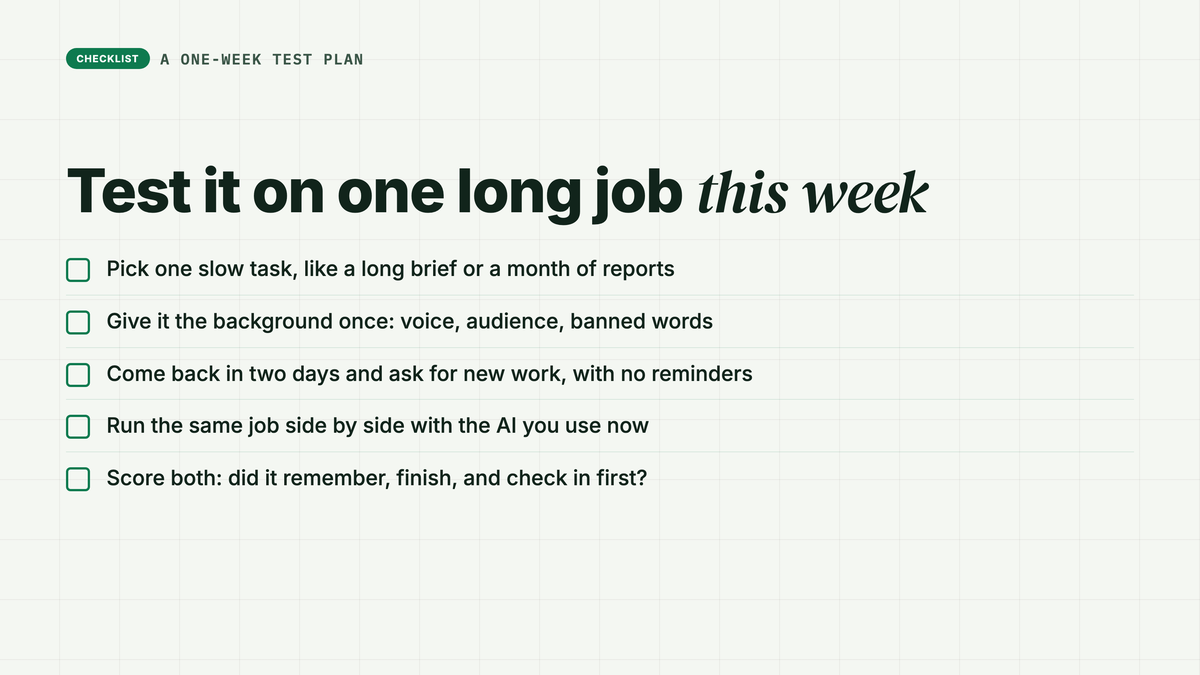
First, pick one slow task. A long brief, a month of reports, or a content calendar that always runs late.
Second, tell it the background once. Brand voice, audience, the words the client bans. Then leave it.
Third, come back two days later. Ask for new work without repeating the context. Check whether it still knows the rules.
Fourth, run the same job side by side. Same task, same files, with the AI you use today.
Fifth, score both on three things. Did it remember? Did it finish? Did it ask before doing anything big?
Write the results down. One honest page beats ten launch charts.
What this means for your plans
Three things change for marketing teams after this launch.
The first is choice. Meta is now a serious option for long agent work, not just a social platform with an AI chat box.
The second is memory as a feature to buy. Until now, most teams built memory themselves with long prompts. A model that keeps context could make that work lighter.
The third is the app. When Muse Wonder reaches the Muse app, your clients may use it before your team does.
That is worth thinking about early. Your client may ask why their own AI already knows their brand and yours does not.
So start a simple brand memory file now. Put the voice rules, the banned words, the audience notes and the past winners in one place.
It will help with any tool you pick. And when a model with memory joins your stack, the context is ready on day one.
One last note on timing. Model launches now land every few weeks. Gemini 4 Argon shipped the very next day.
So treat this as a test slot, not a switch. Run the trial, write it down, and decide with your own numbers.
FAQ
Q: What is Meta Muse Wonder?
A: It is Meta's newest AI model family, launched on 12 October 2026. It has two models, Muse Wonder and Muse Wonder Full. Meta built them for long personal and work tasks.
Q: What is the difference between Muse Wonder and Muse Wonder Full?
A: Muse Wonder Full is the larger and stronger model. Muse Wonder is the main model. Both share Active Memory and Active Focus.
Q: Who can use Muse Wonder today?
A: Builders can use Muse Wonder now through the Meta Model API and Muse Code. Muse Wonder Full is out now for paid Muse Code users. The Muse app gets it soon, paid users first.
Q: What is Active Memory?
A: It is Meta's name for the model's memory across chats. It keeps what matters to you and brings back the right details when a new task needs them.
Q: How does Muse Wonder Full score on outside tests?
A: On the Artificial Analysis Intelligence Index it scored 56, second only to Claude Opus 5.5 at 58. On the Vals Index it placed fifth with 64.57%.
Q: Where is Muse Wonder Full weaker?
A: On Meta's own tests it trails on health questions and on writing code from scratch. Claude Opus 5.5 scored higher on both.
Q: Is it safe to use with client data?
A: Meta says it trained the models not to share private data without permission. A full safety report is due soon. Until then, test it on internal work first.
Sources
- Meta — Introducing Muse Wonder and Muse Wonder Full (12 October 2026; availability, Active Memory and Active Focus, safety notes).
- Meta research blog — Muse Wonder (12 October 2026; the evaluation table, the Artificial Analysis chart, the Prometheus training note and the demos).
- Vals AI — Vals Index (accessed 16 October 2026; ranks and cost per test run).
- YARD — Meta Muse Image and Meta Muse Glimmer (earlier reads of Meta's Muse family).
Insights from Our Experts
Explore our latest articles on digital marketing strategies.