

A browser used to be a window. Now it has an opinion.
AI browsers put an assistant inside the browsing session. It reads the page with you, answers questions about it, and increasingly does the clicking on your behalf.
That last part should interest marketers. When software does the browsing, your site gets read by something that never scrolls. Never gets curious. And never forgives a slow page.
Here is what these browsers are, how big they actually are, and what to change on your site.
What an AI Browser Actually Does
Three things separate an AI browser from a normal one with an add-on bolted to it.
It sees the page. The assistant already has the open page in view. You can ask about what is in front of you without copying anything.
It works across tabs. It can pull from several open pages at once and compare them. That is the feature people use most.
It acts. This is the real shift. It fills forms. It moves between sites. It adds to carts. All from one instruction.
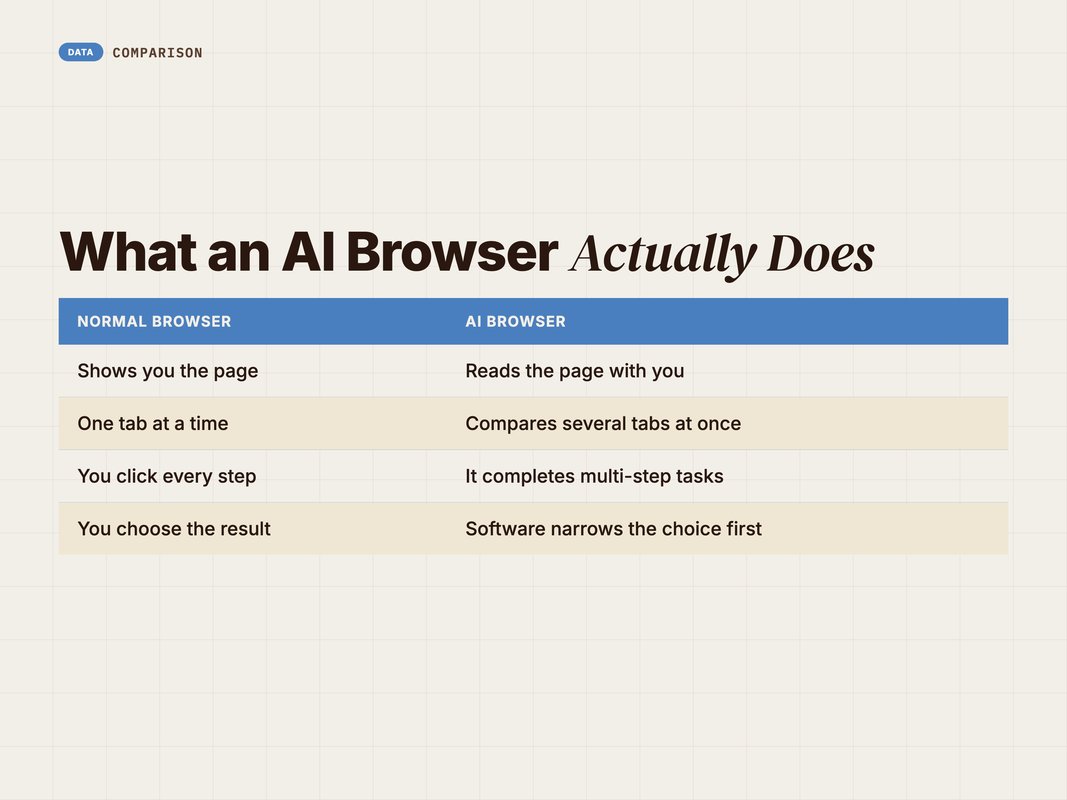
The third one is why this matters more than another chat box. Someone asks for the cheapest option that ships to Pune this week. They are no longer choosing between your page and a rival page.
Software is choosing. And it chooses using whatever it can read on the page.
That is a different game to ranking. You are no longer competing for a click. You are competing to be legible.
Q: Is this the same as AI search?
A: Related but different. AI search answers a query. An AI browser sits inside your session and can take action on the sites you visit.
How Big Is This Actually?
Big enough to plan for. Not big enough to panic about.
Comet leads on raw users, at roughly 18 million a month. Atlas sits near 11 million but grows far faster. Atlas is up about 175 percent quarter on quarter. Comet is up 41 percent (Source: Presenc AI, 2026 — presenc.ai).
Atlas grew from around 1.6 million monthly users a year earlier to roughly 11 million (Source: Presenc AI, 2026 — presenc.ai).
Query volume shows how they get used. Atlas handles an estimated 320 million queries a month. It also runs around 9 million agent tasks in that time (Source: Presenc AI, 2026 — presenc.ai).

For wider context, ChatGPT holds 53.9 percent of web visits across the seven largest AI chatbots, as of August 2026. Gemini is second at 27.9 percent. Claude is third at 9.2 percent (Source: Momentic, 2026 — momenticmarketing.com).
Put next to Chrome, these numbers are small. Put next to your organic traffic from two years ago, they are not.
The growth rates are the part to watch. A category adding 175 percent a quarter does not stay a rounding error for long.
But growth from a small base is easy to over-read. Plan for a channel that matters in two years, not one that matters next month.
And the traffic behaves differently, which is the part worth acting on.
Q: Should I build a strategy just for AI browsers?
A: No. Build one for machine readers generally. AI browsers, AI search and assistants all reward the same things.
The Traffic Is Small and Unusually Good
This is the finding that changes the maths.
Traffic from AI surfaces is still small. But the shoppers it sends arrive with intent. Over the 2025 holidays, Salesforce found shoppers from AI search converted nine times more often than shoppers from social media (Source: Salesforce, 2026 — salesforce.com).
Treat that multiple with care. It is measured against social traffic, not ordinary search, so the gap you see will be smaller.
The direction is still clear, and it makes sense. Somebody arriving from an AI answer was already told what your page holds. And why it fits their question.
They are not browsing. They are checking.

That changes what your pages need to do. A visitor sent by an assistant does not need convincing that you exist. They need the exact fact they were promised, in plain sight.
If they cannot find it in five seconds, the assistant looks wrong. And you lose a very good visitor.
Q: How do I know if this traffic is already arriving?
A: Build an analytics segment for known AI referrers and check the last six months. Most sites find a small, steady stream nobody had noticed.
What Changes on Your Site
The work splits into two jobs. Be readable by a machine, and be usable by one.
Readable is familiar territory.
Put the answer in the first two sentences under each heading. Keep key facts in real text, never inside an image. Use clean structured data. Keep your prices, hours and specs identical everywhere they appear.
Usable is the newer half, and most sites fail it.
An agent completing a task has to get through your interface. That means forms that work without heavy scripts, checkout paths that do not depend on hover states. Buttons that are actual buttons.
It also means fewer pop-ups. A cookie wall, a newsletter box and an age gate are three walls between an agent and a finished task.

There is a useful test here. Turn off JavaScript and try to complete your main conversion path.
Do it on a phone as well. Most agent traffic today arrives through a desktop client, but that will not hold for long.
Log what breaks and how far you got. That log is your fix list, and it usually has fewer than ten items on it.
If you cannot, an agent probably cannot either. That is not a rule, but it is a reliable signal.
Q: Do I need a separate agent-friendly version of my site?
A: No. Everything on that list also helps human visitors, accessibility and normal SEO. Nothing here is wasted if AI browsers stall.
The Robots Question
At some point someone will ask whether to block AI agents. Here is how we think about it.
Blocking is a real option and it has a real cost.
Block them and you vanish from the answers they write. You also vanish from any purchase an agent makes for a user.
For most brands that trade is bad. Being visible inside AI surfaces is worth more than the crawl cost.
There are real exceptions. Paid content you sell. Personal data behind a login. Anything where machine access creates a genuine risk.

Most brands should take the middle path. Allow access. Control what is exposed. Keep sensitive paths behind a login, where they belong.
Also, write it down. A robots policy living in one engineer's head becomes an accident at the next site move.
Q: Will blocking protect my content from being trained on?
A: Partly at best, and it is a separate question from visibility. Decide those two things separately, because the right answer differs.
Where This Is Actually Heading
Two shifts are worth planning for, even though neither is settled.
The agent becomes the customer. Today an agent helps a person browse. Increasingly it will complete the purchase alone, from a one-line instruction.
When that happens, your conversion rate optimisation work changes shape. Persuasion matters less. Machine-readable facts and a clean path matter more.
Nothing in that is science fiction. Atlas is already running millions of agent tasks a month, and most of those are shopping and research.
Comparison gets automated. A person comparing five products reads three and gives up. An agent reads all five, every time, and weights them consistently.
That is good news if your product genuinely wins on a spec. It is bad news if you have been winning on presentation.
So the honest advice is to make sure the facts that favour you are published, plainly, in text. Price, specification, delivery time, warranty, return window.
If an agent has to guess at a fact, it will use whichever source it can read. Often that source is a marketplace listing you do not control.
There is a third possibility worth naming. This may not get big.
AI browsers could stall as a category and fold back into normal browsers as a feature. Plenty of promising interfaces have.
That is fine, because the preparation is the same either way. Every change in this post also improves normal search and normal usability.
That is the test we apply to any new surface. If the work only pays off in one future, we do not do it.
Q: How much should we invest in this today?
A: Enough to be readable and usable. Not enough to build anything browser-specific. The moment you need a custom build for one browser, the cost has outrun the opportunity.
What to Do This Quarter
Five things, roughly in order of effort.
One. Measure what is already happening. Build the AI-source segment in analytics. You cannot argue for effort on a channel nobody has sized.
Two. Fix the top twenty pages. Answer-first openings, real text, clean structured data. Twenty pages covers most of what gets cited.
Three. Run the agent test. Try to complete your main conversion path with scripts limited. Fix whatever breaks.
Four. Audit the interruptions. Count the pop-ups, walls and gates between landing and converting. Remove the ones nobody can defend.
Five. Ask the questions monthly. Twenty real customer questions, asked in the main AI browsers and assistants, logged. Track whether you get named and whether the facts are right.
That last one is the closest thing to a ranking report you can get. It is manual. It is also more honest than any tool selling you a score.
Keep the question set fixed. Changing the questions each month gives you a number that cannot be compared to last month.
An hour a month is the whole cost. Most teams find they can hand it to one person and forget about it.
How We Approach This for Clients
We do not sell AI browser work as a separate service. It is not one. It is the same technical and content hygiene, judged against a new kind of reader.
YARD is an AI-first growth marketing agency. We run performance marketing, LLM SEO, AI creative and AI funnels for D2C and B2B brands. Making sites legible to machines is part of the SEO work now.
Three principles guide it.
We build for the shared surface, not one browser. Any change we make has to help Google, assistants and human readers too. If it only helps one, we skip it.
We measure by asking, not by estimating. A fixed question set, asked monthly, logged over time. Tools that claim a share-of-voice number are guessing.
And we treat usability as part of SEO. If an agent cannot finish a task on a page, that page is broken. However well it reads.
If you want to know whether AI surfaces are already sending you traffic, that is a one-hour answer from your analytics. For the wider search picture, see Generative Engine Optimization: Getting Your Brand in AI Answers.
The Short Version
An AI browser puts an assistant inside the browsing session. It reads pages, works across tabs, and completes tasks for the user.
The scale is real and early. Comet leads on users at roughly 18 million monthly actives, with Atlas near 11 million and growing much faster.
The traffic is small but unusually well qualified, because the visitor was told what your page holds before they arrived.
Your job is two-part. Be readable by a machine and usable by one. Answer-first content, clean structured data, real text, and a conversion path that survives without heavy scripts.
Do not block agents by default. Control what they see instead, and protect only what genuinely needs protecting.
Then measure it the honest way. Ask twenty real questions every month and log who gets named.
Want that baseline built for your site before the next planning cycle? Talk to the YARD team.
FAQ
Q: What is an AI browser?
A: It is a web browser with an assistant built into the window. It can read the page you are on, answer questions about it, and carry out multi-step tasks across sites for you.
Q: How many people use AI browsers?
A: Comet leads on users with roughly 18 million monthly actives. Atlas is around 11 million and growing faster, up from 1.6 million a year earlier.
Q: Do AI browsers send traffic to websites?
A: Yes, and it converts unusually well. Referrals from AI surfaces are reported to convert far above ordinary organic traffic, though the volume is still small.
Q: How do I optimise for an AI browser?
A: Make your pages easy for a machine to read and act on. Clear answers near the top, clean structured data, real text instead of images, and forms that work without heavy scripts.
Q: Can I see AI browser traffic in analytics?
A: Partly. Some arrives with a recognisable referrer and some looks direct. Build a segment for known AI sources and accept that it undercounts.
Q: Should I block AI agents from my site?
A: Rarely. Blocking removes you from answers and from agent-driven purchases. Control what they see instead, and protect only genuinely sensitive paths.
Insights from Our Experts
Explore our latest articles on digital marketing strategies.