

Most blogs never get read. This AI content case study is the exception, and the story is boring in the best way. No viral post. No lucky break. Just a system that ran every week for a year.
A B2B SaaS client we work with started with an empty blog. Zero traffic. Twelve months later it pulled 50,000 monthly visitors. Ahrefs found that 96.55% of pages get no traffic from Google at all (Source: Ahrefs, 2023 — search-traffic study). This blog landed in the other 3.45%.
Here is what actually happened. The starting point. The AI content system. The exact monthly playbook. The month-by-month results. And what we would change if we ran it again. You can copy the whole thing.
The Starting Point: An Empty Blog
The blog had nothing. No posts. No rankings. No email list pulling from it.
The product was solid. The audience was real. But nobody found the site through search. Every visitor came from ads or referrals.
That is a fragile place to be. Paid traffic stops the day the budget stops.
New pages also fight an uphill battle. Only 1.74% of new pages reach Google's top 10 within a year (Source: Ahrefs, 2025 — ranking study). We knew month one would look flat. That was fine. We planned for the slow start.
Q: Why start a blog when most posts get no traffic?
A: Because the winners compound. A ranked post pulls clicks every month with no extra spend. The trick is a system that stacks small wins until a few posts break through. Volume without structure fails. Structure with volume works.
The AI Content System: Pillar, Cluster, Publish, Refresh
The whole engine runs on four moves. We call it the pillar-cluster-publish-refresh loop.
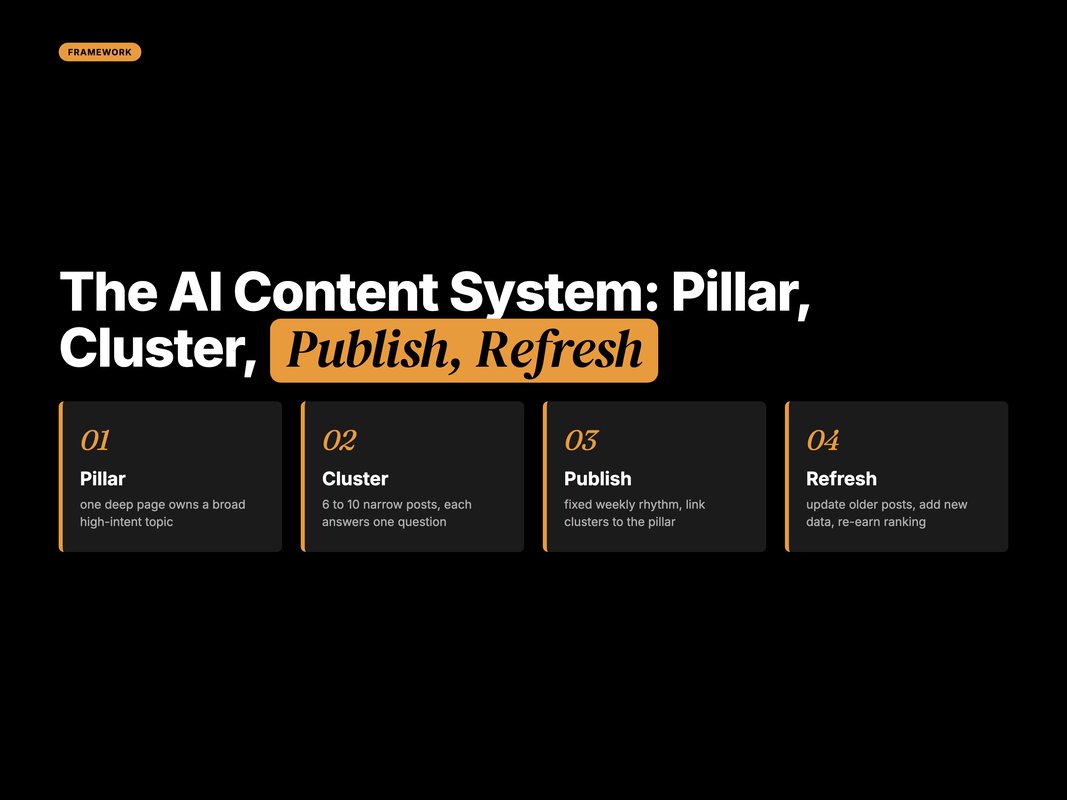
Here is the numbered system:
- Pillar. Pick a broad, high-intent topic. Write one deep page that owns it end to end.
- Cluster. Spin up 6 to 10 narrow posts around that pillar. Each answers one specific question.
- Publish. Ship on a fixed weekly rhythm. Link every cluster post back to its pillar.
- Refresh. Update older posts on a schedule. Add new data. Re-earn the ranking.
AI touched every step. It drafted the pillar outline. It expanded cluster posts from a brief. It flagged decaying pages for refresh.
But a human owned strategy and truth. AI never published on its own. This split matters because in-depth, well-linked posts now beat frequent thin ones (Source: HubSpot, 2025 — State of Blogging).
Q: What does the pillar-cluster model do for AI content?
A: It gives AI a map. The pillar sets the theme. The clusters fill the gaps. Internal links pass authority between them. AI can then draft at scale without drifting off-topic, and the whole set ranks as one strong body of work.
The Exact Monthly Playbook
Every month looked the same. That is the point. Boring beats clever here.
Publishing rate drives results. HubSpot found firms posting more than 11 times a month get nearly triple the traffic of those posting once (Source: HubSpot, 2025 — blogging frequency).
We aimed for 8 posts a month. Two pillars. Six clusters. Plus a set of refreshes.
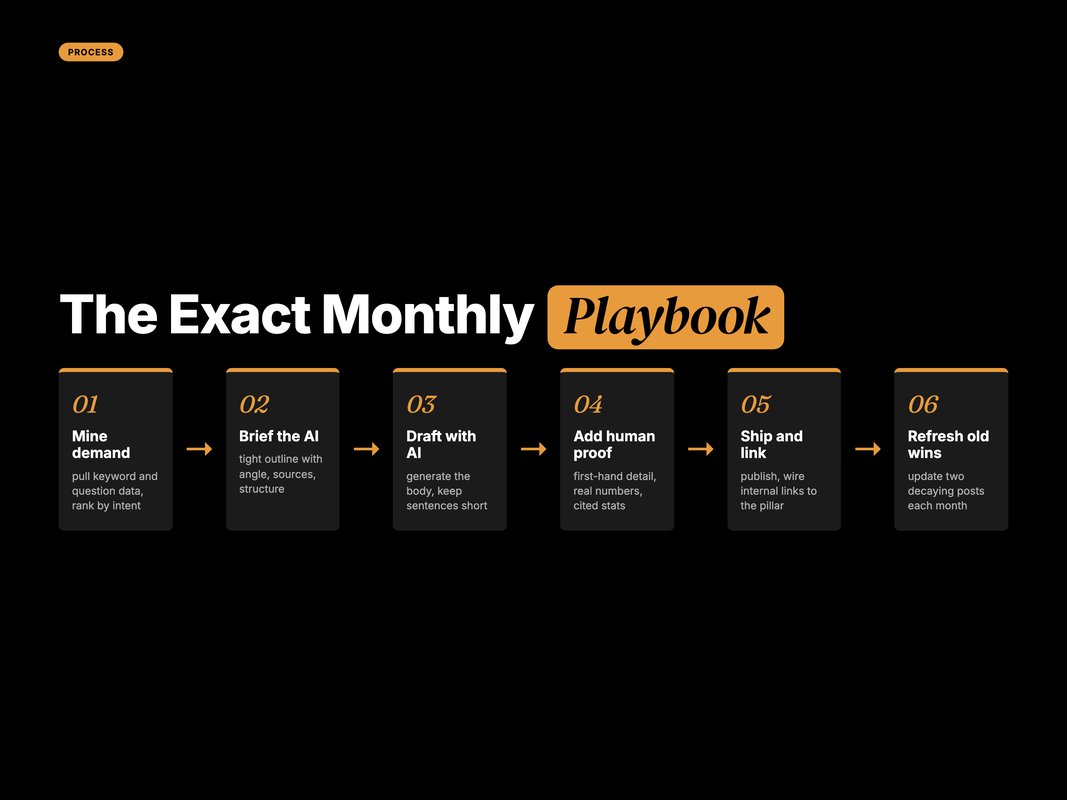
Here is the repeatable process:
- Mine demand. Pull keyword and question data. Rank by intent and gap.
- Brief the AI. Write a tight outline with angle, sources, and structure.
- Draft with AI. Generate the body. Keep sentences short and clear.
- Add human proof. Insert first-hand detail, real numbers, and cited stats.
- Ship and link. Publish. Wire internal links to and from the pillar.
- Refresh old wins. Update two decaying posts with fresh data each month.
Step four is where most AI blogs fail. They skip the human proof. Then they read like every other AI page and rank for nothing.
Q: How many people run this playbook?
A: A lean pod can run it. One strategist, one editor, and an AI-assisted drafting layer. The AI removes the blank-page grind. The humans keep the quality and facts tight. That ratio is what made the output both fast and rankable.
The Results Timeline: Month by Month
Traffic did nothing for a quarter. Then it climbed. Then it climbed fast.
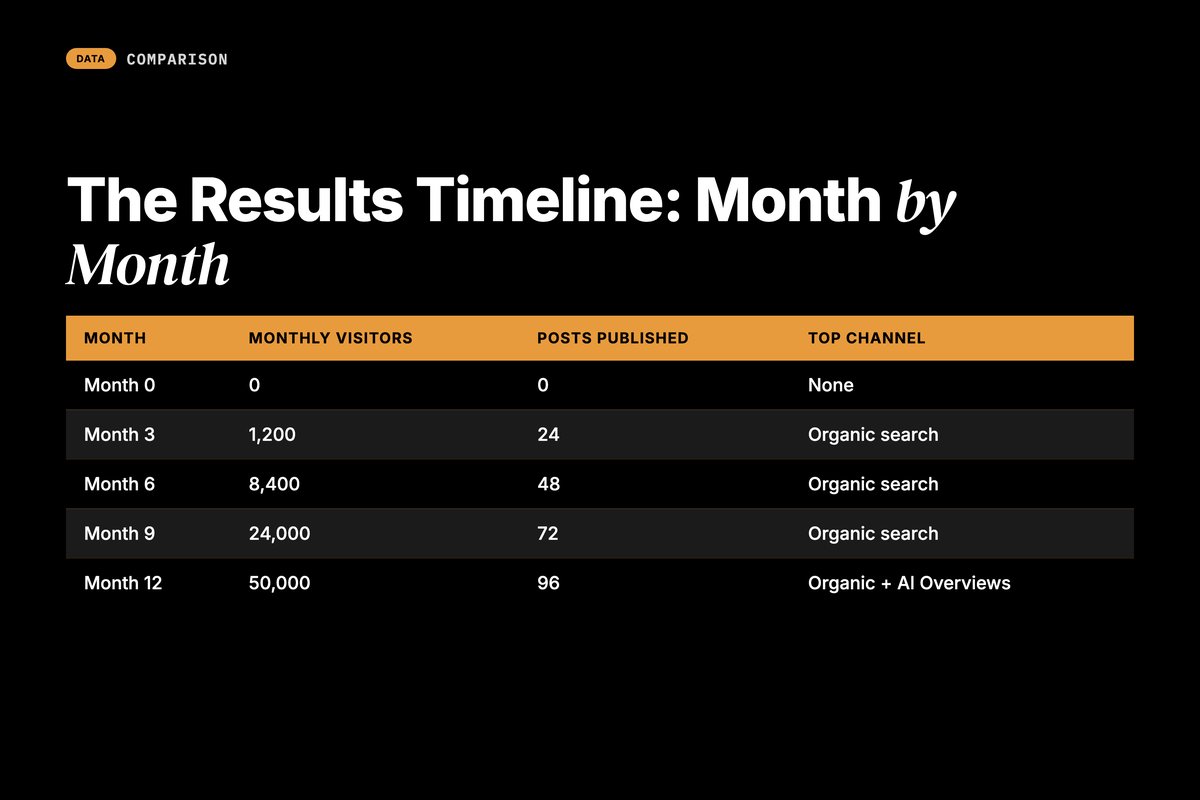
Here is the full arc:
| Month | Monthly Visitors | Posts Published (cumulative) | Top Channel |
|---|---|---|---|
| Month 0 | 0 | 0 | None |
| Month 3 | 1,200 | 24 | Organic search |
| Month 6 | 8,400 | 48 | Organic search |
| Month 9 | 24,000 | 72 | Organic search |
| Month 12 | 50,000 | 96 | Organic + AI Overviews |
The shape is normal. New content is slow. But 40.82% of pages that do reach the top 10 get there within a month once momentum builds (Source: Ahrefs, 2025 — ranking study).
By month twelve, AI Overviews were a real channel. That tracks with the wider shift. Semrush found 13.14% of searches now trigger an AI Overview (Source: Semrush, 2025 — AI Overviews study). Our pillar pages kept earning those citations.
Q: Why was the first quarter so flat?
A: Google needs time to trust new pages and index depth. The clusters had to stack before the pillars gained authority. Once the internal link mesh matured, rankings moved together. Patience in month one to three paid off in month six onward.
The Outcome Metrics That Mattered
Three numbers tell the story. Visitors, publishing depth, and channel mix.
Quick Facts: The 12-Month AI Content Case Study
- 96.55% of pages get zero Google traffic — this blog beat that with structure — (Source: Ahrefs, 2023 — search-traffic study).
- Only 1.74% of new pages hit the top 10 in a year, so slow early months are normal — (Source: Ahrefs, 2025 — ranking study).
- AI Overviews cut position-one clicks by 58%, so pillar citations matter more than ever — (Source: Ahrefs, 2025 — AI Overviews update).
The internal math was just as clean. About 20 percent of posts drove most of the traffic. The pillars earned the AI citations. The clusters earned the long-tail clicks.
Refresh work paid off late but hard. Updated posts re-entered the top 10 faster than brand-new ones. Old pages ranking is the norm now. Most top-10 pages are over three years old (Source: Ahrefs, 2025 — ranking study).
Q: Which metric predicted the breakthrough first?
A: Indexed depth. Once the site had enough linked, indexed cluster posts, the pillars started ranking. Watch coverage and internal links before you watch visitors. Traffic is a lagging signal. Structure is the leading one.
What We Would Do Differently
The system worked. But we left growth on the table.
First, we refreshed too late. We waited months to update decaying posts. AI Overviews now suppress top clicks by 58%, so stale pages bleed fast (Source: Ahrefs, 2025 — AI Overviews update). Refresh sooner.
Second, we under-built for AI answers. Our early posts lacked tight FAQ blocks. AI engines love to quote clean question-and-answer pairs. We added them late.
Here is the replication checklist:
- Choose one high-intent pillar topic with real search demand.
- Draft the pillar first, then plan 6 to 10 cluster posts around it.
- Set a fixed weekly publish rate and never break it.
- Add human proof and a live citation to every stat you use.
- Wire internal links from every cluster back to the pillar.
- Build a clear FAQ block into each post for AI Overviews.
- Refresh two decaying posts with new data every single month.
Q: What is the single biggest lever you missed early?
A: Structuring for AI answers from day one. We treated FAQ blocks as an afterthought. They should have been core. Clean question-and-answer pairs get quoted by AI engines and pull citation traffic that classic SEO alone misses.
How We Run AI Content Like This
We are an AI-first growth marketing agency. We build performance marketing, LLM SEO, AI creatives, and AI funnels for D2C and B2B brands.
This case study is our house style. AI does the heavy drafting. Humans own strategy, facts, and voice. The pillar-cluster-publish-refresh loop is how we scale content without turning it into noise.
We run the whole loop with modern AI tooling. Claude and MCP workflows draft and refresh at speed. A human editor keeps every claim sourced and every page on-brand.
The result is content that ranks in Google and gets cited by AI engines. That dual win is the point. Classic SEO alone leaves the AI channel on the table.
If your blog is stuck near zero, the fix is rarely more posts. It is a better system. We can build that system with you and run it end to end.
Conclusion
Zero to 50,000 monthly visitors is not magic. It is a loop that runs every week without fail. Pillar. Cluster. Publish. Refresh.
AI made the drafting fast. Humans made it true. Structure made it rank. Take away any one of the three and the curve stays flat.
The playbook is above, step by step. The checklist is ready to copy. Slow first quarter, steep back half, that is the shape to expect.
Want a blog that compounds like this one? Book a call and we will map your pillar-cluster plan and the AI system to run it.
FAQ
Q: How long did it take to reach 50K monthly visitors?
A: It took 12 months from the first published post. Traffic was near zero for the first three months. It crossed 8K by month six, 24K by month nine, and 50K by month twelve. The curve was slow, then steep.
Q: Is this AI content case study repeatable for any blog?
A: Yes, if the fundamentals hold. You need a real topic with search demand, a pillar and cluster structure, and a steady publish rate. AI speeds up drafting and refreshing. It does not invent demand that is not there.
Q: Did AI write the whole blog on its own?
A: No. AI drafted, expanded, and refreshed. A human set the strategy, checked every fact, added first-hand detail, and edited for voice. The system was AI-assisted, not AI-only. That split is why the content ranked.
Q: How many posts did it take to hit 50K visitors?
A: The blog published 96 posts across 12 months, about 8 per month. Roughly 20 percent of them drove most of the traffic. The rest built topical depth and internal links that lifted the winners.
Q: Where did the traffic come from?
A: Organic search led every month. By month twelve, a growing share arrived through AI Overviews and AI chat citations. The pillar pages earned the citations. The cluster posts earned the long-tail clicks.
Q: What would you do differently next time?
A: Refresh sooner and structure for AI answers from day one. We waited too long to update decaying posts. We also under-built the FAQ blocks that AI engines love to quote. Both are fixed in the current playbook.
Insights from Our Experts
Explore our latest articles on digital marketing strategies.