

You can build a personal brand on LinkedIn faster with AI. Not by handing it your voice. By handing it the busywork.
Most founders and operators know they should post. Few do it well. The blocker is rarely ideas. It is time, and the blank page.
AI tools fix both. They turn a rough thought into a draft in minutes. They pull five posts from one webinar. They tell you what actually landed.
But the win is not automation. It is leverage. You still bring the stories, the takes, and the judgment. The AI just clears the path.
This guide is a working system, not theory. You get copy-paste prompts, a content plan, tool picks, and a posting cadence. Everything maps to how LinkedIn rewards personal posts today.
Let's build it.
Why a LinkedIn Personal Brand Drives B2B Pipeline
A personal brand is not a logo or a tagline. It is what people believe about you before you speak.
On LinkedIn, that belief moves deals. Buyers trust people more than brand pages. They read your posts, then decide if you are worth a reply.
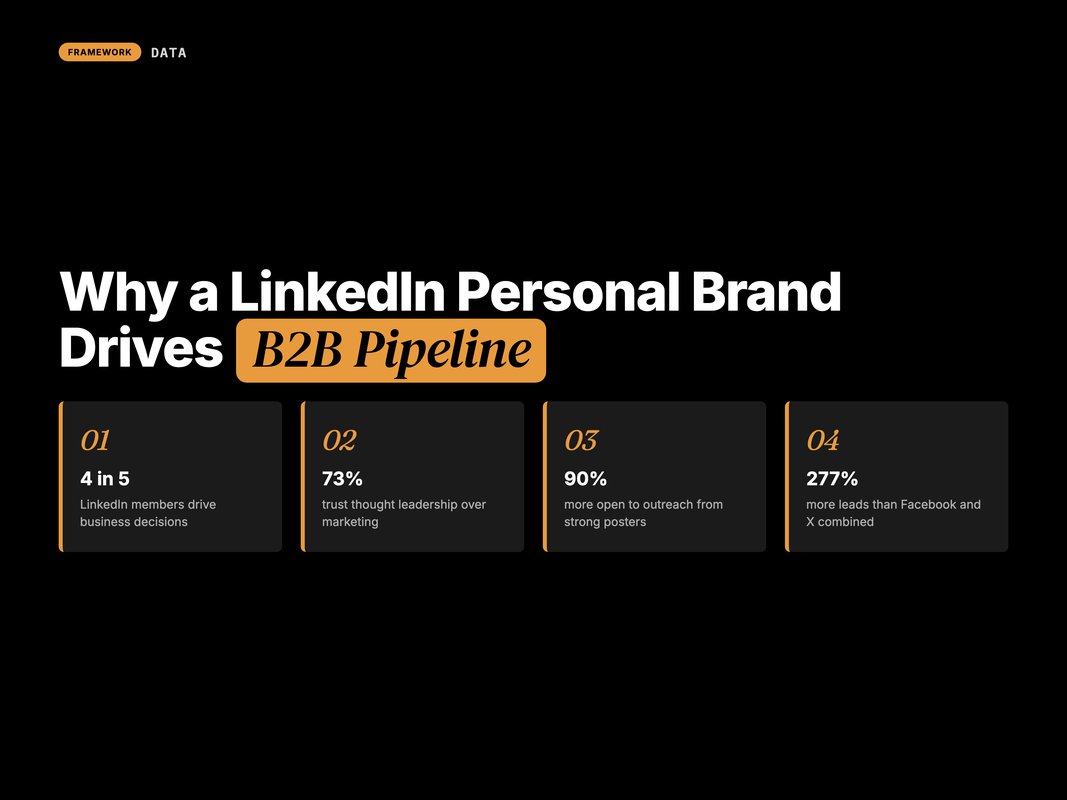
The data backs this hard. Four out of five people on LinkedIn drive business decisions at their company (Source: Sopro, 2025 — sopro.io). Your next client is already scrolling.
Thought leadership is the trust engine. 73% of B2B decision-makers trust it more than marketing materials (Source: Edelman-LinkedIn, 2024 — linkedin.com). That trust converts.
90% of decision-makers are more open to outreach from strong posters (Source: Edelman-LinkedIn, 2024 — linkedin.com). Posting warms the pipeline before you ever pitch.
It even shakes loose competitors. About 70% of C-suite leaders say a piece of thought leadership made them question their current supplier (Source: Edelman-LinkedIn, 2024 — linkedin.com).
There is a compounding effect too. Buyers rarely act on the first post. They watch for weeks. They read a few takes. Then they reach out.
That is why a personal brand outperforms a cold pitch. By the time you talk, they already trust you. The sale is half done.
It also lowers your cost to acquire attention. LinkedIn drives 277% more leads than Facebook and X combined (Source: Sopro, 2025 — sopro.io). And 62% of marketers say LinkedIn generates leads for them (Source: Sopro, 2025 — sopro.io). Your voice does the warming for free.
Trust is now the metric that matters most. 94% of B2B marketers agree trust is key to success (Source: LinkedIn B2B Benchmark, 2025 — linkedin.com). A personal brand is how you earn it at scale.
Q: Does a personal brand really beat a company page for B2B leads?
A: Yes. Personal posts earn more trust and more reach than brand pages. People follow people. Use your profile as the front door, and let the company page support it.
The 2026 LinkedIn Algorithm Signals That Reward Personal Posts
The feed is not random. It rewards a few clear signals. Learn them, and your posts travel further.
Signal one is dwell time. That is how long someone stays on your post. Long dwell time tells LinkedIn the post is worth showing to more people.
Signal two is comments. Comment quality now shapes reach more than likes or vanity metrics (Source: SocialBee, 2026 — socialbee.com). On some breakdowns, comments count for roughly twice the weight of a like (Source: AuthoredUp, 2026 — authoredup.com). Real threads win.
Signal three is the golden hour. LinkedIn watches how a small group reacts in the first 60 to 90 minutes after you post (Source: SocialBee, 2026 — socialbee.com). Strong early engagement unlocks wider reach.
Signal four is format. Native content wins. Multi-image posts hit about 6.60% engagement and native documents about 5.85% (Source: SocialBee, 2026 — socialbee.com). Carousels and documents hold attention longer.
Signal five is a warning. Outbound links in the post body reduce reach, because they pull readers off LinkedIn (Source: SocialBee, 2026 — socialbee.com). Single-link posts tend to perform worst (Source: AuthoredUp, 2026 — authoredup.com). Put the link in the first comment.
There is a human reason behind each signal. LinkedIn wants people to stay and talk. Every rule above rewards that behaviour. Fight it, and you lose reach.
So use the signals as a checklist. Open with a hook that earns the click. Break your text into short lines. White space keeps people reading, which lifts dwell time.
End with a real question. Not "thoughts?" — a specific one. That is how you earn the long comments the algorithm loves.
Post carousels and documents when you can. They hold attention longer than a wall of text. Longer attention means wider reach.
So the rule is simple. Write native posts. Spark real comments. Keep people reading. That is the whole game.
Q: Should I put links in my LinkedIn posts?
A: Not in the body. Links there tend to cut reach. Add them in the first comment or your bio instead. Keep the post itself native and link-free.
Set Your Voice and Positioning With AI First
Skip this step and every AI draft sounds like everyone else. Positioning comes before posting.
Start with one sentence. Who do you help, and what change do you create? That line anchors every future post.
Use AI to sharpen it, not invent it. Feed it your background and let it pressure-test the wording.
Here is a copy-paste prompt to run in Claude or GPT.
You are a B2B positioning strategist.
Here is my background: [paste your role, wins, audience, niche].
My audience is: [describe them].
Draft 5 one-sentence positioning statements for my LinkedIn profile.
Each must name who I help and the outcome I create.
Avoid buzzwords. Sound like a real operator, not a brochure.
Now capture your voice. This is the step most people skip.
Paste three of your best past posts or emails. Ask the AI to build a reusable voice guide.
Read the 3 writing samples below.
Extract my voice into rules a ghostwriter could follow.
Cover: sentence length, tone, favourite phrases, humour, and taboo words.
Return it as a short bullet list I can reuse in every future prompt.
[paste 3 samples]
Save that voice guide. Paste it into every drafting prompt from now on. It keeps AI content sounding like you, not like a robot.
This one file changes everything downstream. Without it, AI defaults to bland. With it, drafts arrive in your rhythm. You edit less and ship more.
Positioning does the same job for topics. When you know who you help, ideas get sharp. You stop posting about everything. You start owning a lane.
Pick a lane narrow enough to be known for. Broad brands are forgettable. Specific brands get referred. The niche is the point.
Q: How do I stop AI posts from sounding generic?
A: Give the AI your real writing samples and a voice guide. Then edit every draft by hand. Cut safe lines and add one detail only you would know.
Build an AI Content System That Runs Weekly
A brand is not one viral post. It is a system that ships every week. AI makes that system fast.
Think of it as five stages. Each stage has one job and one prompt.
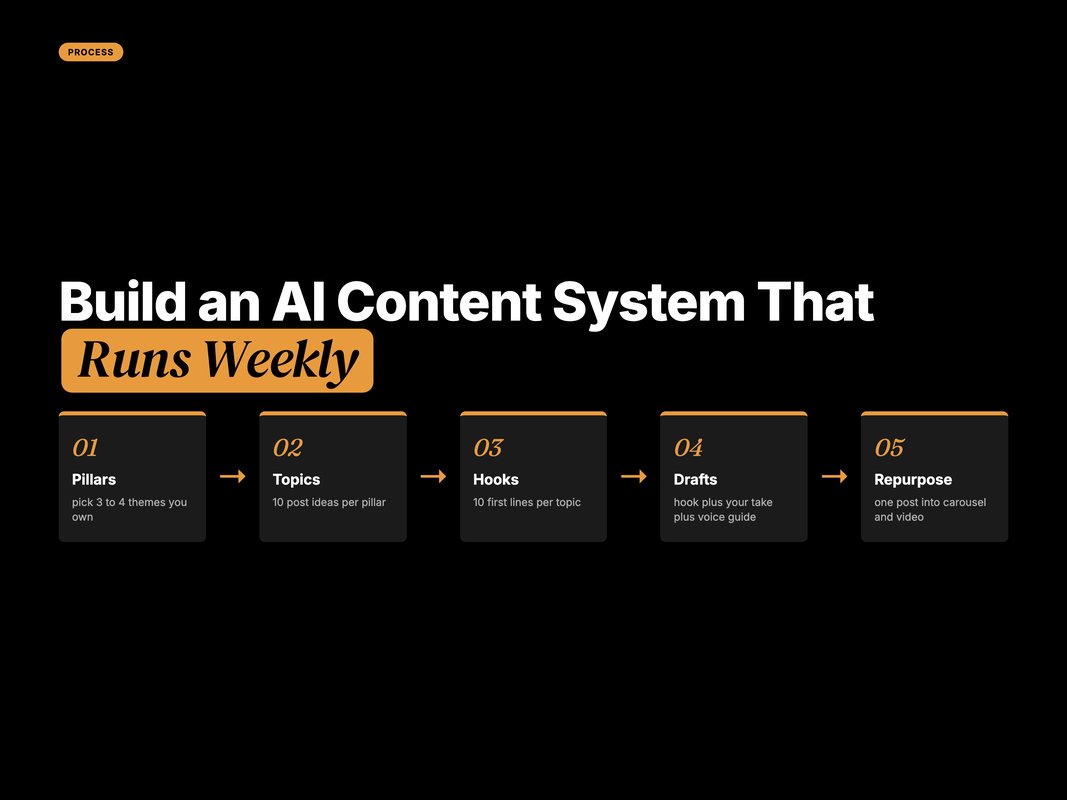
Stage one is pillars. Pick three or four themes you can own. Ask AI to map them from your positioning.
Stage two is topics. Turn each pillar into ten post ideas. Now you have a month of content in one sitting.
Stage three is hooks. The first line decides if anyone reads on. Draft ten hooks per topic, then keep the best.
Write 10 scroll-stopping first lines for a LinkedIn post about [topic].
Rules: max 12 words each. No clickbait. No emojis.
Use my voice guide: [paste voice guide].
Make each one create a small open loop that pulls the reader in.
Stage four is drafting. Feed the hook, your take, and the voice guide.
Write a LinkedIn post using this hook: [chosen hook].
My core point is: [your opinion or story].
Use my voice guide: [paste voice guide].
Keep sentences short. One idea per line. No links in the body.
End with a question that invites a real comment.
Stage five is repurposing. One post becomes many. Turn a strong post into a carousel outline or a short video script.
Here is a repurposing prompt you can reuse.
Turn this LinkedIn post into a 6-slide carousel outline.
Original post: [paste your best post].
Slide 1 is the hook. Slides 2 to 5 each hold one idea.
Slide 6 is the takeaway plus a soft call to action.
Keep my voice: [paste voice guide]. One short line per slide.
Repurposing is where the leverage compounds. One good idea can run for a month. A post becomes a carousel, then a video, then a comment reply. The thinking is done once and reused often.
The system runs in about two hours a week. You write the thinking. The AI handles the reps.
Batch the work to save time. Do topics and hooks in one sitting. Draft the whole week in another. Then edit daily before you post.
Never post a raw draft. That is the rule that protects your brand. Read every line aloud. If it does not sound like you, cut it.
Add one specific detail to each post. A real number. A client moment. A small failure. Specifics are what AI cannot fake, and what readers remember.
The system scales without breaking your voice. That is the whole point. Speed from the machine. Judgment from you.
Q: How much of the writing should the AI actually do?
A: The AI drafts. You decide. Let it handle structure and speed. Keep the opinions, stories, and final edit for yourself.
Pick the Right AI Tools and Skip the Rest
You do not need ten tools. You need a drafting tool and an analytics tool. That is the whole stack.
For drafting, Claude and GPT both work well. They take a good prompt and a voice guide, then return usable drafts. Claude tends to hold a natural tone across long posts.
For an all-in-one option, Taplio bundles ideas, scheduling, and analytics for LinkedIn. Its lowest paid plan starts around $39 a month (Source: Taplio, 2026 — taplio.com/pricing). It suits people who want one dashboard.
For analytics, start with native LinkedIn analytics. It is free and shows impressions, engagement, and follower trends. AuthoredUp adds post formatting and deeper performance history on top.
Here is how the main options compare.
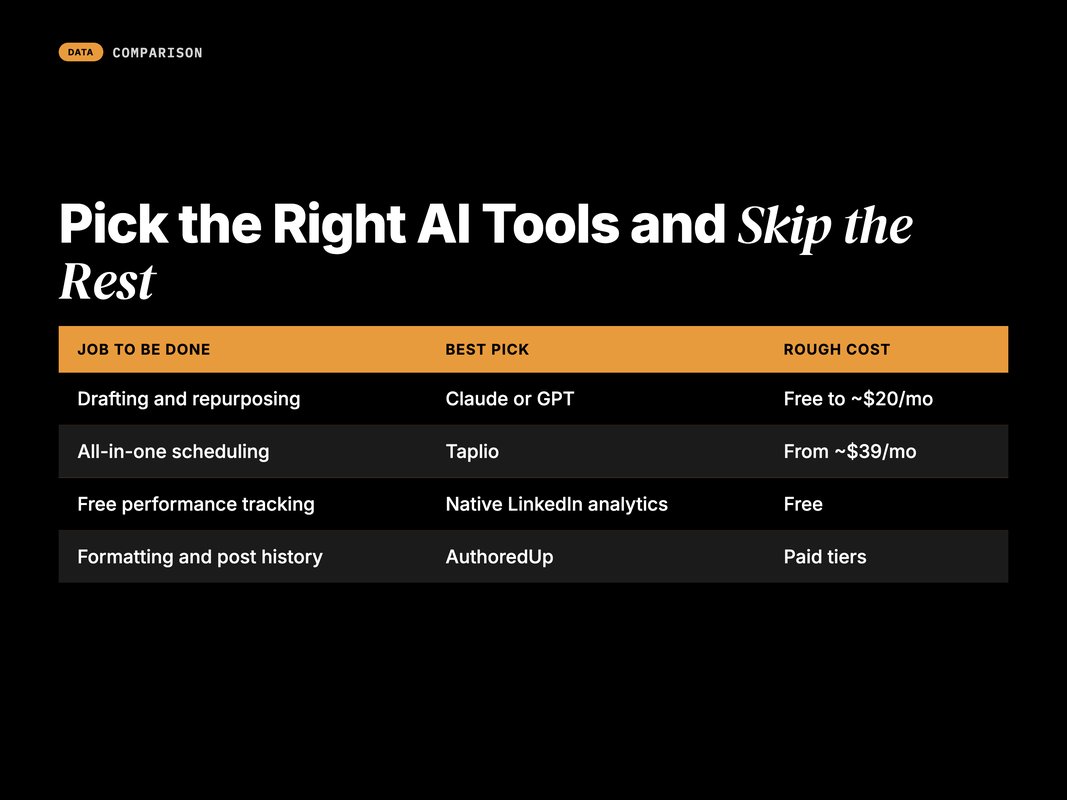
Match the tool to the job. Do not buy five tools that overlap. A drafting tool plus native analytics is enough to start.
Beware of tools that promise full automation. Auto-comment bots and mass-DM tools can breach LinkedIn rules. They also read as spam. The reach is not worth the risk.
Add tools only when you feel a real bottleneck. Struggling to schedule? Get a scheduler. Losing track of what works? Add analytics. Let pain pick the tool, not hype.
Your stack should shrink over time, not grow. The best operators use two or three tools well. They spend the saved time on thinking, not tinkering.
Q: Do I need a paid tool to build a LinkedIn personal brand?
A: No. You can start with a free AI drafting tool and native analytics. Add a paid tool only when scheduling or repurposing becomes your bottleneck.
Set a Posting Cadence and Track What Works
Consistency beats intensity. A steady drumbeat trains both the algorithm and your audience.
Aim for three to five posts a week. Businesses that post weekly see about 2x more engagement than those that post rarely (Source: DemandSage, 2025 — demandsage.com). Show up on a schedule.
Post when your audience is online. For most B2B feeds, that is weekday mornings. Test your own times and keep the winners.
Engage right after you post. Reply to every comment in the first hour. That feeds the golden-hour signal and pulls the thread wider.
Then measure the right things. Followers are a lagging number. Watch comments, profile views, and saves first. Those show real resonance before leads arrive.
Read your own comments like a research file. They tell you what people care about. Turn the best replies into your next posts. Your audience writes half your calendar.
Protect the cadence when work gets busy. This is when most people quit. A missed week breaks the habit. A missed month breaks the brand.
Batch a buffer to survive busy weeks. Keep three posts ready at all times. When a launch or a trip hits, you still show up. The buffer saves the streak.
Do not chase virality. Chase consistency. One viral post fades fast. A steady presence compounds for years. Slow and regular wins this game.
Here is your weekly stat cluster to review every Friday.
Quick Facts: LinkedIn Personal Brand Benchmarks at a Glance
- LinkedIn has over 1.3 billion members and 70 million-plus companies. — (Source: DemandSage, 2025 — demandsage.com).
- Weekly posting drives about 2x more engagement than posting rarely. — (Source: DemandSage, 2025 — demandsage.com).
- 94% of B2B marketers agree trust is key to success. — (Source: LinkedIn B2B Benchmark, 2025 — linkedin.com).
- LinkedIn drives 277% more leads than Facebook and X combined. — (Source: Sopro, 2025 — sopro.io).Q: How often should I post to grow a personal brand?
A: Three to five times a week is a strong target. Weekly posting alone lifts engagement about 2x. Pick a pace you can hold for months, not weeks.
Your LinkedIn Personal Brand Launch Checklist
Ready to start? Use this checklist to go live this week. Work top to bottom.
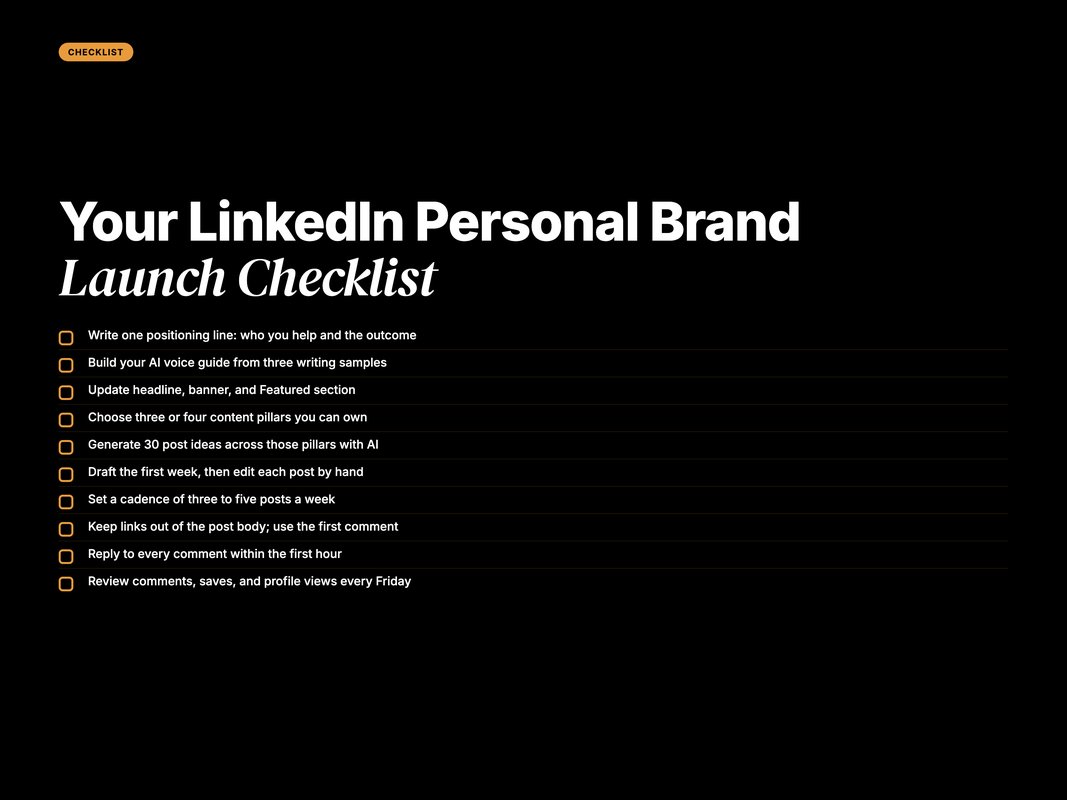
- Write one positioning line: who you help and the outcome you create.
- Build your AI voice guide from three real writing samples.
- Update your headline, banner, and Featured section to match your positioning.
- Choose three or four content pillars you can own.
- Generate 30 post ideas across those pillars with AI.
- Draft your first week of posts, then edit each one by hand.
- Set a cadence of three to five posts a week.
- Keep links out of the post body; use the first comment instead.
- Reply to every comment within the first hour.
- Review comments, saves, and profile views every Friday.
Do not wait for a perfect plan. Ship the first post today. Refine as the data comes in.
Q: What is the first thing I should do to build my brand?
A: Fix your positioning line and profile. Then post once. A clear profile plus one honest post beats a month of planning.
How YARD Builds AI-Native Personal Brands
We are an AI-first growth marketing agency. We run performance marketing, LLM SEO, AI creatives, and AI funnels for D2C and B2B brands.
Personal branding sits inside that work. Founder posts feed the funnel. They warm buyers before a single ad runs.
Our approach is the same one in this guide. AI does the reps. Humans keep the voice.
We build a voice guide for each founder. We map pillars to real pipeline goals. Then we set up an AI content system the team can run without us.
The tools are means, not magic. We use Claude for drafting, MCP-based workflows for repurposing, and clean analytics for feedback. The point is always leverage, not slop.
We have seen founders go from silent to steady in a quarter. Comments come first, then inbound replies, then real conversations. That is how a personal brand turns into pipeline.
The results tend to build quietly. A profile view here. A saved post there. Then a warm reply that starts a deal. Small signals stack into momentum.
If you want a system like this built for your team, that is our lane. We would rather teach you the engine than rent you posts.
Conclusion: Build the Engine, Keep Your Voice
Building a personal brand on LinkedIn is not about posting more. It is about posting with a system.
AI gives you the leverage. It drafts, repurposes, and measures. You bring the stories, the opinions, and the final edit.
Follow the signals that matter. Write native posts. Spark real comments. Hold attention past the first line.
Set your positioning. Build a voice guide. Run the weekly system. Post three to five times a week and reply fast.
The founders who win here are not the loudest. They are the most consistent. Start this week, keep your voice, and let the system compound.
Want help building your AI content engine? That is exactly what we do at YARD. Start with a conversation, not a contract.
FAQ
Q: Can AI tools build a personal brand on LinkedIn for me?
A: AI tools speed up the work, but they do not replace you. Use them to draft, repurpose, and analyse. Keep your own stories, opinions, and voice in every post. Full automation reads as spam and hurts trust.
Q: Which AI tools are best for a LinkedIn personal brand?
A: Claude or GPT handle drafting and repurposing well. Taplio adds scheduling, ideas, and analytics in one place. Native LinkedIn analytics and AuthoredUp help you track what works. Pick a drafting tool plus one analytics tool and stop there.
Q: How often should I post to build a LinkedIn personal brand?
A: Three to five posts a week is a strong cadence. Businesses that post weekly see about 2x more engagement. Consistency beats volume. One good post beats five rushed ones.
Q: Do outbound links hurt my LinkedIn reach?
A: Links in the post body tend to reduce reach because they pull people off the platform. Put the link in the first comment instead. Keep the post itself native text, a carousel, or a document.
Q: How long does it take to build a personal brand on LinkedIn?
A: Expect three to six months of steady posting before momentum shows. Comments and profile views come first. Inbound leads and pipeline follow later. Track leading signals, not just followers.
Q: Will AI-written LinkedIn posts sound robotic?
A: They will if you post the first draft. Feed the AI your real writing samples and voice rules. Then edit every draft by hand. Cut generic lines and add one specific detail only you would know.
Insights from Our Experts
Explore our latest articles on digital marketing strategies.