

Threads ads are no longer a test. They went global in January 2026.
Since then the app has grown to half a billion users. And the placement is switched on by default in most campaigns you build.
So the real question is not "should I try Threads". You are probably already buying it. The question is whether you should give it its own budget, its own creative and its own read.
Short answer: yes for a specific set of brands, no for everyone else. This piece explains which side you fall on, and what to do this week either way.
Quick Facts: Threads Ads at a Glance
- Threads reached 500 million monthly active users on 16 June 2026 — (Source: Meta, 2026 — about.fb.com).
- The global ads rollout began the week of 26 January 2026 — (Source: PPC Land, 2026 — ppc.land).
- Threads had more than 400 million monthly users at the time of that rollout — (Source: PPC Land, 2026 — ppc.land).
- Threads hit 100 million daily active users in December 2024 — (Source: PPC Land, 2026 — ppc.land).
- The placement is enabled by default for Advantage+ and manual placements — (Source: PPC Land, 2026 — ppc.land).
What actually changed in January
Meta tested Threads ads for a year with a limited set of advertisers. That ended in January 2026.
The global rollout began the week of 26 January 2026 (Source: PPC Land, 2026 — ppc.land). Every advertiser with Ads Manager access got the placement.
Two details matter more than the headline.
First, the placement turns on automatically for new campaigns built with Advantage+ or manual placements. You opt out, not in.
Second, format support is narrower than Instagram (Source: PPC Land, 2026 — ppc.land).
| Format | Runs on Threads |
|---|---|
| Single image | Yes |
| Single video | Yes |
| Image carousel | Yes |
| Video carousel | No |
| Advantage+ catalog | Images and image carousels only |
| App ads | Yes |
Video carousels do not run. If that is your workhorse format, plan around it.
This is the detail most teams miss. They duplicate an Instagram campaign, leave the placement on, and half the ad set never serves on Threads at all. The report then shows a tiny Threads spend and everyone concludes the audience is small.
The audience is not small. The creative was ineligible.
Q: Do I need a Threads account to run Threads ads?
A: No. The placement is bought through Meta Ads Manager like any other. A live Threads presence helps your organic reach, but it is not a gate on the ads.
The scale question, answered honestly
Threads reached 500 million monthly active users on 16 June 2026 (Source: Meta, 2026 — about.fb.com).
That is a real audience. It is also not an Instagram-sized one.
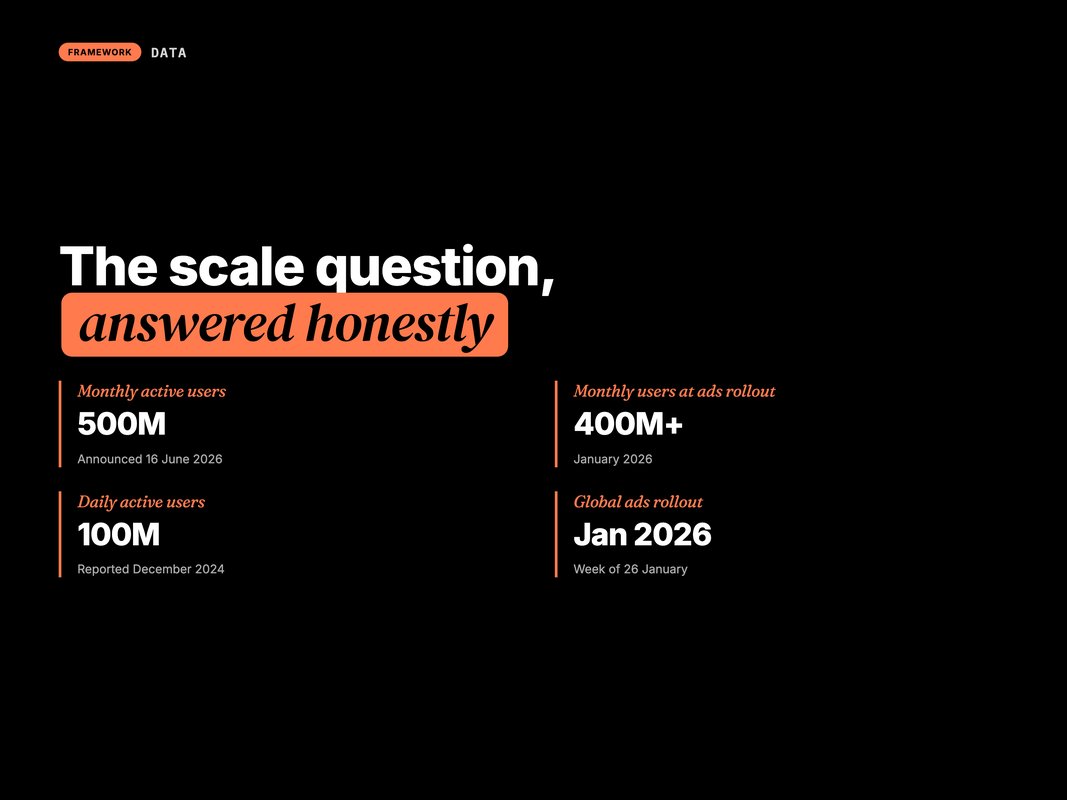
The growth curve is what should interest you. More than 400 million monthly users in January. Half a billion by June. Meta reported 100 million daily active users back in December 2024 (Source: PPC Land, 2026 — ppc.land).
The gap between monthly and daily is the thing to watch. A large monthly base with a smaller daily one means reach is cheap and frequency builds slowly.
That shape suits awareness. It suits it less for a two-week sale.
Who should test it now
Be early if three things are true.
You sell to a text-first, opinion-led audience. You already produce a lot of static creative. And you can afford a test budget that does not need to pay back this month.
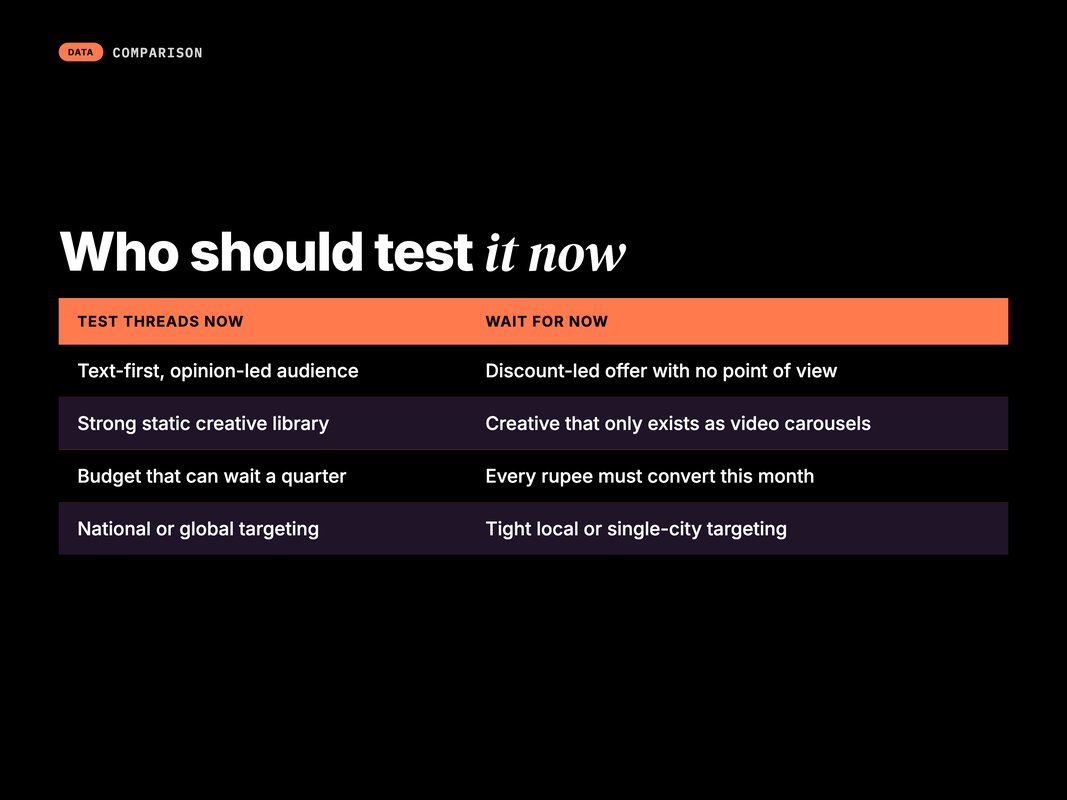
B2B and creator-economy brands sit best here. So do publishers, fintech, SaaS and anything where the buyer reads before they buy.
The people on Threads are there to read takes. That is a good match for a brand with a point of view. A poor one for a brand with only a discount.
Q: Is Threads better for awareness or conversion?
A: Awareness and consideration today. The daily audience is still building, so retargeting pools fill slowly. Treat conversion results as a bonus, not the reason to be there.
Who should wait
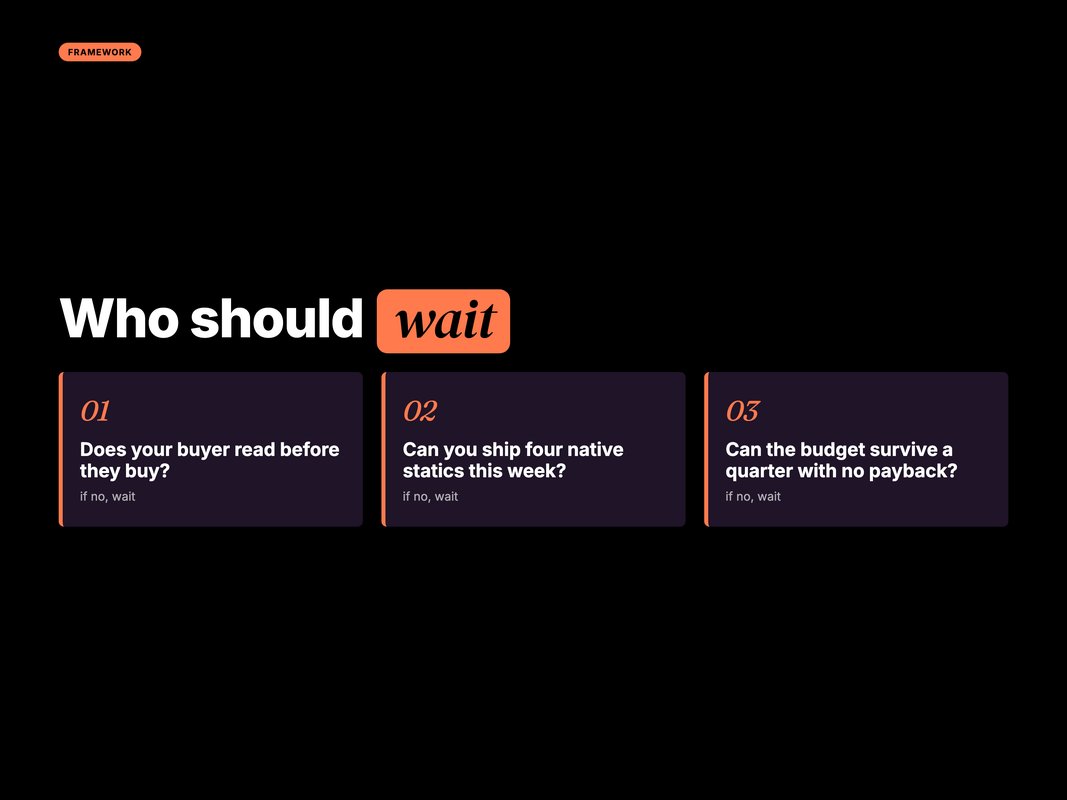
Skip it for now if your budget is tight and every rupee has to convert this quarter.
Skip it if your targeting is heavily local. Reach thins out fast below a metro-level audience.
Skip it if your creative library is all video carousels. That format does not run, and rebuilding it is real work for an unproven placement.
And skip it if nobody on your team can read a placement-level report. An untested placement inside a blended campaign is not a test. It is a leak.
There is no penalty for waiting six months here. Threads is not a land-grab where early accounts get a permanent edge. It is an auction. It will still be there when your creative pipeline can feed it.
The only cost of waiting is the cheaper auction you skipped. On a modest budget, that is a fair trade.
We use one simple test to decide which side a brand sits on.
Two yes answers means test now. One or none means wait, and revisit when your static creative pipeline is healthier.
The setup that gives you a real answer
Most teams get no signal from Threads because they never isolate it. The placement runs inside a broad Advantage+ campaign, takes a sliver of budget, and the report says nothing.
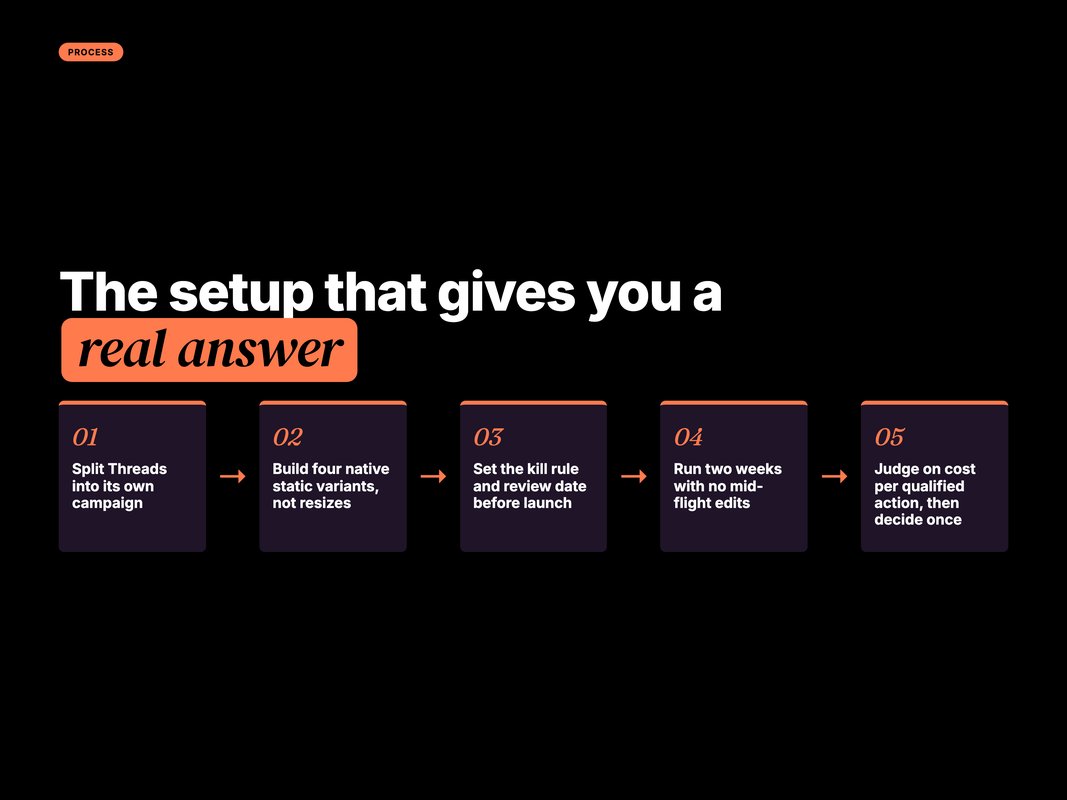
Here is the setup we use to get a clean read in two weeks.
Two rules make or break this.
Give it its own campaign. Blended reporting will never tell you whether Threads worked, because Meta's optimisation will move spend to the cheapest surface.
And give it native creative. Threads is a text-forward feed. A repurposed Instagram Reel with baked-in captions looks like an intruder there.
Set the kill rule before you launch, not after. Write down the cost per qualified action that would make you stop. Then hold yourself to it on review day.
Two weeks is the right window for a first read. Long enough to clear the learning phase. Short enough that a bad result costs you very little.
Resist the urge to edit mid-flight. Every change resets delivery and pushes your answer another week out. Set it, leave it, judge it once.
One last habit. Log the test in a shared doc with the date, budget, creative set and result. When someone asks next quarter whether Threads works, you will have an answer instead of a memory.
Q: How much budget does a fair test need?
A: Enough for roughly 50 conversions at your current cost per result, or two weeks of steady delivery, whichever comes first. Below that you are reading noise.
Creative that fits the feed
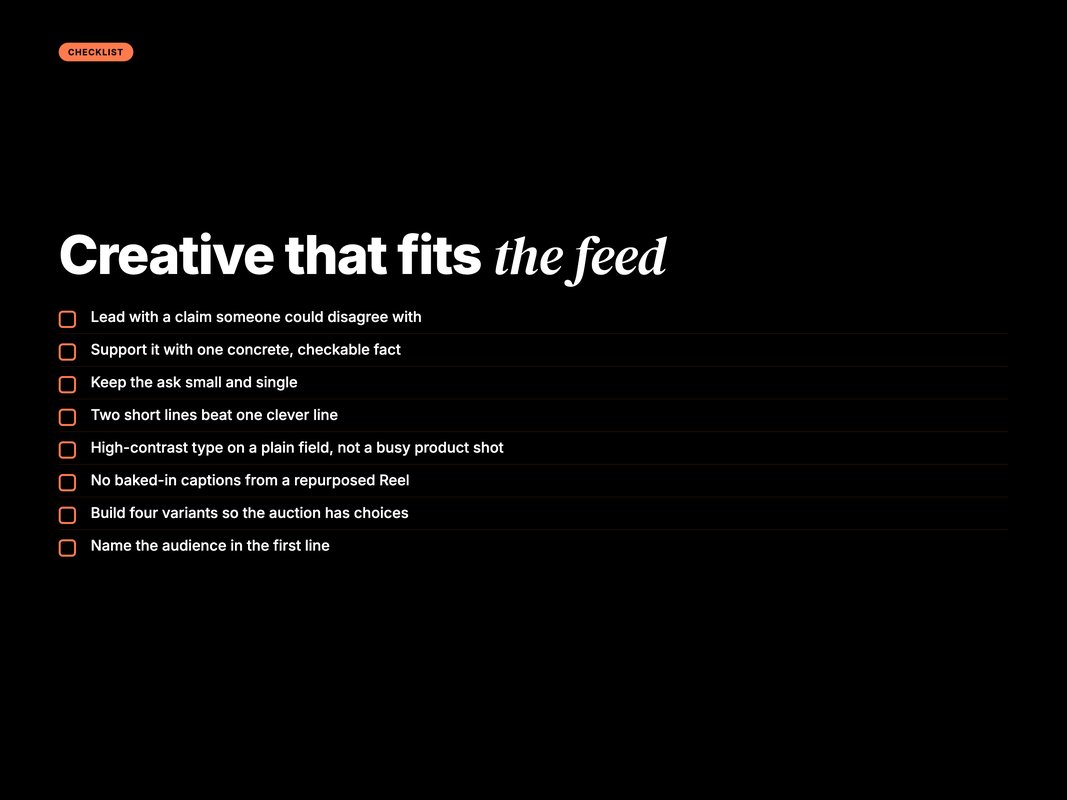
Threads rewards a specific kind of ad. It is closer to a good post than a good banner.
The pattern that works is simple. Lead with a claim someone could disagree with. Support it with one concrete fact. Then make the ask small.
Copy length is the other lever. Threads readers scroll fast but read more than Instagram users do. Two short lines beat one clever line.
Design also needs to change. High-contrast type on a plain field reads better than a busy product shot. Save the lifestyle photography for feeds built to reward it.
Hard-sell creative underperforms here, and the reason is contextual. A feed built for opinion punishes anything that reads like a billboard.
One more thing on measurement. Because reach is cheap, click volume can look great while quality lags. Judge Threads on cost per qualified action, not cost per click. Our note on How to Structure a Meta Ad Account: The Advantage+ Playbook covers how to hold that structure together.
What we would do at YARD
We are an AI-first growth marketing agency. We run performance marketing, LLM SEO, AI creative and AI funnels for D2C and B2B brands.
On a new placement like this, our bias is to test small and early rather than wait for a case study. Early auctions are usually cheaper. The cost of finding out is a few weeks of a modest budget.
So we do three things on day one. We split Threads into its own campaign so the data is readable. We build four native static variants instead of resizing old assets. We set a fixed review date and a kill rule before spending anything.
Then we do the boring part. Two weeks of steady delivery, no mid-flight edits, one decision at the end.
If it works, it becomes a standing line in the plan. If it does not, we switch the placement off across the account and revisit at the next scale milestone. Either way the answer cost very little to get.
We run this same test structure across every new placement Meta ships. It is not exciting. It is the reason our clients stop guessing.
The takeaway
Threads ads are worth a test for brands whose buyers read before they buy. They are worth skipping for everyone chasing this quarter's number.
The one thing nobody should do is nothing. The placement is on by default, so doing nothing means you are already spending there without a plan.
Go into Ads Manager this week. Pull a placement breakdown for the last 30 days. Find out what Threads has already cost you and what it returned.
Then decide on purpose instead of by accident.
Want us to run that placement audit for you? You can book a call with our team and we will send back the numbers.
FAQ
Q: Are Threads ads available to everyone?
A: Yes. Meta began the global rollout in the week of 26 January 2026, after a year of testing. Any advertiser with Ads Manager access can now run the Threads feed placement.
Q: How big is Threads in 2026?
A: Meta announced that Threads reached 500 million monthly active users on 16 June 2026. That is up from more than 400 million at the time of the ads rollout in January.
Q: Am I already running Threads ads without knowing?
A: Probably. The Threads feed placement is on by default for new campaigns using Advantage+ or manual placements. You have to deselect it in campaign settings to opt out.
Q: Which ad formats work on Threads?
A: Image ads, video ads, image-only carousels, Advantage+ catalog ads limited to images and image carousels, and app ads. Video carousels are not supported.
Q: Are Threads ads cheaper than Instagram?
A: Do not assume it. Threads sits in the same auction as the rest of Meta, so your cost depends on demand for your audience. Split it into its own campaign for two weeks and read your own numbers.
Q: Who should skip Threads ads for now?
A: Brands with tight budgets, heavy local targeting, or creative that only exists as video carousels. There is not enough incremental reach yet to justify the setup work.
Insights from Our Experts
Explore our latest articles on digital marketing strategies.