

Dynamic Search Ads have been quietly useful for a decade. They are on the way out.
Google is deprecating DSA campaigns and pushing advertisers toward AI Max, or toward Search campaigns using broad match with Smart Bidding (Source: PMG, 2026 — pmg.com).
You have more time than you did. You do not have as much as it feels.
This is the working plan. The real dates, what you give up, what you gain, and a campaign-level migration you can run without wrecking a quarter.
What Google Actually Changed
The headline is the delay, and it is worth reading precisely.
The automatic upgrade of DSA campaigns was pushed from September 2026 to February 2027 (Source: Search Engine Roundtable, 2026 — seroundtable.com). Google made the change on its Ads Developer Blog in June, and the Ads Liaison confirmed it publicly.
The reason given was advertiser feedback, plus a wish to stay out of the way of the Q4 peak.
Google also reversed an earlier step. You can create new DSA campaigns again for now (Source: Digital Applied, 2026 — digitalapplied.com).
So the current shape is a long runway with two hard walls at the end.
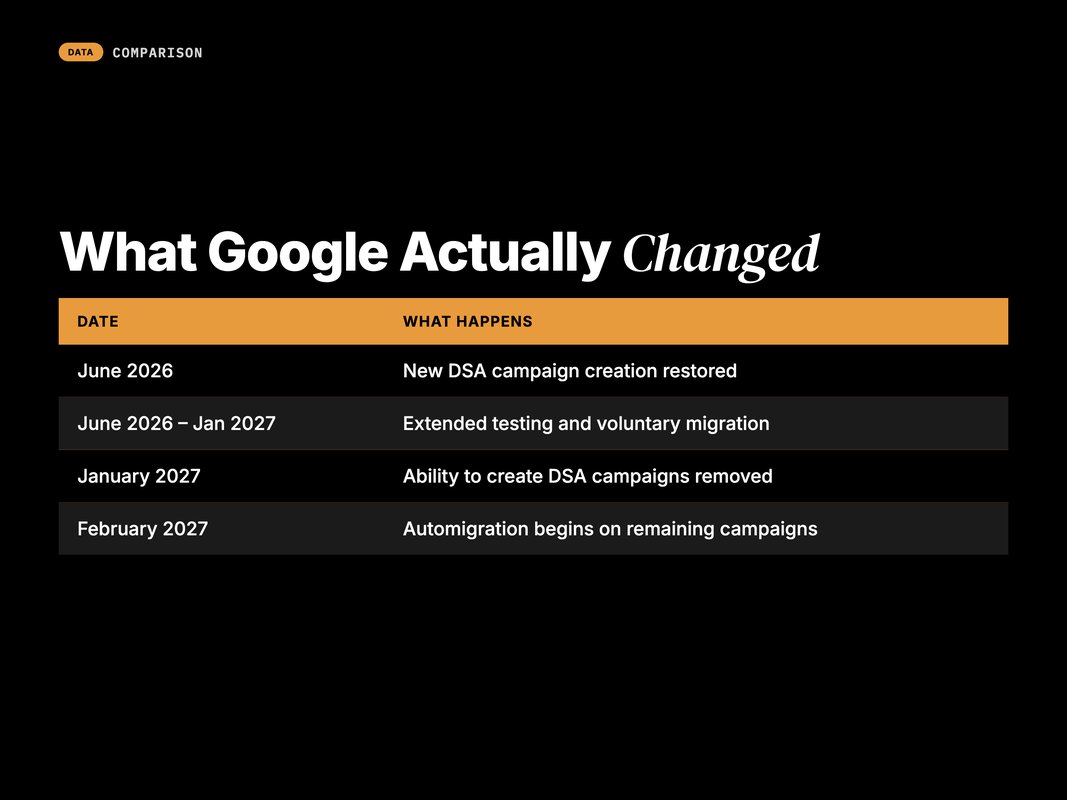
Read the dates as a work plan, not a countdown. Work backwards from February and the schedule writes itself. Two months of prep, three months of staged migration, one month of buffer.
January 2027 is when you lose the option to build new. February 2027 is when anything left gets moved for you.
Anything moved for you is moved on Google's defaults. That is the part to avoid.
Defaults are not malicious. They are just generic. They assume nothing about your margins, your excluded regions, your out-of-stock pages or your brand terms.
An account migrated on defaults typically spends two to three weeks learning things you already knew. That is the real cost of waiting.
Q: Has the deadline moved before?
A: Yes, and it may move again. Plan for February 2027 anyway. A delay you did not need costs nothing. A deadline you missed costs a quarter.
What AI Max Actually Is
Cut through the branding. AI Max is a set of features you switch on inside a Search campaign.
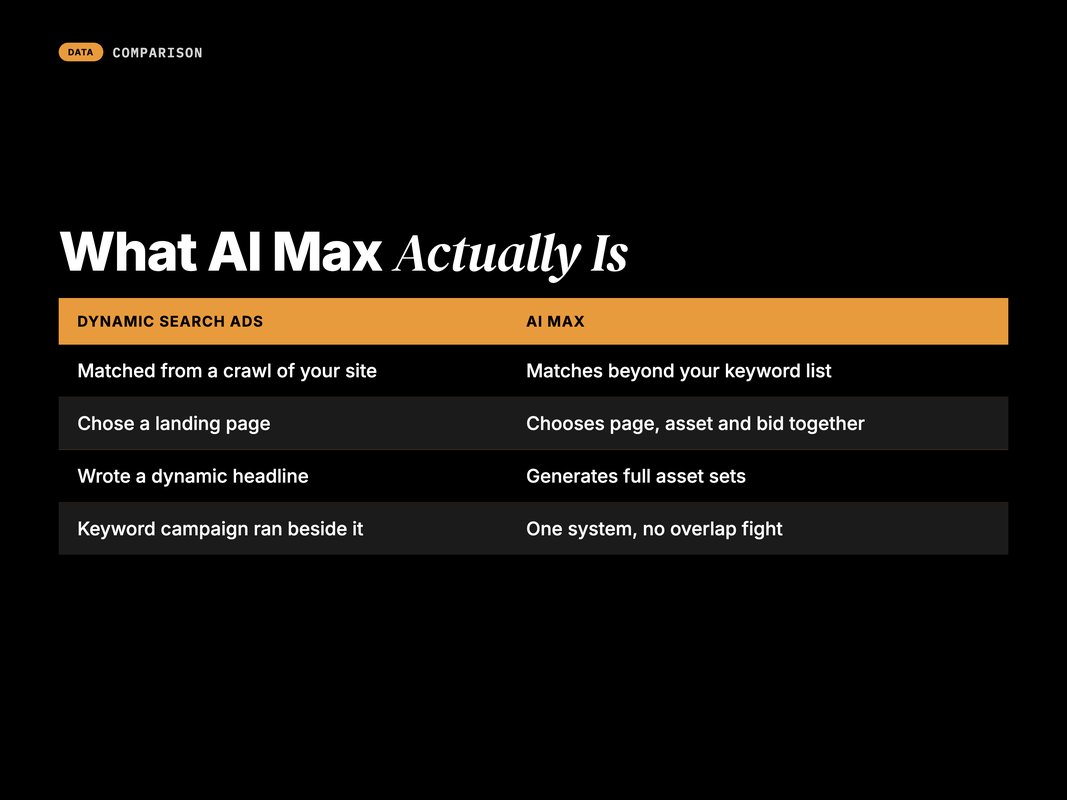
It does three jobs that DSA used to do, plus one it never did.
It matches beyond your keywords. Queries can be served that no keyword in your account covers.
It picks landing pages. It can choose the best page on your site for a query. DSA did the same job by crawling your site.
It writes assets. Headlines and descriptions get generated from your site and your existing ads.
And it optimises the combination. That is the new part. DSA chose a page and wrote a headline. AI Max tunes page, asset and bid together.
That is why this is not a like-for-like swap. DSA was a coverage tool. AI Max is a control-surface change.
Q: Is AI Max a new campaign type?
A: No. It is a feature set inside Search campaigns. That matters, because you can enable it on an existing campaign and keep the history.
Two Paths Out, and When to Pick Each
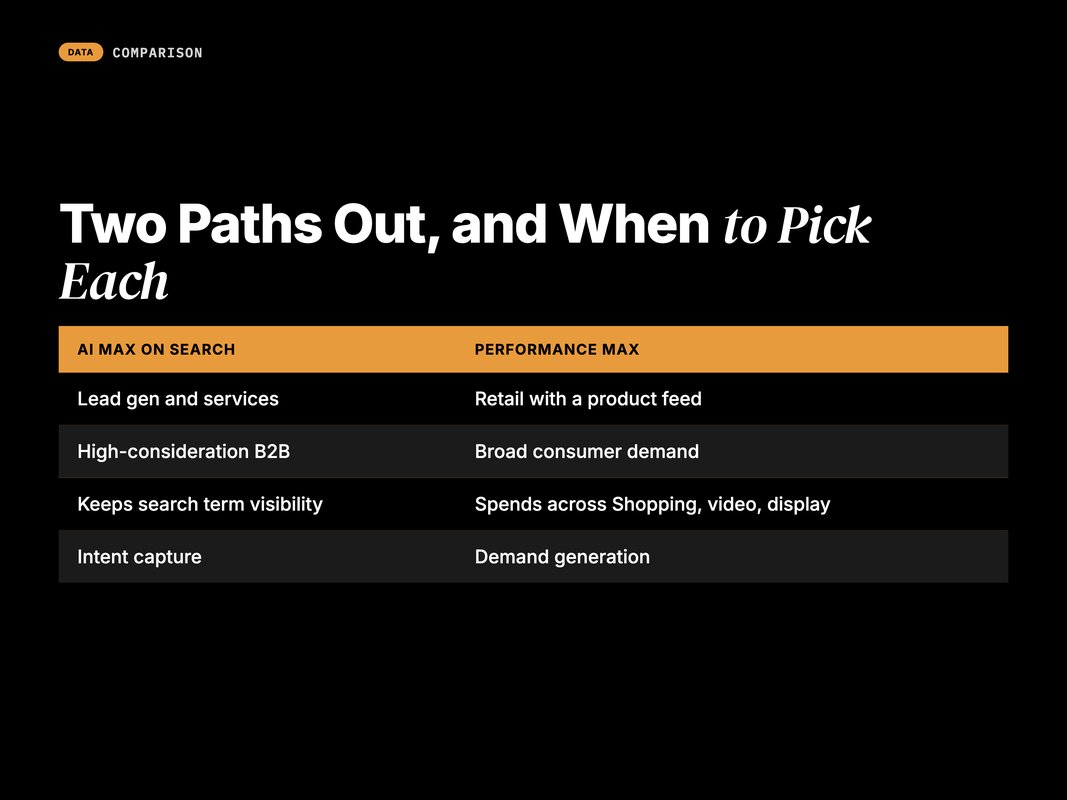
Google offers more than one destination. Picking the wrong one is the most expensive mistake in this whole move.
Path one is AI Max on a Search campaign. Path two is Performance Max.
They are not interchangeable.
Choose AI Max on Search when search intent is your engine. Lead generation, services, high-consideration B2B, anything where the query itself carries the intent. You stay inside Search inventory. You keep search term visibility. You keep a clean line back to the query.
Choose Performance Max when you sell products across channels. Retail with a feed, broad consumer demand, budget you are happy to spend across Shopping, YouTube and Display. It buys reach that Search alone cannot.
The failure case is a lead-gen account pushed into Performance Max because it sounded like the modern option. Lead quality drops, the search term view narrows, and nobody can explain where the money went.
The tell is usually in the lead form. Volume holds or rises while sales-qualified leads fall. If you are only reporting on form fills, that decline is invisible for a full quarter.
So before you migrate a lead-gen account, get offline conversions flowing back into the platform. Without them, any automated system optimises toward the wrong thing.
There is a third, quieter path. Some DSA campaigns should simply be retired.
If a DSA campaign exists only to catch spelling variants your keyword campaign already covers, it does not need a successor. Audit for that before you migrate anything. We usually find one or two.
Q: Can I run both paths?
A: Yes, and many accounts should. Search with AI Max for intent capture, Performance Max for demand generation. Just keep budgets and reporting separate so you can tell them apart.
What You Give Up
Be honest about the trade before you make it. Three things get looser.
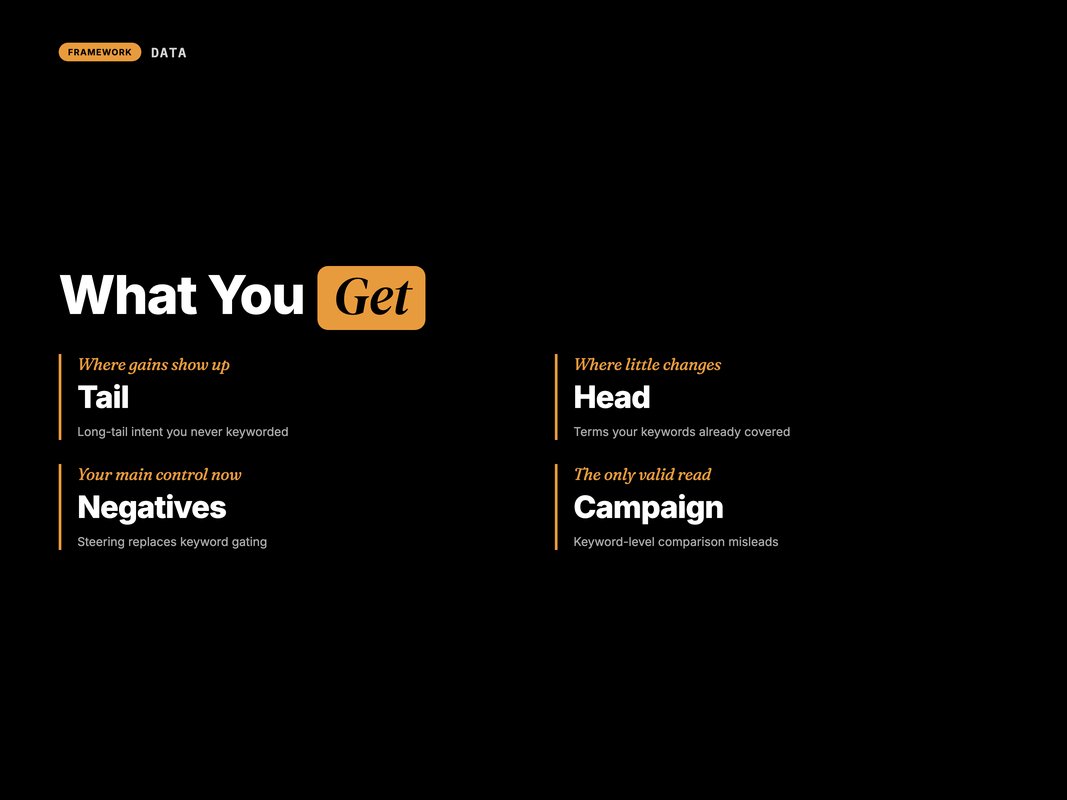
The keyword as a boundary. With DSA you controlled targeting through page feeds and categories. With AI Max, query matching is wider by design. Your negative list stops being hygiene and becomes the main steering wheel.
Predictable landing pages. You can still set URL rules. But the system has more freedom to send traffic to a page you did not plan for.
Clean reporting lines. When matching, assets and pages all move, attributing a change to any one of them gets harder. Your before-and-after has to be at the campaign level, not the keyword level.
None of these are dealbreakers. They are just real, and pretending otherwise makes for a bad migration.
There is one more loss that catches people out. Comparison across the change is genuinely hard.
Your keyword-level history stops being the right unit. You need a campaign-level baseline, captured before you migrate. Without one, you will spend a quarter arguing about whether it worked. Nobody wins that argument.
Take that snapshot now. Cost per conversion, conversion volume, brand share and average order value for the last ninety days. Save it somewhere outside the platform.
The teams that struggle are the ones who assumed the new system would behave like the old one with a better engine. It does not.
Q: Can I keep tight control if I want it?
A: Partly. Brand exclusions, negatives, location settings and URL rules all still work. You are steering rather than gating, and steering needs more attention early on.
What You Get
The upside is real, or Google would not be forcing the move.
Coverage of queries you never thought of. This was DSA's original pitch and AI Max does it better, because it is working with more signals than a page crawl.
Faster asset iteration. Generated headlines give you more variants to learn from. You still edit them, but you start from something.
One system instead of two. Most accounts ran DSA beside a keyword campaign and fought over which one served. That overlap goes away.
Better performance on long-tail intent. This is where the gains usually show up. Not on your head terms, which were already covered.
Set expectations correctly with whoever signs off the budget. Head-term performance will not transform. Tail coverage and asset volume will.
There is a second-order gain worth naming. Account structure gets simpler.
Most accounts we inherit carry three or four campaign types doing overlapping jobs. DSA catching spillover, a broad campaign catching intent, a brand campaign catching the rest. They compete in the same auctions and split the learning signal.
Collapsing that into fewer, better-fed campaigns usually helps on its own. Some of the lift people credit to AI Max is really the lift from cleaning up the structure.
The Migration Plan We Actually Run
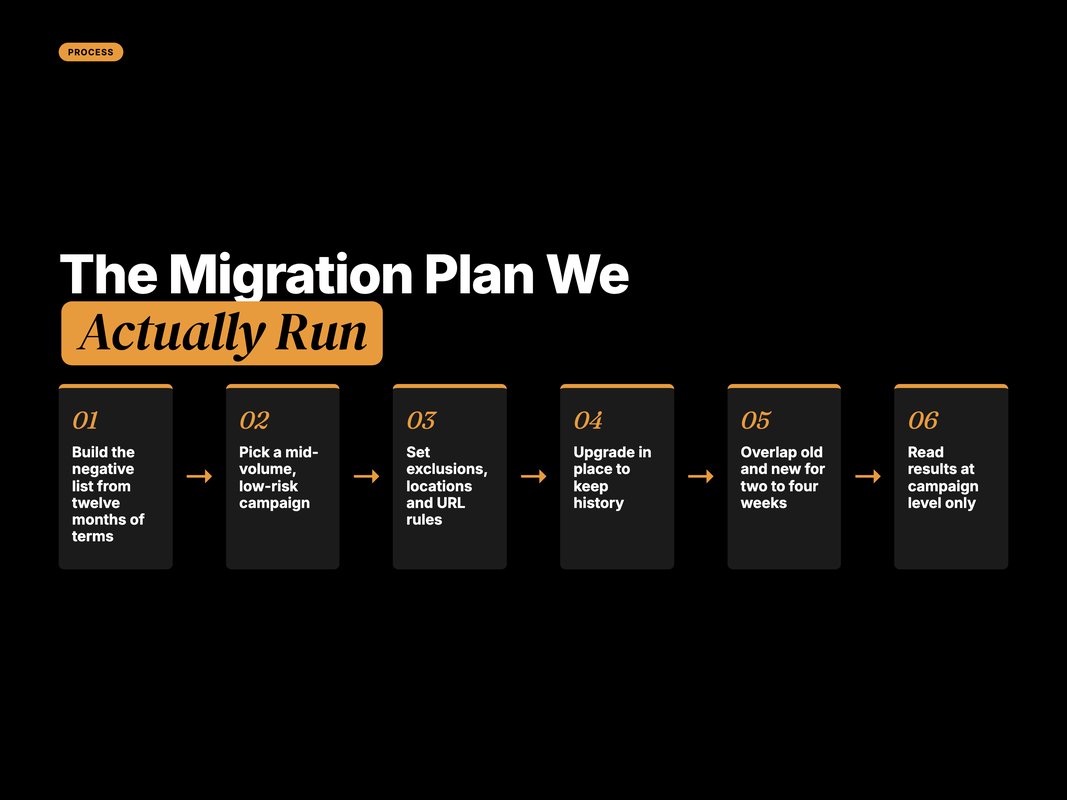
Do not migrate the account. Migrate one campaign, learn, then repeat.
Here is the sequence, in order.
Step one. Build the negative list first. Before you touch a campaign, export twelve months of search terms. Pull every query you would never want to pay for. This list is your steering wheel, so build it before you need it.
Step two. Pick the least scary campaign. Not your top revenue driver. Choose a mid-volume campaign with clean conversion tracking and enough data to read a result in three weeks.
Step three. Set the guardrails. Brand exclusions, location settings, URL rules, and the negative list from step one. All of it before you enable anything.
Step four. Upgrade in place where you can. Enabling AI Max on an existing campaign keeps the history and the bidding signal. Building fresh throws both away.
Step five. Overlap, do not switch. Where a new build is unavoidable, run old and new together for two to four weeks. Split budget deliberately. Do not let them fight silently.
Step six. Read at campaign level. Compare cost per conversion and conversion volume for the whole campaign. Keyword-level comparisons will mislead you here.
Then repeat on the next campaign. Most accounts need three cycles before the pattern is obvious.
Sequence matters more than speed here. Each cycle teaches you something you apply to the next one, so a rushed first migration costs you twice.
A realistic schedule for a mid-size account is one campaign a month from August. That puts the revenue driver in November or December, with the deadline still months away.
If your Q4 is heavy, stop migrating in October. Freeze the account, trade through peak, and resume in January. There is enough runway to afford that pause.
Q: How long does one campaign migration take?
A: About four weeks end to end. One week of prep, two to three weeks of overlap and reading. Faster than that and you are guessing.
Controls to Set Before You Turn It On
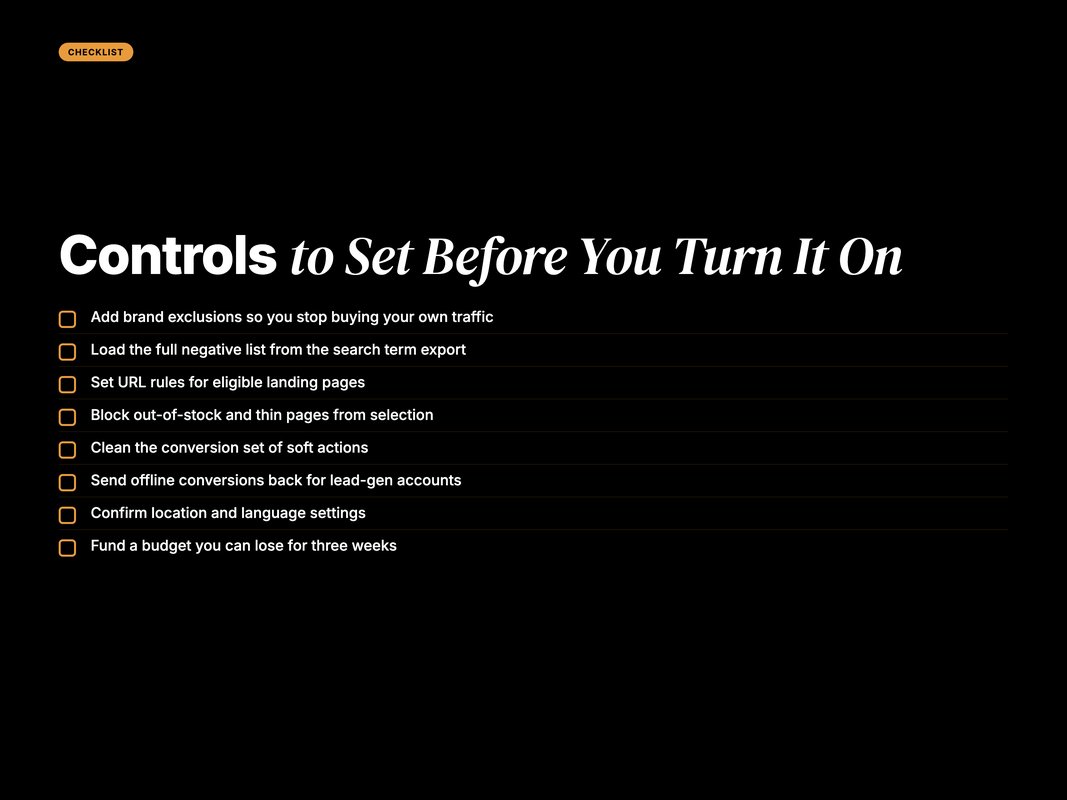
This is the checklist we run on every migration. Skip it and the first two weeks get expensive.
Four of these matter more than the rest.
Brand exclusions. Without them, the system will happily buy your own brand traffic and report it as a win. Your cost per conversion will look great and your incremental revenue will not move.
URL rules. Decide which pages are eligible. Out-of-stock pages, thin pages and old campaign landers should be off the table.
A real negative list. Not the fifteen terms in your account today. The full export-driven list from step one.
Conversion hygiene. If you are still counting soft actions as conversions, wider matching will find you a mountain of them. Fix the conversion set before you widen the funnel.
One more, easy to forget. Set a budget you are willing to lose for three weeks. Learning periods are real, and starving one produces a bad reading.
The rule of thumb we use is simple. A campaign needs enough daily budget to produce at least a handful of conversions a day, or the bidding never settles.
If your campaign cannot clear that bar, consolidate it with another before you migrate. Two starved campaigns learn slower than one fed campaign.
What to Watch in the First 30 Days
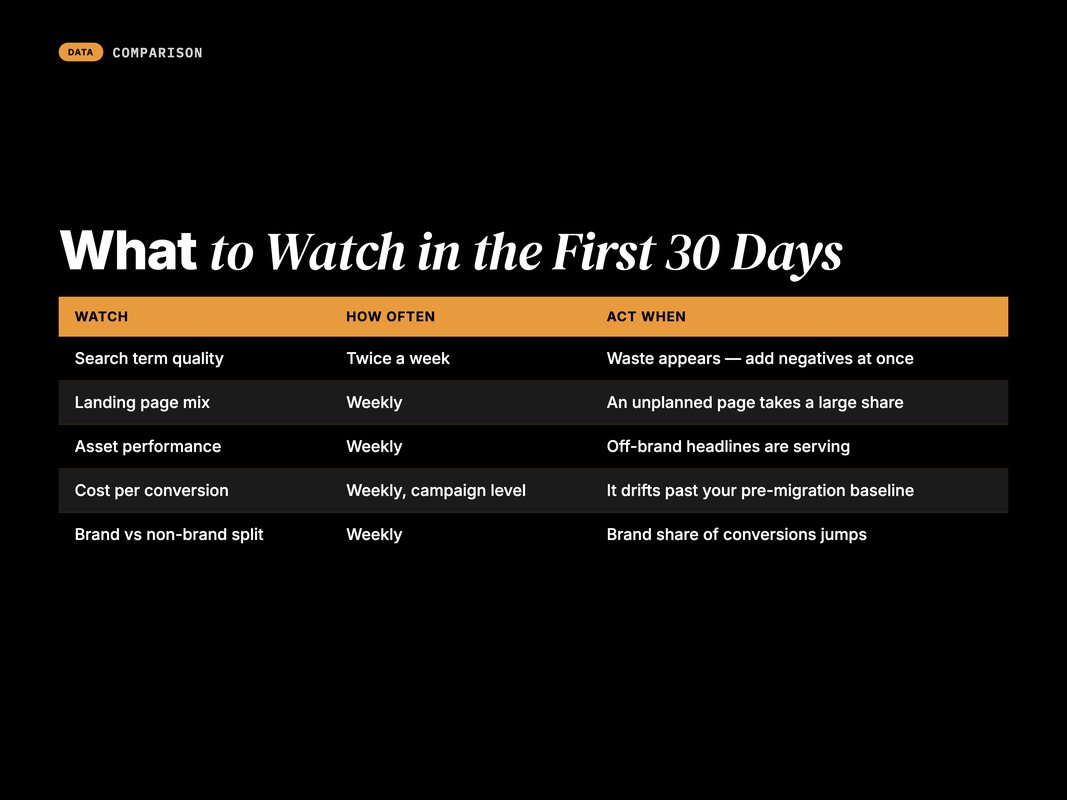
The first month is a reading exercise, not an optimisation exercise. Resist the urge to fix things on day four.
Watch five things.
Search term quality. Pull the report twice a week for the first fortnight. This is where wide matching shows its hand.
Landing page mix. Check which pages are actually getting traffic. If a page you did not intend is taking a third of it, tighten your URL rules.
Asset performance. Look at which generated headlines survive. Kill the off-brand ones. Keep the pattern of the winners for your manual assets.
Cost per conversion at campaign level. Not by keyword. Not by ad group. The whole campaign against its own pre-migration baseline.
Brand versus non-brand split. If brand share of conversions jumped, your exclusions are not doing their job.
Change one thing at a time. In a system this automated, a week where you changed four settings tells you nothing.
Keep a simple change log while you are at it. Date, campaign, what changed, why.
It sounds like overhead. It is the only thing that keeps the review honest. By week six, nobody remembers what changed in week two.
Q: When should I intervene?
A: Add negatives whenever the search term report shows waste, from day one. Leave bids and budgets alone for at least two weeks unless spend is running away.
How We Handle This for Client Accounts
Migrations are where accounts quietly lose a quarter. Not through a dramatic failure, but through a slow drift nobody attributed to anything.
YARD is an AI-first growth marketing agency. We run performance marketing, LLM SEO, AI creative and AI funnels for D2C and B2B brands. Platform migrations like this are a standing part of the account work.
Our approach is boring on purpose.
We build the negative list before the migration, not after. Twelve months of search terms, sorted, with a documented rule for what gets excluded and why.
We migrate one campaign at a time, in ascending order of risk. The revenue driver goes last, once the pattern is known.
We hold a fixed reading window. Two to four weeks per campaign, campaign-level metrics, one variable at a time. No mid-window panic edits.
And we write the guardrails down as a spec. The next person to touch the account knows why a setting is what it is.
Running DSA today with no plan for the move? That is a two-week planning job. Then a three-month execution one. Better started in August than in January. For the wider AI Max picture, see the complete AI Max guide for advertisers.
The Short Version
DSA is ending. The auto-migration moved to February 2027, and the ability to create new DSA campaigns ends in January 2027.
Use the extra runway. Migrating on your own terms beats being migrated on Google's defaults.
AI Max is not a like-for-like swap. You trade keyword boundaries for wider matching, and negatives become your main control.
Run it campaign by campaign. Build the negative list first. Set brand exclusions and URL rules. Upgrade in place so you keep your history. Overlap old and new for two to four weeks. Then read the result at campaign level, never by keyword.
Then watch the search term report like it is the only report that exists. For the first month, it nearly is.
Want the migration plan built against your account before Q4 locks up? Talk to the YARD team and bring twelve months of search terms.
FAQ
Q: When do Dynamic Search Ads go away?
A: The auto-migration moved from September 2026 to February 2027. You lose the ability to create new DSA campaigns in January 2027. Existing ones get upgraded from February 2027.
Q: What is AI Max?
A: AI Max is Google's set of AI features for Search campaigns. It matches queries beyond your keyword list, generates ad assets from your site, and picks landing pages. It is a feature set, not a new campaign type.
Q: Should I migrate now or wait?
A: Migrate now, on your terms. Voluntary migration lets you keep control of settings and learn on one campaign. Auto-migration in 2027 will not ask you first.
Q: Will I lose my performance history?
A: Not if you upgrade in place rather than building fresh. Where you must build new, run both for two to four weeks. That gives bidding data before you switch the old one off.
Q: Does AI Max mean I lose control of targeting?
A: You lose the keyword as a hard boundary. You keep brand exclusions, negatives, location controls and URL rules. Set those before you turn anything on.
Q: What is the biggest migration mistake?
A: Migrating everything in one week with no negative list and no URL rules. The account then spends into irrelevant queries and low-value pages before anyone notices.
Insights from Our Experts
Explore our latest articles on digital marketing strategies.