

Google shipped three new AI models on July 21, 2026. Not one flagship. Three workhorses. Gemini 3.6 Flash, Gemini 3.5 Flash-Lite, and Gemini 3.5 Flash Cyber all arrived on the same day.
Most coverage focused on the security model. That one is aimed at governments, not brands. But the real story for marketers sits in the other two. The cost of running AI just dropped again. And the drop compounds.
Here is what launched, what it costs, and what you should do about it this week.
What Google actually shipped
Let's keep the facts clean. Three models, three jobs.
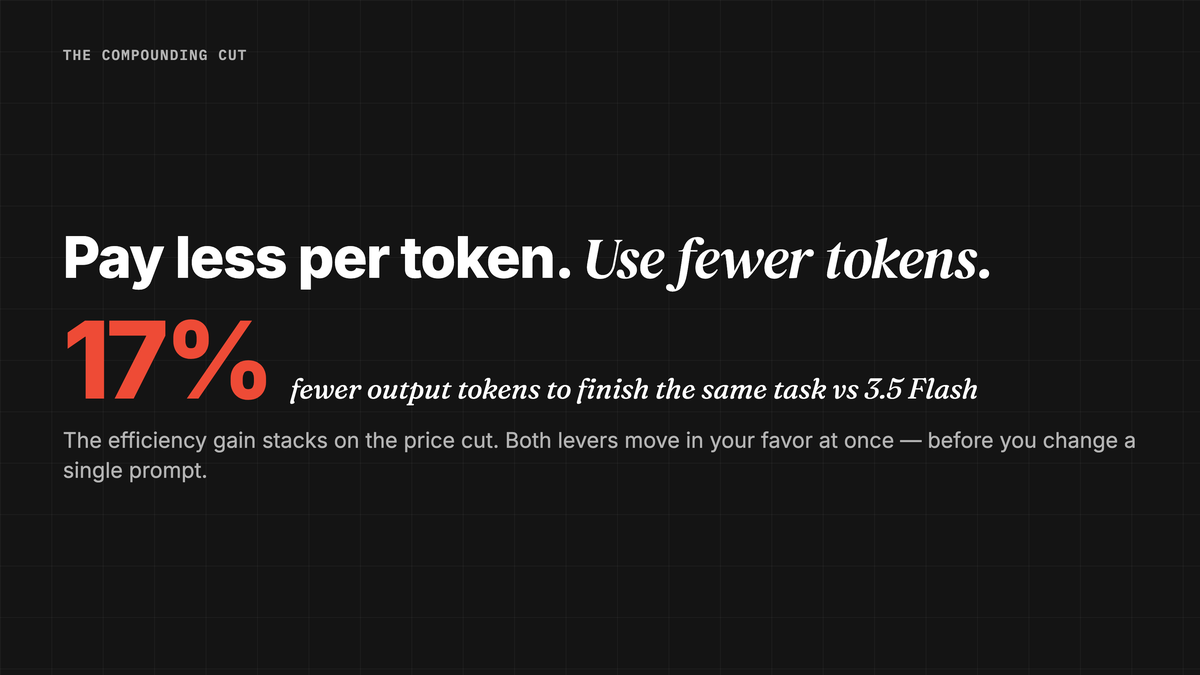
Gemini 3.6 Flash is the new everyday model. Google says it beats the old 3.5 Flash at coding, knowledge work, and multimodal tasks. It also works more efficiently. The model uses 17% fewer output tokens to finish the same task, per Google's announcement.
Gemini 3.5 Flash-Lite is the speed play. It streams 350 output tokens per second, per Google. It is built for high-volume agent work and document processing. Think of it as the model you use when you need thousands of small tasks done fast.
Gemini 3.5 Flash Cyber is the headline-grabber. It finds and patches software security flaws. CNBC reports it is Google's answer to Anthropic's Mythos model, which leads in automated code defense. For now, only governments and trusted partners get access.
One more detail matters. The long-awaited Gemini 3.5 Pro did not ship. CNBC notes its development is reported to be months behind. Google led with cheap and fast instead of big and smart. That choice tells you where the market is going.

The numbers that matter
Every AI launch comes wrapped in benchmarks. Most of them will not change your week. These few might.
Price. Gemini 3.6 Flash costs $1.50 per million input tokens and $7.50 per million output tokens, per Google's pricing. Flash-Lite comes in at $0.30 per million input tokens and $2.50 per million output.
Efficiency. The 17% cut in output tokens stacks on top of the price. You pay less per token. You also use fewer tokens. Both levers move in your favor at once.
Coding and agent skill. On the DeepSWE benchmark, 3.6 Flash scores 49%, up from 37% for the prior Flash model, per Google. On OSWorld-Verified, a test of real computer use, it hits 83.0%. That is a cheap model doing work that needed a flagship last year.
Why should a marketer care about coding scores? Because agent workflows run on them. When a budget model can operate software and finish multi-step tasks, automation stops being a premium project. It becomes a line item.
The real story: the floor keeps dropping
Zoom out. This launch is not about Google. It is about a pattern.
We flagged it when OpenAI shipped GPT-5.6 with lower prices. We flagged it again when cheap frontier models started matching last year's leaders. Now Google has cut the cost of "good enough" AI one more time.
Each cut moves AI spend from "innovation budget" to "utility bill." The tasks you priced out six months ago are worth pricing again. A content pipeline that cost too much to run daily might now run hourly. An agent that was too slow at scale might now stream ten times faster on Flash-Lite.
There is a second pattern too. Google keeps pushing AI deeper into its own surfaces. The new models power the Gemini app and Google Search features. We covered what that absorption looks like when Google put image generation inside Search. Cheaper models accelerate it. The cheaper each AI answer gets, the more of them Google can serve, and the fewer clicks leave the page.
And the security angle? CNBC frames Flash Cyber as Google chasing Anthropic's lead in code defense. The AI race now has a security front. Marketers cannot use these models yet. But your clients will start asking about AI and security in the same breath. Be ready for that conversation.

A worked example: what the price cut looks like
Numbers land better than claims. So let's run one.
Say your team drafts 200 content assets a month with AI. Product blurbs, ad variants, email drafts, briefs. Assume each job takes about 2,000 input tokens and 1,500 output tokens on the old model.
On the new pricing, the input side of that workload costs about 60 cents a month on 3.6 Flash. The output side comes to around $2.25. That is the whole drafting workload for less than a coffee. Now add the 17% output-token cut, per Google. Your output cost falls again, to roughly $1.87, before you change a single prompt.
The point is not the exact cents. Your token counts will differ. The point is the shape of the math. At these prices, model cost stops being the reason you say no to an idea. The real costs move elsewhere. Setup time. Review time. Quality control. Plan for those instead.
And that reframes the question for your team. Stop asking "can we afford to run AI on this?" Start asking "is this worth a human reviewing the output?" That is a much better filter.
What it means for search and AI visibility
There is an SEO thread here too, and it is easy to miss.
These Flash models are the engines behind consumer surfaces. Google says the new models reach the Gemini app and Google Search features. Cheaper tokens mean Google can afford to run AI on more queries. More AI answers mean more journeys that start and end on Google's page.
We have tracked this pattern all year. Answers moved into AI Overviews. Shopping moved in next. Then images moved in. Each step ran on models getting cheaper in the background. This launch is the background.
For your content strategy, the response stays the same, and it compounds:
- Be the source the AI cites, not the page it replaces. Original data, named experts, and first-hand tests earn citations.
- Structure content so machines can lift it cleanly. Clear headings. Direct answers high on the page. Schema in place.
- Watch your AI-referral traffic separately from classic organic. The mix is shifting under your feet.
- Keep building assets AI cannot fake. Real photography. Proprietary numbers. Strong opinions with receipts.
None of that is new advice. But every price cut makes it more urgent. The cheaper the tokens, the more answers Google serves without you.
What this changes for your marketing stack
Here is the practical read, by workload.
Content operations. Drafting, repurposing, tagging, and summarizing all run on tokens. A 17% efficiency gain plus lower prices means your cost per piece falls without touching quality settings. If you run high-volume workflows, re-quote them this week.
Agentic workflows. Flash-Lite's 350-token-per-second speed, per Google, targets exactly the work marketers automate. Lead scoring. Catalog cleanup. Report generation. Campaign QA. Speed matters here because slow agents block the queue. Fast, cheap agents change what is worth automating.
Data and reporting. Document processing is a named use case for Flash-Lite. Piles of PDFs, transcripts, and briefs can be parsed at low cost. The blocker for most teams was never capability. It was price at volume. That blocker keeps shrinking.
Vendor pressure. Every tool in your stack that bills for "AI features" now has cheaper inputs. Watch which vendors pass savings on and which quietly widen margins. Ask your key vendors which model powers your plan. Their answer tells you a lot.
Do this now
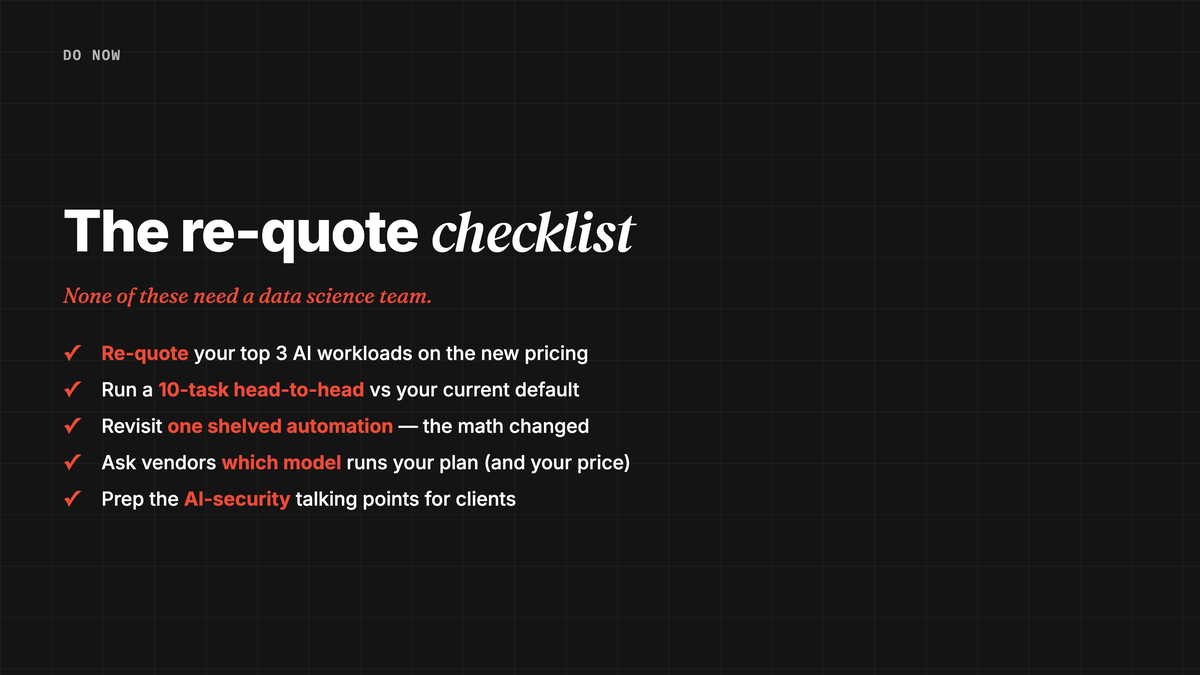
Five moves, none of which need a data science team.
- Re-quote your AI workloads. Pull your top three AI use cases. Check what they cost on the new pricing. Cheap models improved more than expensive ones this cycle.
- Test 3.6 Flash against your current default. Run ten real tasks side by side. Judge output quality, speed, and token use. Switch if it wins. Loyalty to a model is not a strategy.
- Revisit one shelved automation. Something you scoped and dropped for cost. Re-scope it on Flash-Lite pricing. The math likely changed.
- Ask vendors the model question. Which model runs your plan, and did your price move? Silence is also an answer.
- Note the security thread. Client questions about AI risk are coming. The Mythos-versus-Cyber race gives you the context to answer well.
How to run the head-to-head test
"Test the new model" is easy to say. Here is a way to do it in an afternoon.
Pick ten real tasks. Not toy prompts. Pull actual jobs from last week. A product description. A campaign summary. A tricky client email. A data cleanup. Real inputs, real stakes.
Run them on both models. Your current default and 3.6 Flash. Same prompts. Same settings where possible. Save every output.
Score three things. Quality first: would you ship this output with light edits, heavy edits, or not at all? Speed second: how long did each task take end to end? Cost third: compare token counts, not just price sheets. The 17% efficiency claim is Google's number. Verify it on your work.
Decide per workload, not overall. The common outcome is a split. The cheap model wins the volume work. The flagship keeps the hard reasoning. That split is where the savings live. Route each job to the cheapest model that clears your quality bar.
Write the result down. A one-page note. Which model won which task, and by how much. You will re-run this in a quarter, because the models will change again. The note turns a scramble into a routine.
Teams that do this quarterly treat model launches as procurement events. Teams that skip it pay flagship prices for utility work. The gap between those two postures is now real money.
What to watch next
Three things will tell you where this goes.
The Gemini 3.5 Pro question. The flagship is missing, and CNBC reports it is months behind. When it lands, the top end of the market resets. Until then, the action stays at the budget tier.
Rival price moves. Google cut prices in public. OpenAI and Anthropic can read a price sheet too. If they answer, your costs fall again without you lifting a finger. Keep your workloads portable so you can take the best offer.
The security race. Flash Cyber versus Mythos is round one of a new competition, per CNBC's framing. Automated code defense will shape how enterprises trust AI vendors. Trust shapes budgets. Budgets shape what your clients ask you to build.

The caveat
Do not switch your stack on launch-day claims. Benchmarks come from Google's own announcement. Real workloads are messier than test sets. Run your own comparisons before you migrate anything that matters. And remember the missing piece: the flagship 3.5 Pro is still absent. If your work needs top-end reasoning, this launch does not change your answer yet.
FAQ
What did Google launch on July 21, 2026?
Three models. Gemini 3.6 Flash for general work, Gemini 3.5 Flash-Lite for speed and volume, and Gemini 3.5 Flash Cyber for finding and patching security flaws, per Google's announcement.
How much does Gemini 3.6 Flash cost?
$1.50 per million input tokens and $7.50 per million output tokens, per Google. It also uses 17% fewer output tokens than the prior Flash model.
Can marketers use Gemini 3.5 Flash Cyber?
Not now. CNBC reports access is limited to governments and trusted partners at launch.
Is Gemini 3.6 Flash good enough to replace a flagship model?
For many everyday tasks, yes. It scores 49% on DeepSWE and 83.0% on OSWorld-Verified, per Google. For hard reasoning, test before you switch.
Where can I try the new models?
Through Google AI Studio and the Gemini API for developers, plus the Gemini app and Search features for consumers, per Google.
Why did Gemini 3.5 Pro not launch?
Google has not said. CNBC reports its development is running months behind expectations.
What should marketers do first?
Re-quote your top AI workloads on the new pricing, and run a ten-task head-to-head against your current model. Price moved. Your defaults should be re-tested, not assumed.
Sources: Google — Gemini 3.6 Flash, 3.5 Flash-Lite and 3.5 Flash Cyber announcement · CNBC — Google expands Gemini lineup with cheaper models and new Mythos rival · The Next Web — Google launches Gemini 3.6 Flash and a Mythos rival
Insights from Our Experts
Explore our latest articles on digital marketing strategies.