

Programmatic SEO is how you rank for a thousand searches at once. You build one template. You feed it a dataset. Each row becomes a page.
That is the whole trick. But scale cuts both ways. The same pipeline that captures huge long-tail demand can also flood Google with thin pages. And Google is very good at spotting that now.
This playbook shows you the full pipeline. Keyword pattern discovery. Data sourcing. Template design. AI content generation with guardrails. Internal linking. Indexing control.
You will get copy-pasteable steps, a named framework, and a quality checklist. We will also draw the line between real programmatic SEO and scaled content abuse. Cross that line and you lose the whole domain. Stay on the right side and you build a compounding traffic engine. Let us walk the pipeline end to end.
What Programmatic SEO Actually Is
Programmatic SEO means one thing. Template plus dataset equals many pages.
You are not writing pages one by one. You are designing a page pattern once. Then you let data fill it, row by row.
Think of a workflow-automation SaaS we all know. It built a page for every app it connects to. Then a page for every pair of apps. That single pattern now drives millions of visits a month.
The reason it works is the long tail. Most searches are rare. Keywords with fewer than 10 monthly searches make up almost 93% of one major index. (Source: Ahrefs, 2024 — ahrefs.com/blog/long-tail-keywords)
You cannot hand-write for that tail. There is too much of it. So you template it.
The goal is simple. Be the best answer for ten thousand specific questions. Not the tenth-best answer for one broad one.
But not every topic fits this model. Programmatic SEO needs structured, repeatable data. Location pages fit. Product specs fit. Price and comparison pages fit.
Opinion pieces do not. Deep guides do not. Anything that needs a human voice per page is a bad fit. If you cannot describe the page as a table row, do not template it.
Here is the mindset shift. Stop thinking in pages. Start thinking in patterns and rows. One good pattern can unlock thousands of pages. One weak pattern just makes noise.
Q: What makes a good programmatic SEO page?
A: A good page answers one specific query with real, unique data. It has facts a template alone could not invent. It helps the reader finish a task. If you strip the data and every page reads the same, it is not good enough.
When It Works vs When It Becomes Spam
Programmatic SEO is not banned. Thin, empty pages are.
Google is blunt here. It defines scaled content abuse as many pages made mainly "to manipulate search rankings and not helping users." (Source: Google Search Central, 2026 — developers.google.com/search spam policies)
Read that again. It is about intent and value. Not volume alone.
Two more traps live in the same policy. Doorway pages funnel users through near-identical pages to one destination. Site reputation abuse borrows a strong domain's authority to rank weak third-party pages. (Source: Google Search Central, 2024 — developers.google.com/search blog)
So what separates good from bad? Unique data and real user value.
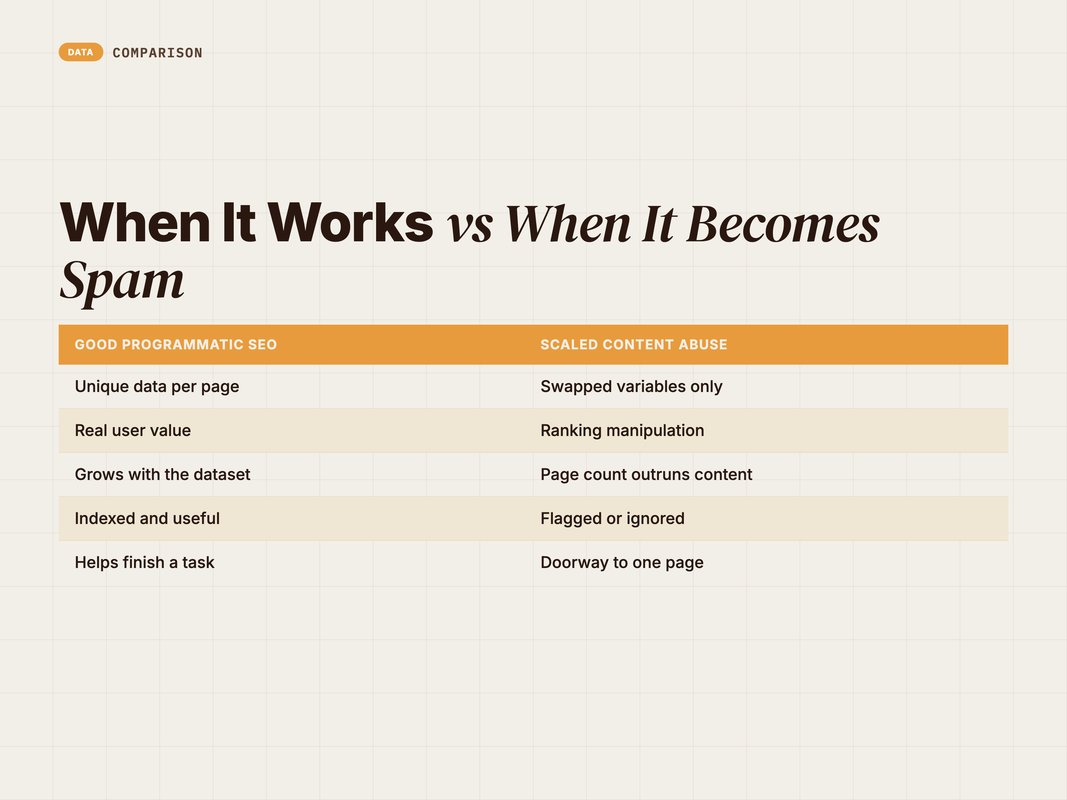
A real estate site with live listing data is fine. A page-per-city clone with swapped names is not. The first helps. The second manipulates.
Run this gut check on any page you plan to ship. Would a user thank you for it? Does it answer their exact query? Could a human write it faster than your template? If the page fails those, it is thin.
There is also a volume signal to watch. Spam systems compare how many URLs you add against how much real content ships. A spike in pages with no matching spike in substance looks like abuse. Grow your page count in step with your data, not ahead of it.
Q: Will Google penalise AI-written pages?
A: Not for being AI-written. Google judges content by quality, not origin. The penalty comes from using automation to make many low-value pages to game rankings. Keep the value high and the origin does not matter.
The End-to-End Programmatic SEO Pipeline
Here is the full pipeline in one view. Six stages, in order.
You run them like an assembly line. Data flows in one end. Indexed, useful pages come out the other.
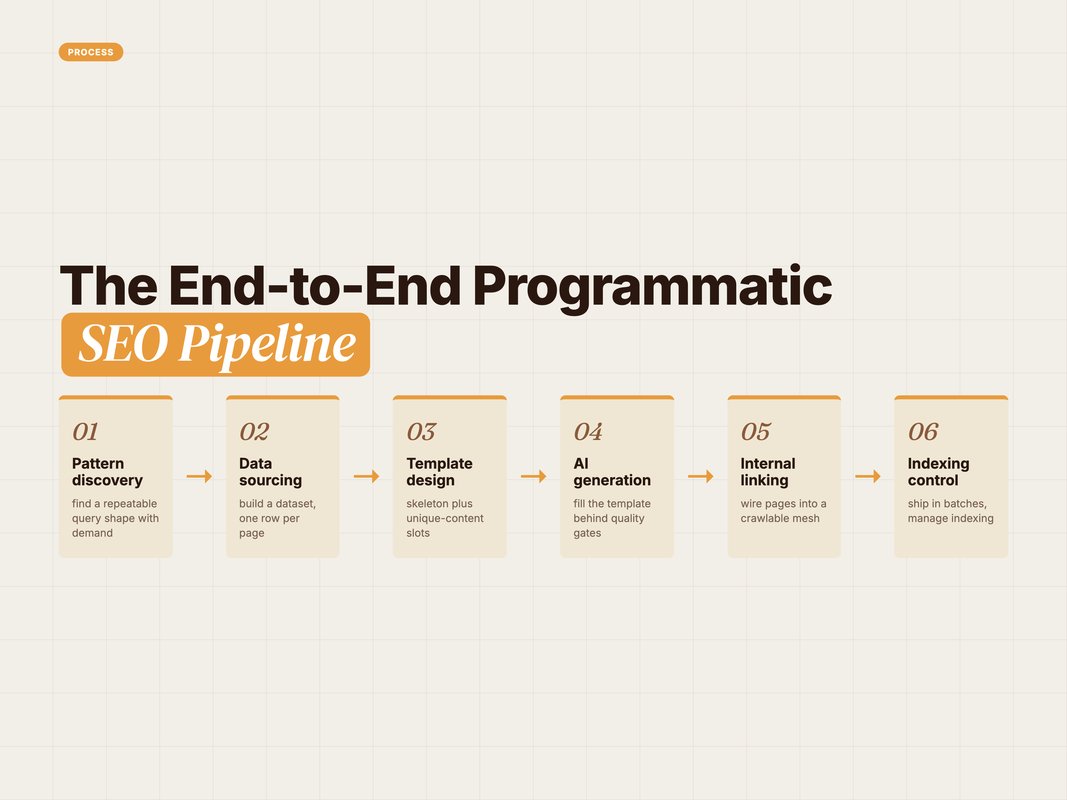
Each stage has a job. Skip one and quality drops. Let us name them.
- Pattern discovery. Find a repeatable query shape with real demand.
- Data sourcing. Build a structured dataset, one row per page.
- Template design. Design the page skeleton and its unique-content slots.
- AI generation. Fill the template with AI, behind quality gates.
- Internal linking. Wire pages together so they are found and understood.
- Indexing control. Ship in batches and manage what gets indexed.
We will go deep on each. But notice the order. Data before template. Quality gates before scale. Get that wrong and you scale a mistake.
Each stage also needs an owner and a tool. Here is the stack we use.
| Stage | Job | Tool layer |
|---|---|---|
| Pattern discovery | Find the query shape | AI plus keyword research |
| Data sourcing | Build the dataset | Airtable or Sheets |
| Template design | Design the page skeleton | Webflow or your CMS |
| AI generation | Write the copy | Claude behind gates |
| Internal linking | Wire the mesh | Automated link rules |
| Indexing control | Ship in batches | Search Console |
Nothing here is exotic. A data layer, a CMS, an AI model, and a rule engine. The judgment lives in the gates between stages, not in the tools.
Q: Do I need code to run this pipeline?
A: Not much. A spreadsheet or Airtable holds the data. A CMS like Webflow holds the template. AI writes the copy. Light automation glues them. Most of the work is judgment, not code.
Step 1 and 2: Find the Pattern, Build the Data
Start with the pattern, not the pages. Look for a query shape you can repeat.
Good shapes look like this. A job in a city. Tool A versus tool B. A product for a use case. Each blank is a column in your data.
Test the pattern before you commit. Ask three questions of it. Does real search demand exist? Is the competition beatable? Can you get unique data for every row? If any answer is no, drop it.
Here is a prompt to find patterns fast.
You are an SEO strategist. My site is about [topic].
List 10 repeatable search patterns my audience uses,
in the form "[variable] + [modifier]".
For each, give: the pattern, 3 real example queries,
and the data columns I would need to build one page per row.
Rank by likely search demand and low competition.
Now build the data. One row per page. This is the part people skip.
Each row must carry unique facts. Numbers, specs, prices, local details. If a row has nothing unique, the page will be thin.
Store it in Airtable or Google Sheets. Those are your data layer. One column per template variable. One extra column for the "unique value" this page adds.
Where does the data come from? A few reliable places. Your own product database. A public API. A supplier feed. First-hand research you run once and reuse.
The best data is data your competitors do not have. Live prices. Real reviews. Local details. Anything scraped from the same source everyone uses will not help you stand out.
Q: What if I do not have enough unique data?
A: Then you are not ready to scale that pattern. Thin data makes thin pages, and thin pages get ignored or flagged. Enrich the data first. Add stats, comparisons, or first-hand details. No unique data, no page.
Step 3 and 4: Template Design and AI Generation
Now design the template. Treat it like a product, not a blog post.
Every good template has two zones. A fixed frame. And unique-content slots that change per row.
The frame is your H1 pattern, intro shape, and section headers. The slots are where real per-page data lands. Aim for at least one slot no template could fake.
Here is a generation prompt with guardrails baked in.
Write the body for a page targeting "[query from row]".
Use ONLY these facts: [paste the row's unique data].
Rules:
- Lead with the specific answer in the first 2 sentences.
- Include every unique data point above, in context.
- Do not invent numbers, prices, or claims.
- If a fact is missing, write "[MISSING: fact]" instead of guessing.
- 250-350 words, short sentences, no filler.
That "[MISSING]" rule is your safety net. It surfaces thin rows before they publish.
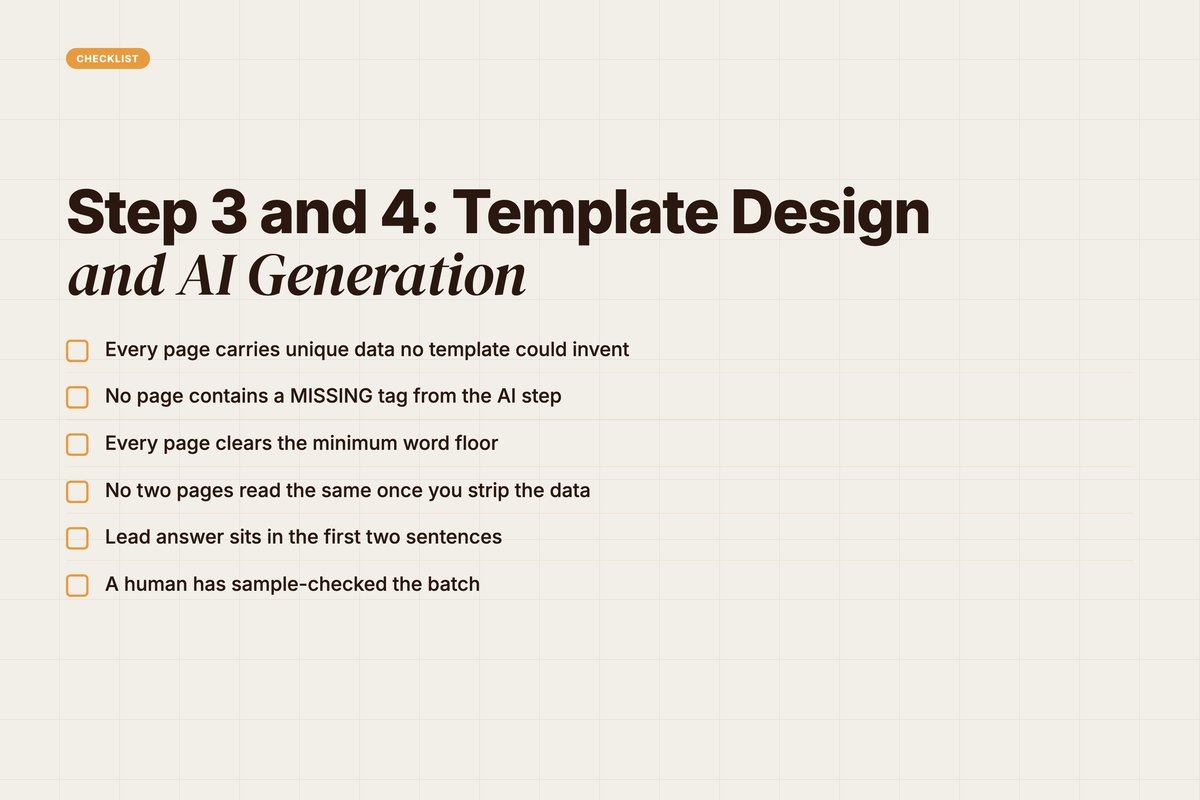
Run a quality gate on every page before it ships. Reject any page with a missing tag. Reject any page under your word floor. Reject any two pages that read the same after you remove the data.
Google's own guidance backs this up. It judges content by quality, not by how it was made. (Source: Google Search Central, 2023 — developers.google.com/search AI content)
So AI is fine. Thin AI output is not. The gate is what keeps you safe.
Keep a human in the loop too. Not on every page. On a sample of every batch. Read 20 pages by hand. If they read well and help, ship the batch. If they feel empty, hold it back.
This is the step teams skip when they chase speed. Do not skip it. One bad batch can drag down your good pages. The sample check is cheap insurance.
Q: How do I stop AI pages from sounding identical?
A: Feed each page different data and force the model to use it. The uniqueness comes from the row, not the prose. If pages still feel same-y, your data is too thin, not your prompt.
Step 5 and 6: Internal Linking and Indexing
Pages that no one links to rarely get found. Internal linking fixes that.
Every programmatic page needs links in and links out. Both matter.
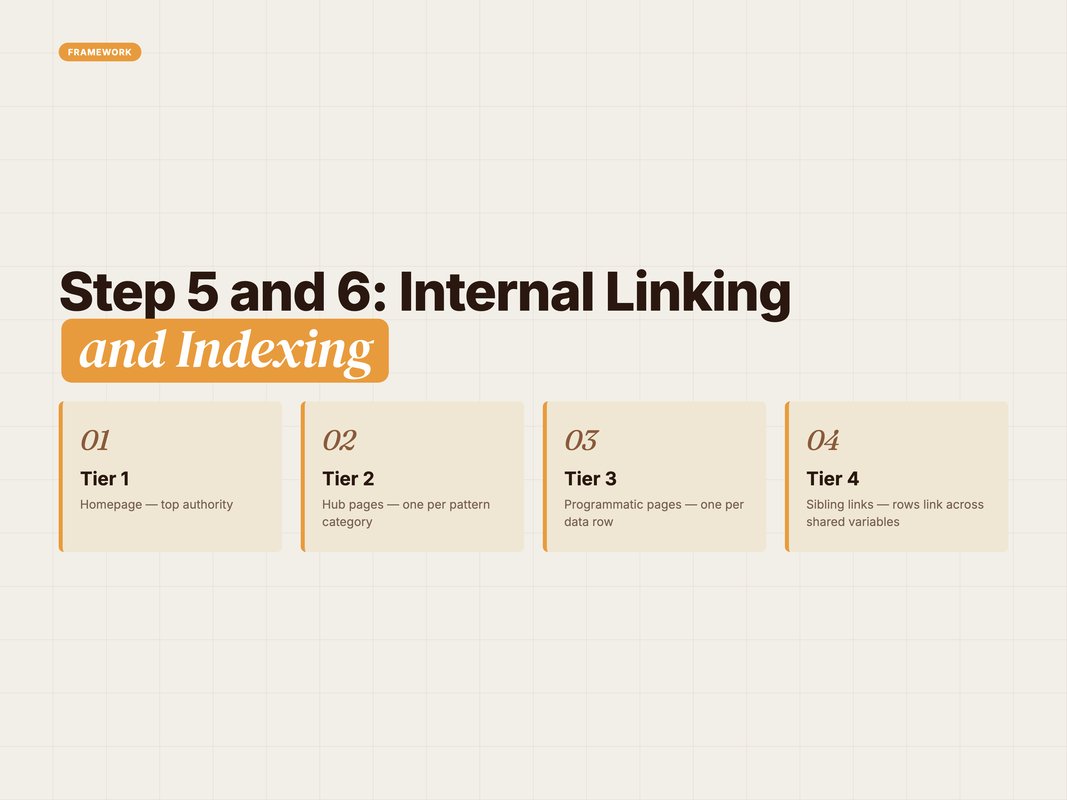
Link in from your hubs. A "[Job] in [City]" set should link from a national hub page. Link out to related rows. City pages link to nearby cities. Comparison pages link to each other.
You can automate this. Build a rule, not a manual list.
For each page, auto-generate an internal link block:
- Link to its parent hub page.
- Link to 5 sibling rows sharing the same [category].
- Link to 3 rows sharing the same [secondary variable].
Use the row's real name as anchor text, not "click here".
That rule alone builds a dense, crawlable mesh. No hand-linking.
Good anchors matter too. Use the row's real name as the link text. Never use "click here". The anchor tells Google what the target page is about.
Now control indexing. Do not publish 10,000 pages on day one.
Ship in batches. Index a small set first. Watch impressions in Search Console for two to three weeks. If pages earn impressions and stay indexed, scale the next batch. If they get ignored, fix the template before you expand.
Keep low-value rows out of the index entirely. A noindex on weak pages protects the strong ones.
Watch three signals as you scale. Index coverage, impressions, and average position. If coverage drops, Google is rejecting pages as thin. That is your cue to stop and fix the data, not push more pages.
A sitemap helps here. Submit the batch you want crawled. Leave the rest out. This gives you control over what Google sees and when.
Q: Why not publish every page at once?
A: Because a flood of thin pages is exactly what spam systems watch for. Batching lets you prove quality on a small set first. It also gives you a kill switch if something goes wrong.
The SCALE Framework for Quality at Scale
Quality does not survive scale by accident. You engineer it. Use this five-part model.
Each letter is a gate. A page passes only if it clears all five.
- Source unique data. Every page needs facts a template cannot invent.
- Constrain the AI. Feed it only the row's data. Ban invented numbers.
- Assess a sample. Hand-check a slice of pages before each batch.
- Link the mesh. Wire pages together with automated internal links.
- Expand in batches. Index a small set, prove it, then scale.
Quick Facts: Programmatic SEO at Scale
- Keywords with under 10 monthly searches are almost 93% of one major keyword index — this is the long tail programmatic SEO targets. (Source: Ahrefs, 2024 — ahrefs.com/blog/long-tail-keywords).
- Scaled content abuse means making many pages mainly "to manipulate search rankings and not helping users." (Source: Google Search Central, 2026 — developers.google.com/search spam policies).
- Google's site reputation abuse policy was updated in November 2024 to cover third-party pages that borrow a host's ranking signals. (Source: Google Search Central, 2024 — developers.google.com/search blog).
- Google evaluates content by quality and helpfulness, not by whether AI made it. (Source: Google Search Central, 2023 — developers.google.com/search AI content).
The SCALE framework is not clever. It is a discipline. Run every batch through it.
Here is the pre-publish checklist we run on every batch.
- Every page has unique data no template could invent.
- No page contains a MISSING tag from the AI step.
- Every page clears the minimum word floor.
- No two pages read the same once you strip the data.
- Each page links in from a hub and out to siblings.
- A human has sample-checked at least 20 pages.
- Only this batch is in the submitted sitemap.
If a page fails any line, it does not ship. Fix it or noindex it. That rule alone keeps most sites out of trouble.
Q: What is the fastest way to fail at programmatic SEO?
A: Skip the data step. Teams that template first and source data later always ship thin pages. Data first, template second. That order is the whole game.
How We Run This Pipeline at YARD
We are an AI-first growth marketing agency. Programmatic SEO is one of our core LLM SEO plays.
The pattern is the same for every client. We hold the data layer in Airtable. One row per page. One column for the unique value each page adds.
We use Claude and MCP workflows to generate copy behind quality gates. The gates reject thin pages before they ever publish. Nothing ships without unique data.
We publish into a CMS like Webflow and automate the internal-link mesh. Then we index in batches and watch Search Console before we scale.
We have run this for D2C brands and B2B clients across several verticals. The playbook holds. It is performance marketing, LLM SEO, AI creatives, and AI funnels, run as one system.
The lesson from every build is the same. The winners are not the fastest publishers. They are the teams with the tightest quality gate. Scale is easy. Quality at scale is the moat.
If you want this pipeline built for your site, that is the kind of work we do.
Conclusion
Programmatic SEO is a real growth engine. Template plus data equals many pages. Done right, it captures the long tail no team could ever hand-write.
But scale is a double-edged sword. The same speed that wins can flood Google with thin pages. That is scaled content abuse, and it can sink a whole domain.
The line is clear. Unique data and real value keep you safe. Empty clones get you flagged.
Run the six-stage pipeline. Source data first. Constrain the AI. Gate every page. Link the mesh. Index in batches. Then scale.
Want help building a programmatic SEO engine that survives Google and compounds over time? Book a call with us and we will map your first pattern together.
FAQ
Q: What is programmatic SEO?
A: Programmatic SEO is a way to build many pages from one template plus a dataset. You pick a repeatable query pattern, map each row of data to a page, and publish at scale. Done well, each page answers a real, specific search.
Q: Is programmatic SEO against Google's rules?
A: No. Programmatic SEO is fine when each page adds real value. It breaks Google's rules when you spin up many pages just to manipulate rankings. Google calls that scaled content abuse, and its spam systems target it directly.
Q: Can I use AI to write programmatic SEO pages?
A: Yes. Google judges content by quality and helpfulness, not by how it was made. AI is allowed. The risk is generating many thin pages with no added value, which does violate the spam policies. Keep AI on the plumbing and keep a human on quality.
Q: How many pages can I publish at once?
A: There is no fixed cap. The safe move is to ship in batches, index a small set first, and watch performance. If those pages get impressions and stay indexed, expand. If they get ignored, fix the template before you scale.
Q: What data do I need for programmatic SEO?
A: You need a structured dataset with one row per page. Each row should carry unique facts, numbers, or details that no template alone could invent. Location data, product specs, pricing, and comparison values all work. Thin data makes thin pages.
Q: How do I keep quality high across thousands of pages?
A: Set a quality bar before you scale. Require unique data per page, a minimum word count, and at least one section a template cannot fake. Sample-check a slice of pages by hand. Block any page that fails from getting indexed.
Insights from Our Experts
Explore our latest articles on digital marketing strategies.