

Real estate digital marketing has split into two camps.
The brand-only camp still buys hoardings and runs hero films. The performance-first camp tracks every rupee from impression to site visit to closed booking. The performance camp is winning.
Buyers are online for nine of ten purchase decisions before they ever speak to a sales team. Most projects are losing the first nine to channels they barely measure.
This post lays out how performance-first real estate digital marketing actually works in 2026. The funnel. The channel mix. The five-step lead gen loop. The tools. The pitfalls. The case shape we see in our own client work.
Why Real Estate Marketing Has Changed
The old model was broadcast. Print, hoardings, a TVC at launch, a roadshow if the project was big enough. None of it tracked back to a sale.
The new model is direct response. Every spend produces a measurable lead. Every lead routes to a CRM. Every CRM record ties back to a channel, a creative, and a cost.
Three forces drove the shift. Property portals lost their lead-quality edge. Meta and Google built better intent targeting. AI changed how fast a lead can be qualified.
Buyers also changed. NAR finds 51% of buyers in 2024 found their home online. A number that has climbed steadily for over a decade. (Source: NAR, 2024 — nar.realtor)
The shift hits Indian and GCC developers harder than US ones. The portal layer here was always weaker. The CRM layer was thinner. The brand-led campaigns were louder. So the swing to performance is sharper. Most growth-stage developers we see today track three numbers daily — cost per lead, cost per qualified visit, and cost per booking. Anything else is a vanity metric.
The other quiet driver is buyer expectation. A buyer who scrolls Instagram for three hours a night expects the same speed and feel from a developer's funnel. A 24-hour callback window feels like a week. A static print ad feels like 2014.
Q: Are property portals dead?
A: No, but they are no longer the only game. They are now one channel in a stack of five. Their leads are colder than direct Meta or Google leads in most markets we see. Use them for inventory listing and remarketing, not as the primary funnel.
The Performance-First Funnel Explained
A performance-first real estate funnel has four stages. Each stage has its own metric and its own channel mix.

Stage 1 — Awareness. The job is to put the project in front of buyers in the right city, locality, and budget bracket. Meta video and YouTube bumper ads do most of the work. Cost per thousand views is the metric.
Stage 2 — Consideration. The buyer raises a hand. They watch a long video. They scroll a microsite. They open a brochure email. Cost per microsite visitor is the metric. Meta carousel and Google Display fill this slot.
Stage 3 — Lead. The buyer fills the form. They drop a phone number. They click WhatsApp. Cost per lead is the metric. Meta lead forms, Google Search, and broker portals fill this slot.
Stage 4 — Qualified visit. The lead becomes a site visit, virtual or physical. Cost per qualified site visit is the metric. AI triage, broker chase, and human sales close the loop.
Most teams optimise stage 3 and ignore stage 4. That is the error. The number that matters is cost per qualified visit, not cost per lead.
Q: Why is qualified visit the right metric?
A: A lead is a phone number. A qualified visit is a buyer in the right budget who showed up. The first is cheap. The second is the gate to a sale. Optimising on the first inflates volume but sinks the funnel.
Channel Mix That Actually Works
The performance-first channel mix in 2026 is short. Five channels do almost all the work.

The five channels:
- Meta paid (Facebook + Instagram). The volume engine. Lead forms plus retargeting plus reels. 40 to 55 percent of most performance budgets.
- Google Search. The high-intent engine. People searching "2 BHK in Noida sector 150" buy faster. 20 to 30 percent of budgets.
- Google YouTube. Awareness plus remarketing. Bumper ads at top of funnel, in-stream at consideration. 5 to 10 percent.
- WhatsApp + AI calling. The qualification layer. Sub-minute response. Critical for lead-to-visit ratios.
- Property portals. Inventory listing plus remarketing. Lower priority for direct-response than five years ago. 5 to 15 percent.
That is it. SEO is a long tail layer that pays off in year two. Print is a brand layer for ultra-luxury only. Outdoor is launch-week theatre.
This stack works for plotted, premium, and luxury developers. The percentages shift but the channels stay.
Lead Quality vs Lead Quantity
Most real estate marketing dashboards still report leads. The right report is qualified visits and bookings.
Quick Facts: real estate lead funnel benchmarks 2026
- Lead-to-qualified-visit ratio in performance-first projects: 12 to 22 percent. (Source: NAR Profile of Home Buyers and Sellers, 2024 — nar.realtor).
- Median time to first response from a top-quartile real estate brand: under 2 minutes (Source: Harvard Business Review classic study on lead response time — hbr.org).
- Buyers who used a real-estate website in their search in 2024: 51 percent (Source: NAR, 2024 — nar.realtor).
- Click-through rate lift from short-form vertical creative vs static on Meta: roughly 1.4x to 1.8x in 2025 (Source: Meta Business, 2024 — business.facebook.com).
Lead-to-qualified-visit ratio is the truer health check. A project at 18 percent is healthy. A project at 4 percent has a creative or audience problem, not a budget problem.
The other quiet driver is response time. Leads called back inside 60 seconds convert at four to ten times the rate of leads called back inside ten minutes. The HBR study from 2011 still holds. The numbers got more brutal once buyers started expecting WhatsApp.
Q: What kills lead quality fastest?
A: Two things. Loose audience targeting and slow first response. A poorly targeted Meta lead form pulls 100 leads of which 4 are real buyers. A 30-minute call-back window kills the rest. Tighten both before adding budget.
The 5-Step Real Estate Lead Gen Loop
Every performance project we set up follows this loop. Five steps. Done weekly. Compounds in three months.

Step 1 — Define the qualified buyer. Pin city, locality, ticket size, family size, intent (end-use vs investment). Without this, every channel feeds noise.
Step 2 — Build the creative library. Five hooks per project. Each hook has three video formats and two static formats. Refresh every two weeks. Creative fatigue is the silent killer in real estate ads.
Step 3 — Run the channel mix. Meta paid as primary. Google Search as intent capture. WhatsApp as the qualification gate. Hold YouTube and portals at low spend until step 1 is locked.
Step 4 — Triage every lead in under 60 seconds. AI calling agent or human BDR. The first call qualifies budget, intent, and timeline. The CRM tags every lead. Slow triage burns 60 percent of paid spend.
Step 5 — Loop the data back. Every Monday, look at lead-to-visit ratio per creative, per audience, per city. Kill the bottom decile. Double down on the top decile. Repeat.
Five steps. Run weekly. Real estate teams that hold this rhythm see cost per qualified visit drop 30 to 50 percent inside ninety days.
The rhythm matters more than the spend size. A small project running this loop weekly will outperform a large project running it monthly. The compounding lives in the loop, not in the budget. Most real estate brands skip step 5. They ship campaigns. They check on them in month two. The bottom decile burns the budget for eight weeks. That is where most of the leak sits.
Step 4 deserves its own note. AI calling agents are no longer experimental. The good ones speak in the buyer's language, qualify on budget and timeline. Book a site visit if the lead is hot. The bad ones still sound robotic. Pilot two providers for two weeks before committing.
The Tools Stack You Actually Need
Real estate stacks bloat fast. Most projects need five tools, not fifteen.
The minimal performance stack:
- Meta Ads Manager + Google Ads. Where the spend lives. Non-negotiable.
- A CRM. HubSpot, Zoho, Salesforce, or a real-estate-specific CRM like LeadSquared. Every lead lands here.
- WhatsApp Business + AI calling agent. Sub-minute first response. Cuts cost-per-visit by 30 to 50 percent in the markets we see.
- A lightweight microsite. Hosted on Webflow or a fast Next.js stack. Loads in under 2 seconds. Forms map to the CRM.
- A reporting layer. Looker Studio or Metabase. Pulls Meta, Google, CRM, and portal data into one dashboard.
That is the entire stack for most premium and luxury developers. Anything more is bloat. Anything less leaks attribution.
Q: Do I need a Salesforce-class CRM for a single project?
A: No. A real-estate-specific CRM like LeadSquared or even HubSpot's Starter tier is enough for projects under 500 units. Salesforce makes sense at portfolio scale, not project scale.
Common Mistakes Real Estate Brands Keep Making
Run the same audit on 30 real estate brands and the same mistakes show up. Five repeat the most.
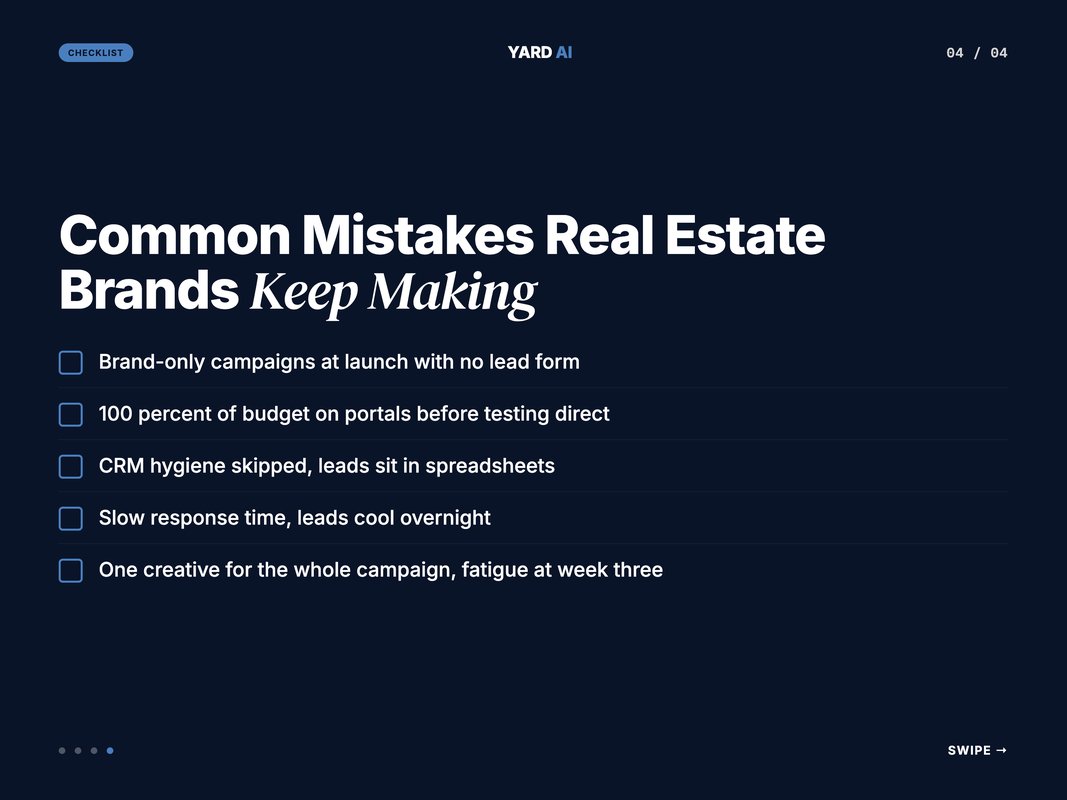
The 5 most common mistakes:
- Running brand-only campaigns at launch with no lead form anywhere in the funnel.
- Booking 100% of budget on portals before testing direct Meta or Google for the project.
- Skipping CRM hygiene. Leads sit in spreadsheets. Attribution disappears. Sales blames marketing.
- Ignoring response time. The lead form fires at 11 PM. Sales calls back at 11 AM next day. The lead is cold.
- One creative for the whole campaign. Fatigue hits at week three. Cost per lead doubles. The fix is a creative library.
Fix these five and most projects cut cost per qualified visit by 40 percent in the first quarter.
A Case Shape We See Often
Most performance-first real estate accounts we run move through a similar shape in their first three months. The numbers below are illustrative of the pattern, not from any one project.
The starting point is usually a portal-heavy budget. Roughly seven in ten rupees go to a single portal. About a quarter goes to Meta. The rest sits on Google Search. Cost per qualified visit lands somewhere between INR 18,000 and INR 35,000 depending on city and ticket.
Month one is a rebalance. Meta paid moves to half of the budget. Google Search moves to a quarter. Portals drop to fifteen percent. WhatsApp plus AI triage gets switched on. Cost per qualified visit drops 25 to 35 percent in the first 60 days.
The rebalance does the heavy lifting. The cost reduction comes from cutting the portal layer and routing the budget to channels with better lead-to-visit ratios. Most teams resist the cut because portals feel safe. They are not safer. They are just more familiar.
Month three is the loop kicking in. The creative library is on its third refresh. The CRM is clean. The Monday report shows clear top-decile audiences. Cost per qualified visit settles 40 to 55 percent below the starting baseline. Booking velocity rises in step.
This is the typical arc, not a guarantee. Markets vary. Tickets vary. The discipline is what ports.
A few details inside the arc are worth calling out. Meta lead forms get hit hard by ad fatigue around week six. Refresh the hooks before week six, not after. Google Search needs negative keyword pruning every Monday. Half the spend can leak to "rent" or "PG" queries if the negatives stay loose. WhatsApp templates need to be approved in advance during launch week, not the morning of launch day. Each of these is a small thing. Each one moves cost per qualified visit by a few percent. The compound is the result.
How YARD Approaches Real Estate Performance Marketing
YARD is a digital marketing agency built around AI-native workflows. We run paid, SEO, and content for B2B, DTC, and real estate brands. Real estate is one of the verticals we focus on.
What we have learned across plotted, premium, and luxury projects is that the playbook is consistent. The buyer changes. The ticket size changes. The locality changes. The loop does not. Every brief starts with the same question. What is the qualified buyer worth, and what is the spend ceiling per qualified visit. Every quarter ends with the same number on the dashboard.
The way we approach a new real estate account is the same loop laid out above. We start with a tight definition of the qualified buyer. We build the creative library before we open the first ad account. We wire CRM and AI triage on day one. We rebalance the channel mix in the first 30 days.
The outcome we look for is consistent. A qualified-visit cost that lands 30 to 50 percent below the starting baseline inside the first quarter. Booking velocity follows.
If you run a project or launch and want a second look at the funnel, that is what we do. The first audit is short. The first changes ship in week one.
You can see how we work and the verticals we serve at yardagency.ai. The YARD Way is built around measurement first.
Conclusion — Pick One Loop, Run It This Quarter
Real estate digital marketing in 2026 is not complicated. It is just under-disciplined.
Pick the loop in this post. Run it for a quarter. Watch the cost per qualified visit. Adjust weekly.
Most projects find that lead volume is fine and the gap is in qualification, response time, and CRM hygiene. Fix those three first. The numbers move before any new budget is added.
The hardest part is not the strategy. It is the patience to hold the loop. Most teams break the rhythm in week three when one bad day spooks the founder. The teams that hold the loop through ninety days see the curve bend. The ones who panic into a portal blast see the cost per visit creep right back up.
Start small. Pick one project. Wire one CRM. Refresh one creative library. Then scale to the next.
If you want a second pair of eyes, book a 30-minute audit at yardagency.ai. We will pick three highest-impact moves for your project and rank them by lift per rupee.
FAQ
Q: What is performance-first real estate digital marketing?
A: It is real estate marketing where every spend tracks back to a measurable outcome. A qualified lead, a site visit, or a booking. No brand-only campaigns. Every channel earns its slot.
Q: Which channel works best for real estate lead generation?
A: Meta plus Google Search is the workhorse pairing in 2026. Meta drives volume and remarketing. Google captures high-intent search. YouTube and broker portals fill the gaps. The mix shifts by city and asset type.
Q: How much should a developer spend on digital marketing?
A: Most performance-first developers run at 0.5 to 1.5 percent of project gross sales value through launch. The number rises during launch and drops during sell-down. Cost per qualified lead is the truer metric than budget percentage.
Q: What is a good cost per qualified lead in real estate?
A: It varies by market and ticket. Most premium projects in India aim for INR 800 to INR 2,500 per qualified lead. Luxury and GCC projects sit higher. The truer benchmark is cost per site visit and cost per sale, tracked end to end.
Q: Should real estate brands use AI for lead qualification?
A: Yes. AI calling agents and AI WhatsApp triage now handle the first qualification call. They cut response time to under sixty seconds. Sales teams get a smaller, hotter pipeline. Conversion rates lift, often sharply.
Q: How long until performance marketing shows results?
A: First leads land in week one. Stable cost per lead lands in week three. Sales attribution lands in month two or three depending on cycle length. Anyone promising sales in week one is selling, not marketing.
Q: What is the role of CRM in real estate digital marketing?
A: CRM is the spine. Without it, you lose attribution. With it, you can see which channel and which creative drove the closed deal. Most projects we see fail not on traffic but on CRM hygiene.
Insights from Our Experts
Explore our latest articles on digital marketing strategies.