

Five lakh a month sounds like a lot until you list what you are supposed to do with it.
Paid ads. Content. SEO. Outbound. Events. Tools. A designer. Someone to run it.
You cannot do all of that well. The good news is you do not have to. Trying is the most common way early SaaS budgets get burned.
This is the split we would run, the benchmarks behind it, and the order to cut things in when the number drops.
Start With the Benchmarks, Not the Channels
Channel debates go in circles until someone puts a number on the table.
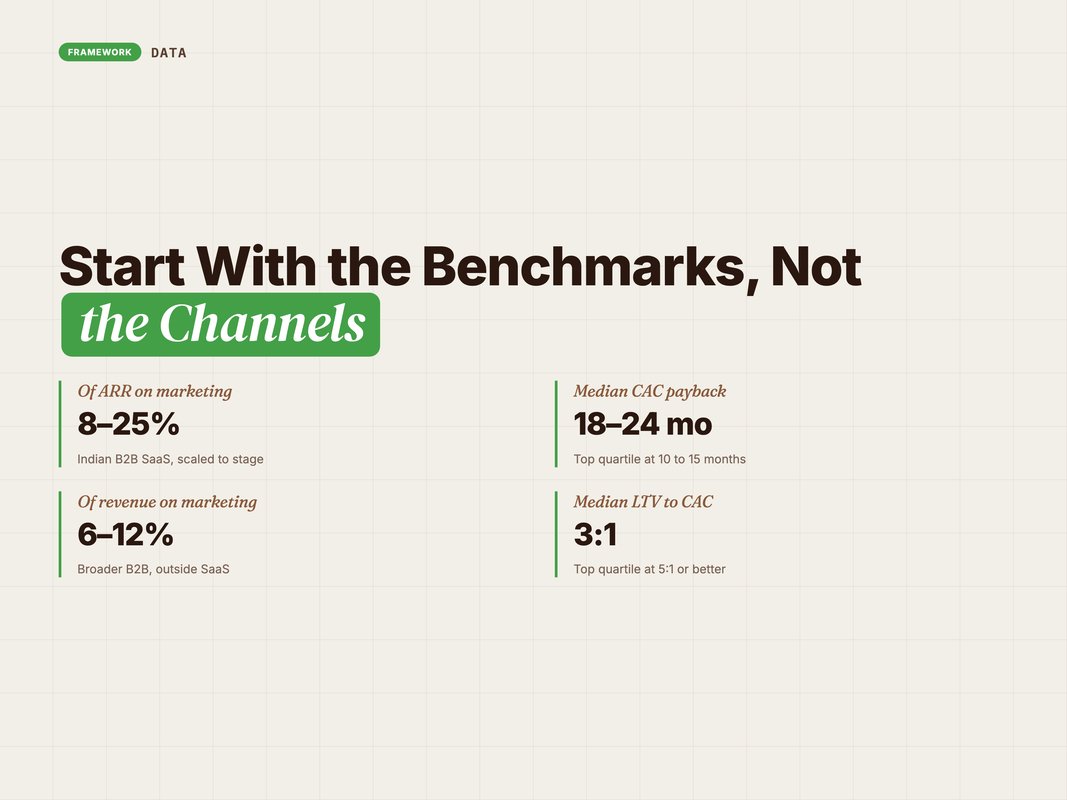
Indian B2B SaaS companies are advised to budget between 8 and 25 percent of ARR on marketing in 2026, scaled to stage (Source: upGrowth, 2026 — upgrowth.in).
That range is wide on purpose. Early growth sits near the top. Mature companies with strong retention sit near the bottom.
Run the maths backwards. At ₹5L a month you are spending ₹60L a year. If that is 20 percent of ARR, your ARR is around ₹3 crore. If it is 10 percent, you are at ₹6 crore.
That single calculation tells you which playbook you are in.
Below roughly ₹3 crore ARR, you are still finding out what works. The budget should be spent on learning fast and cheaply.
Above roughly ₹6 crore, you should already know your best channel. The budget should be spent on scaling it, not on adding two more.
Getting that call wrong is expensive in both directions. Scaling before you know your winner burns money. Still experimenting at ₹10 crore wastes a year.
Two more numbers should shape every decision that follows.
Healthy CAC payback for B2B SaaS in 2026 sits at 18 to 24 months at the median. The top quartile lands at 10 to 15 months (Source: GrowthSpree, 2026 — growthspreeofficial.com).
On efficiency, a three to one ratio of lifetime value to acquisition cost is the median. Five to one or better is top quartile (Source: GrowthSpree, 2026 — growthspreeofficial.com).
For comparison, broader B2B companies outside SaaS spend 6 to 12 percent of revenue on marketing (Source: GrowthSpree, 2026 — growthspreeofficial.com).
Q: Why does payback matter more than CAC?
A: Because payback tells you how long your cash is locked up. A high CAC with fast payback is fine. A low CAC with 30-month payback can still kill you.
The Split We Would Run
Here is the allocation, then the reasoning.
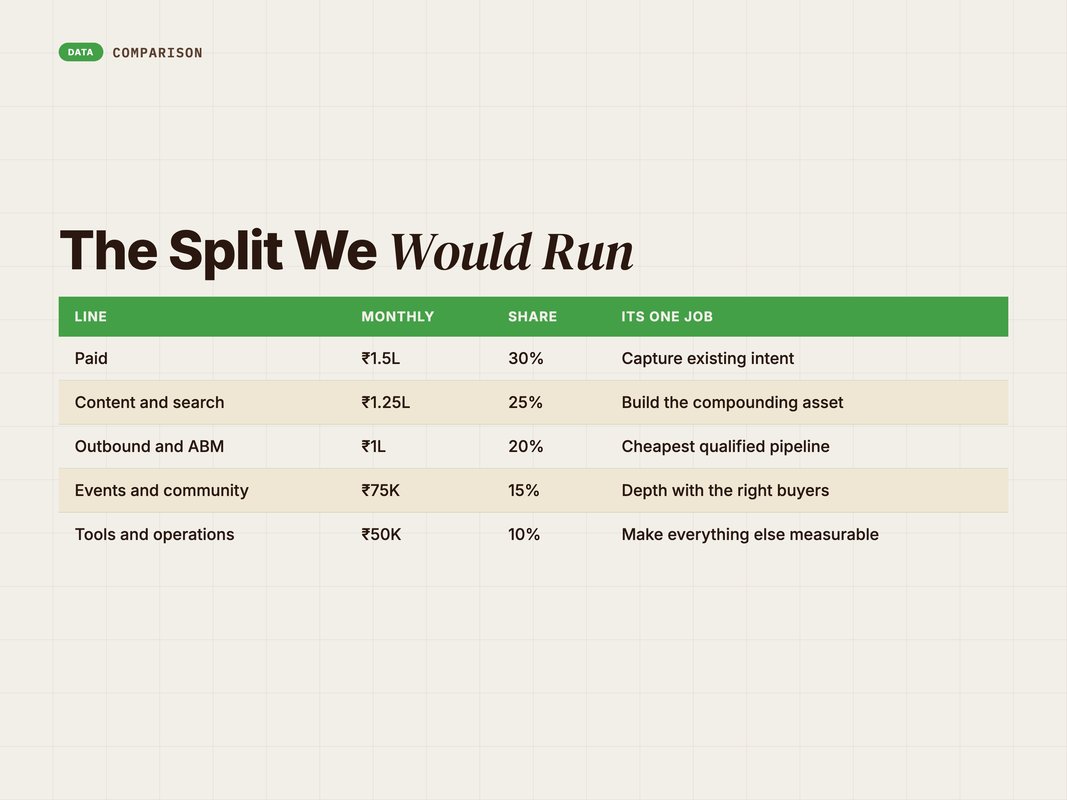
Paid, ₹1.5L. Thirty percent. Almost all of it on capturing existing intent. Branded search, competitor terms where allowed, and high-intent category terms. Very little on broad awareness.
Content and search, ₹1.25L. Twenty-five percent. This is your compounding asset and it is slow. Money goes to a small number of deep pages, not to volume.
Outbound and account-based work, ₹1L. Twenty percent. At this size, targeted outbound usually beats broad demand work on cost per opportunity.
Events and community, ₹75K. Fifteen percent. Small, specific, high-density gatherings. Not a booth at a large expo.
Tools and operations, ₹50K. Ten percent. Analytics, CRM hygiene, automation. Boring and non-negotiable.
That last line is the one founders try to cut first. It is also the line that makes every other line measurable.
An account with dirty CRM data cannot tell you which channel produced revenue. So the other ₹4.5L becomes a guess.
A Series B company in India runs a similar shape. Paid takes 25 to 35 percent. Content and search take 20 to 25 percent. Account-based work takes 15 to 20 percent. Events take 10 to 15 percent, and tools take 10 percent (Source: upGrowth, 2026 — upgrowth.in).
Our split sits close to that. The differences are deliberate and we will get to them.
Q: Why so little on brand awareness?
A: At ₹5L a month you cannot buy enough of it to matter. Awareness spend works when it is sustained and large. Below that threshold it is a donation.
Why Paid Gets Less Than People Expect
Most founders want to put more into paid, because it moves fastest.
It also stops fastest. The day you turn it off, the pipeline stops.
That is the trade nobody prices in properly. Paid buys you speed and rents you demand. It does not build anything you keep.
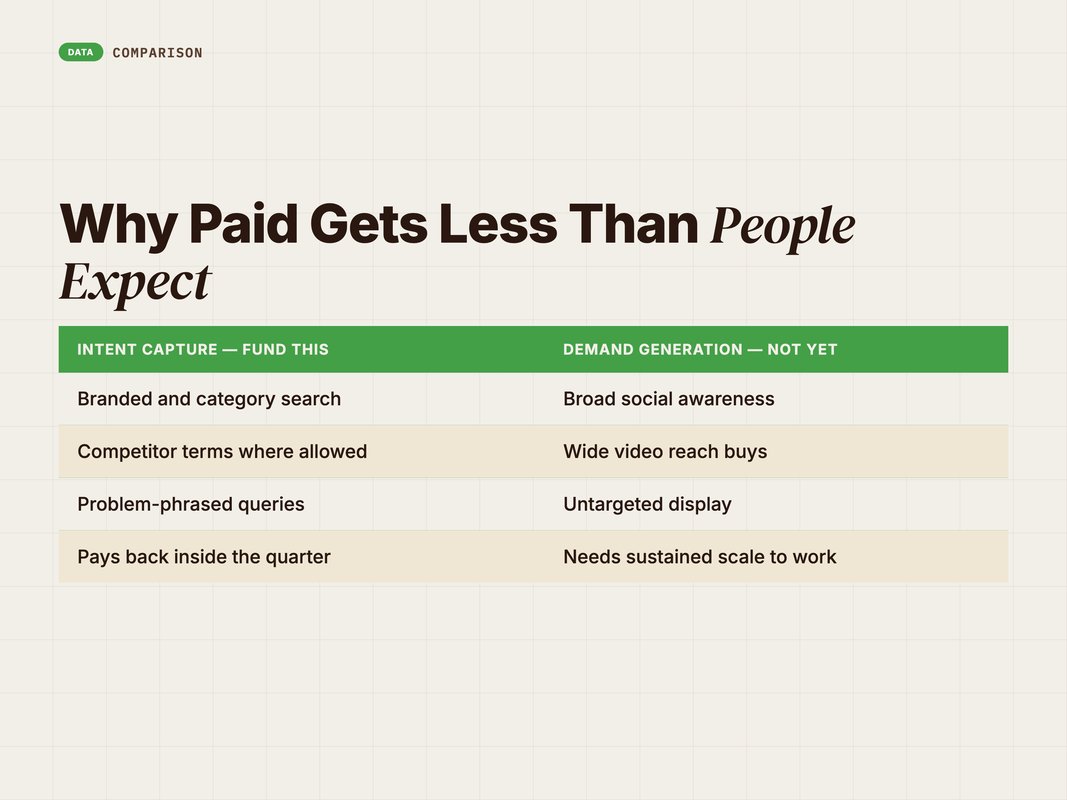
At this budget, paid has one job. Capture the demand that already exists.
That means your money goes to people actively searching for what you sell. Your brand name, your category terms, and the problems your product solves stated as questions.
It does not mean broad targeting on social to build familiarity. That works at ten times this budget.
There is a second reason to keep paid modest. Paid inflates fastest as competition grows. A budget built mostly on paid is a budget that shrinks in real terms every year.
Content and outbound do not have that property. Your content asset from last year still works. Your CRM and your list still work.
Q: When should paid go above 30 percent?
A: When payback is under 12 months and you have proven it at least twice. Efficiency first, then scale. Never the other way round.
The Content Money Should Buy Depth, Not Volume
This is where most SaaS budgets leak.
The instinct is to publish often. Twelve posts a month, a newsletter, a social calendar. It feels productive and it rarely moves pipeline.
At ₹1.25L a month, buy fewer and better.
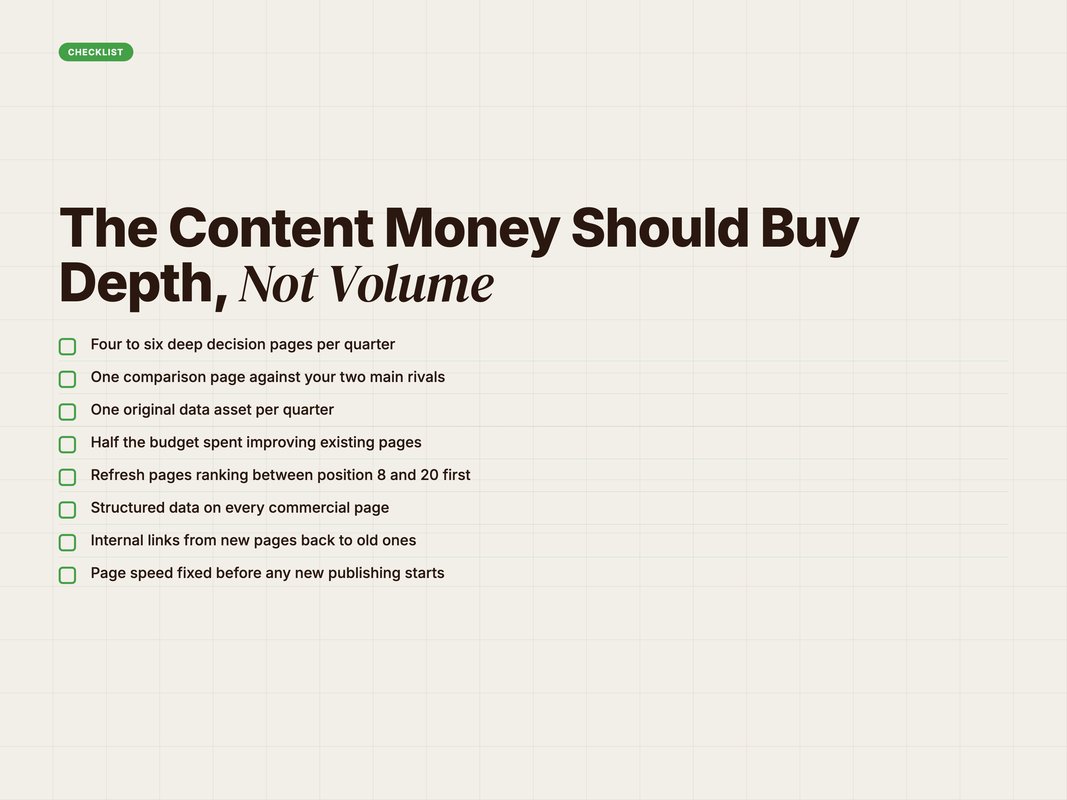
Four to six deep pages a quarter. Comparison pages, integration pages, use-case pages and one genuine point of view. Pages a buyer reads while making a decision.
One real data asset a quarter. A survey, a benchmark, an analysis of your own product data. This is what earns links and citations, and it is the only content that reliably does.
Ongoing improvement of what exists. Half your content budget should go to pages you already published. Refreshing a page ranking at position 12 beats writing a new one that lands at 40.
Technical hygiene. Structured data, page speed, internal links. Cheap and it compounds.
There is one more item worth funding here. A proper comparison page against your two main rivals.
Buyers search for that comparison whether or not you write it. If you do not, someone else writes it for you, and they will not be generous.
Notice what is missing. There is no line item for publishing volume. Volume is not the constraint.
There is also no line for social posting. That is not because social does not matter. It is because at this budget it should be the founder's time, not the marketing budget.
Founder-led distribution is genuinely cheap and genuinely effective in B2B SaaS. It costs attention, not money, so it does not appear in this table.
Buyer-relevant depth is the constraint, and it is much harder to produce.
Q: What about AI-assisted content at volume?
A: Use AI to produce more of the deep pages faster, not to publish more shallow ones. The bottleneck was never the drafting.
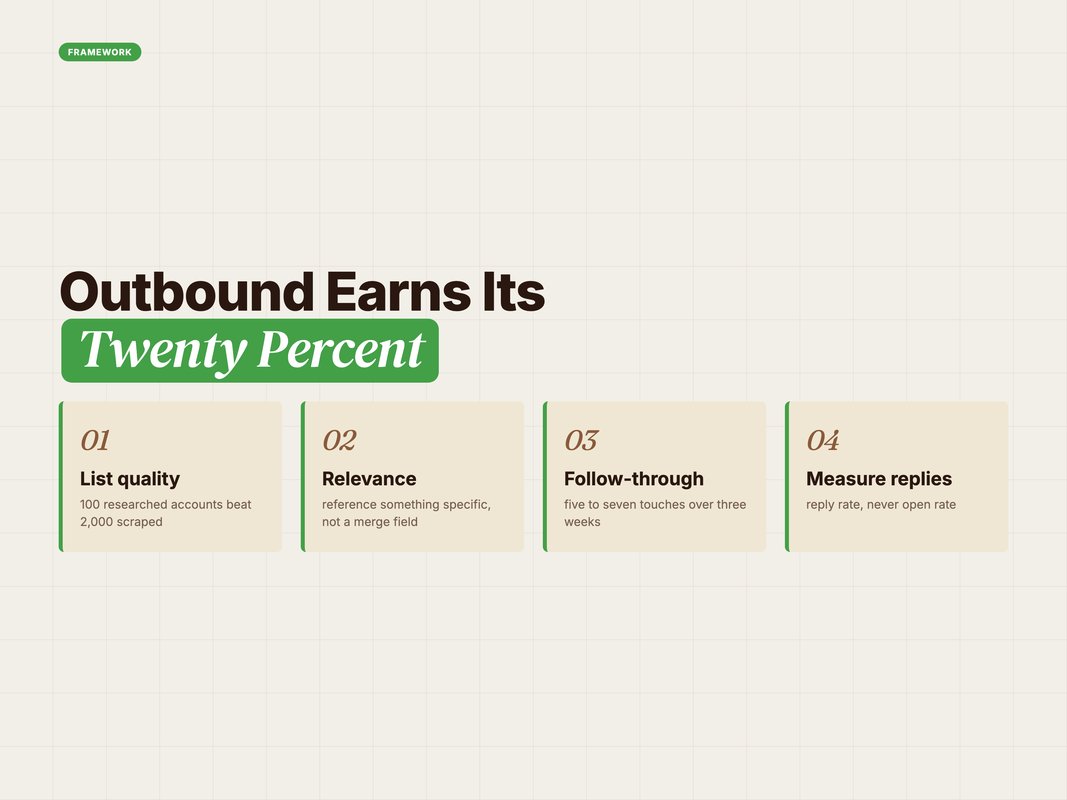
Outbound Earns Its Twenty Percent
At this size, outbound is often your cheapest source of qualified pipeline. It is also the least fashionable.
The reason it works is arithmetic. If your annual contract value is meaningful, you do not need many customers. You need the right hundred conversations.
Spend the money on three things.
List quality. A hundred accounts researched properly beats two thousand scraped. This is where AI genuinely helps, by reading company signals at a scale a person cannot.
Relevance. A message that references something specific about the account. Not a merge field with a company name in it.
Follow-through. Most outbound fails at message three, not message one.
A sequence that stops after two touches is a sequence that spent money on research and then walked away from it.
Five to seven touches over three weeks is the shape that works. Vary the channel, not just the wording.
What not to spend it on is tooling that lets you send more, faster. That is how a domain gets burned and a brand gets a reputation.
There is a simple test for whether outbound is working. Look at reply rate, not open rate.
A campaign with high opens and no replies is not a warming-up problem. It is a relevance problem, and sending more of it will not fix it.
Track positive replies per hundred accounts. Anything above a few percent is healthy at this size.
Q: Does outbound still work in 2026?
A: Targeted outbound does. Volume outbound does not, and it damages the brand while failing. The gap between the two has widened every year.
Where AI Actually Saves You Money Here
At this budget, AI is not a strategy. It is a way of buying more output from the same money.
Four places it genuinely pays for itself.
Account research. Reading a hundred companies properly used to be a week of someone's time. It is now an afternoon. This is the single biggest saving in the whole plan.
Content depth. Not more posts. Better versions of the pages you were already going to write, produced faster. The budget stretches to six deep pages instead of four.
Search term and competitor monitoring. Watching what changes in your category weekly, without anyone remembering to check.
Reporting. Pulling the four numbers every month and writing the first draft of the commentary.
Notice what is not on that list. Ad copy generation saves almost nothing at this scale, because you are not writing that many ads.
And customer-facing automation is a bad early bet. A chatbot that annoys forty prospects costs more than it saves.
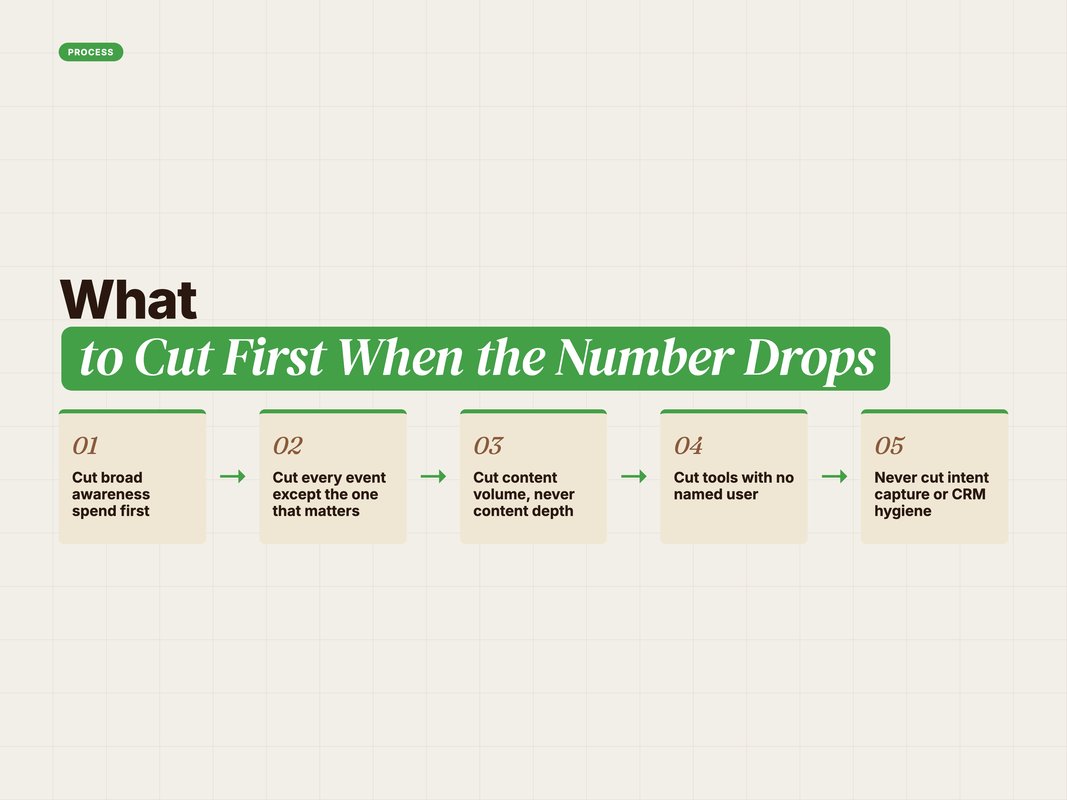
The rule we use is simple. Spend AI budget on reading, not on writing.
Reading is where the volume problem lives. Writing was never your bottleneck, and a small team can already write better than it can research at scale.
Q: What is a sensible tool budget for AI at this size?
A: A small share of the ₹50K tools line. If AI tooling is eating your whole operations budget, it has stopped being a saving.
What to Cut First When the Number Drops
Budgets get cut. Have the order decided before it happens, not during.
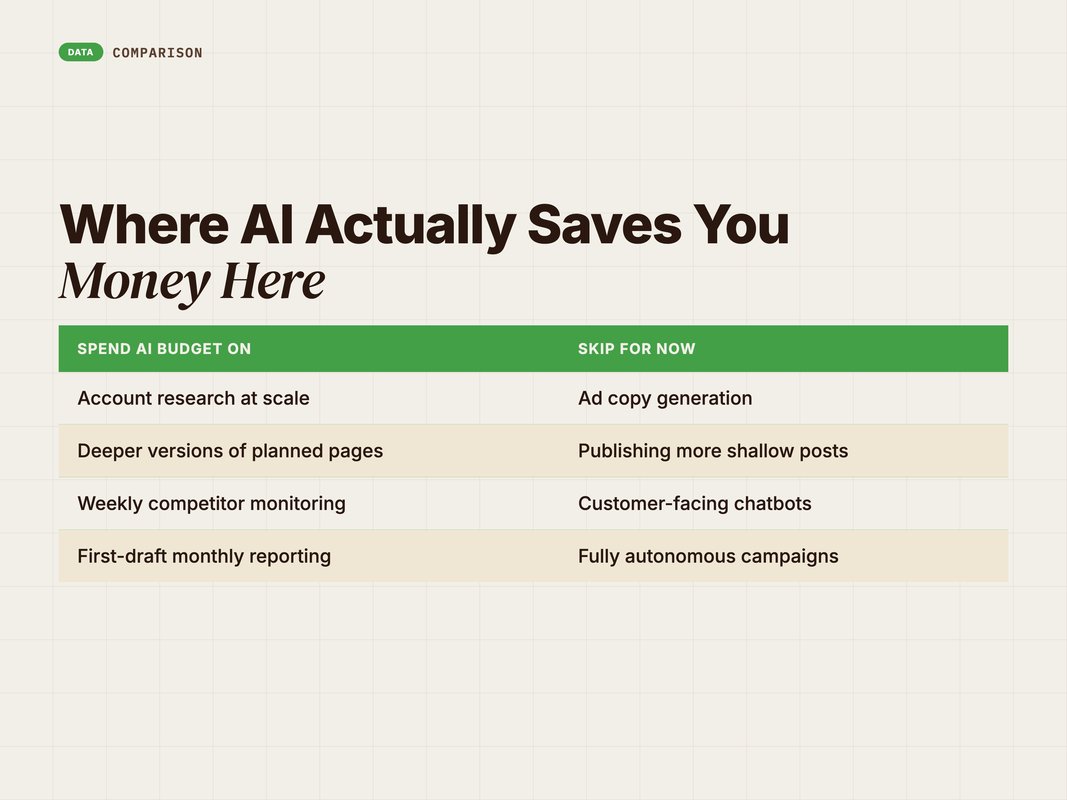
Cut in this sequence.
First, broad awareness spend. Any paid activity aimed at people who do not know they have the problem yet.
Second, events beyond one. Keep the single event where your buyers actually gather. Drop the rest.
Third, content volume, not content depth. Stop publishing supporting posts. Keep improving the pages that already rank.
Fourth, tools you cannot name a user for. Every stack has two or three of these.
Never cut first: intent capture and CRM hygiene. Branded search, high-intent terms and clean data are the last things to go. They are the cheapest revenue you have.
Branded search deserves a special note. Founders cut it regularly, on the logic that those people would have found you anyway.
Some would. Enough would not, and the term is cheap. Test it with a two-week pause before you cut it permanently.
There is one more rule worth holding. Do not cut a channel before you have measured it properly for two quarters.
Two quarters is not arbitrary. B2B sales cycles are long enough that one quarter of data tells you almost nothing about a channel's real yield.
Cut on the second bad quarter, not the first.
Most channels get killed on a bad month, and the bad month was usually a tracking problem.
The Measurement You Actually Need
You do not need a full attribution stack at this budget. You need four numbers, reported monthly.
Cost per qualified opportunity, by channel. Not cost per lead. Opportunity, as sales defines it.
CAC payback, by segment. How many months until a customer repays acquisition cost.
Pipeline coverage. Pipeline value divided by the target. Below three times, you have a top-of-funnel problem.
Coverage is the earliest warning signal you have. It moves months before revenue does, which makes it the most useful number on the page.
Content-influenced pipeline. Which deals touched a content page before closing. Imperfect, and better than arguing about it.
Everything else is optional at this stage. Four numbers, one page, every month.
Note what is not on the list. There is no line for impressions, followers, or website sessions.
Those numbers are not useless. They are just not decisions. At this budget, every metric you report should change what you do next month or come off the page.
The discipline that matters is consistency. The same four numbers, defined the same way, for four quarters running. That is what turns reporting into decisions.
Write the definitions down once and keep them somewhere shared. What counts as qualified. What counts as an opportunity. When the clock starts on payback.
Those definitions will feel obvious in month one. By month eight, two people will disagree about them unless they are written down.
How We Work With SaaS Teams at This Stage
Small budgets need sharper choices, not more channels.
That is the part that is hard to do internally. Everyone in the room has a channel they believe in, and nobody wants to be the one who loses theirs.
YARD is an AI-first growth marketing agency. We run performance marketing, LLM SEO, AI creative and AI funnels for D2C and B2B brands, including early-stage SaaS.
Three habits define how we run a budget this size.
We start by picking what not to do. A ₹5L plan that names five channels and excludes six is a plan. One that lists everything is a wish.
We put half the content budget on existing pages. New pages are the exciting half and the improvement work usually returns faster.
And we hold the same four metrics for a full year. Changing the scorecard every quarter is how teams lose the ability to tell whether anything worked.
If your budget is spread across eight channels and nothing is clearly winning, the fix is usually subtraction. For the wider market picture, see State of Performance Marketing in India — 2026.
The Short Version
Work out what ₹60L a year represents as a share of your ARR. That tells you which playbook applies.
A workable monthly split is ₹1.5L paid, ₹1.25L content and search, ₹1L outbound, ₹75K events and community, ₹50K tools.
Keep paid focused on capturing existing intent. Broad awareness needs a budget you do not have yet.
Spend content money on depth and on improving pages that already rank. Volume is not your constraint.
Give outbound real money and spend it on list quality, not sending volume.
Track four numbers monthly. Cost per qualified opportunity, CAC payback, pipeline coverage and content-influenced pipeline.
And decide your cut order now, while nobody is panicking.
The plan that beats a bigger budget is usually the one that says no to more things. Focus is the only advantage a small budget actually has.
Want this split modelled against your actual ARR and pipeline? Talk to the YARD team.
FAQ
Q: How much should a SaaS company spend on marketing?
A: Indian B2B SaaS firms are advised to budget 8 to 25 percent of ARR in 2026, scaled to stage. Early growth sits at the high end. Mature companies sit far lower.
Q: How should a ₹5L monthly budget be split?
A: A workable split is 30 percent paid and 25 percent content and search. Then 20 percent outbound, 15 percent events and community, and 10 percent tools.
Q: What is a healthy CAC payback period?
A: Around 18 to 24 months is the 2026 median for B2B SaaS. The top quartile sits at 10 to 15 months. Median payback has stretched since 2023.
Q: What should you cut first when budget is tight?
A: Broad awareness spend and anything you cannot attribute. Keep the channels that capture existing intent, because they pay back inside the quarter.
Q: Is ₹5L a month enough for B2B SaaS?
A: It is enough to win a narrow segment. It is not enough to compete broadly. The budget forces focus, which is usually good for an early-stage company.
Q: What LTV to CAC ratio should you target?
A: Three to one is the 2026 median for B2B SaaS. Five to one or better puts you in the top quartile. Below two to one, growth is destroying value.
Insights from Our Experts
Explore our latest articles on digital marketing strategies.